High Net Worth Home Buyer Financing: The Complete Guide
By Tyler Singletary · · Updated · in Decision frameworks
Most home-buyer financial advice is written for someone whose biggest asset is a savings account. If your biggest asset is a taxable investment portfolio — and especially if that portfolio holds a decade of unrealized gains — almost none of that advice translates cleanly to your situation.
This guide is for the high-net-worth home buyer who has options that ordinary buyers do not. Specifically: someone whose net worth is meaningfully larger than the home they are buying, whose income includes investment returns and equity compensation as well as W-2 salary, and whose decision is not "can I afford this?" but "what is the cheapest way to fund this?"
There are five financing paths worth modeling for an HNW home purchase. Each has a different tax consequence, a different opportunity cost, and a different risk profile. Picking the wrong one can cost six figures over a typical hold period. Picking the right one is rarely about chasing the lowest sticker rate.
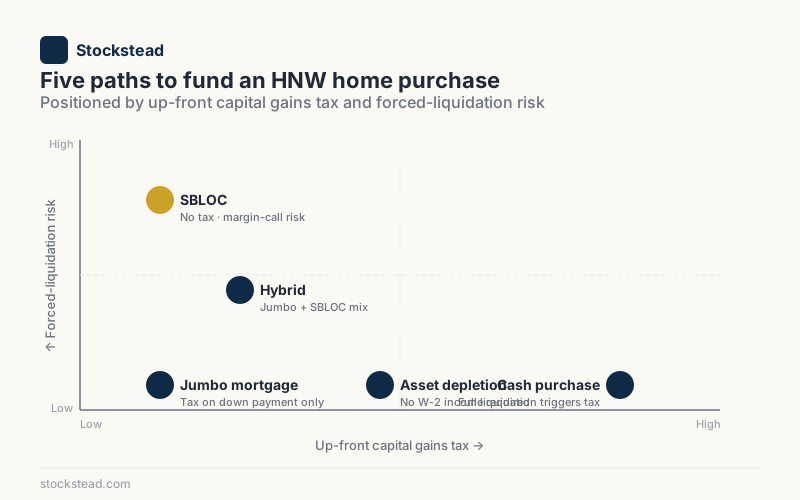
The five paths
Before we get into details, here is the landscape:
| Path | Mechanics | Best for |
|---|---|---|
| 1. Cash purchase | Liquidate enough portfolio to cover the full price | Low cost basis or no-tax-state buyer |
| 2. Jumbo mortgage | Bank loan secured by the home, 10–25% down | Long horizon, high tax bracket, want fixed rate |
| 3. SBLOC | Loan secured by your investment portfolio | Avoid capital gains; portfolio stays invested |
| 4. Hybrid | Jumbo + SBLOC, often SBLOC for the down payment | Buy without realizing gains; preserve fixed-rate certainty on the bulk |
| 5. Asset-depletion mortgage | Bank treats portfolio as "implied income" | Limited W-2 income; retired or pre-IPO; large liquid assets |
The right answer depends on your specific portfolio composition, tax bracket, time horizon, and risk tolerance. There is no universal best — only a best for your situation.
Path 1: Pay cash by liquidating
Mechanics: you sell enough of your taxable portfolio to cover the purchase price, write a check at closing, and own the home outright. No lender, no monthly payment, no interest expense.
The simplicity is genuine. The cost is not.
Liquidating a long-held taxable portfolio triggers two costs that standard mortgage calculators ignore. The first is the capital gains tax bill — at top federal long-term rates of 20% under IRS Topic 409, plus the 3.8% Net Investment Income Tax when applicable, plus state taxes (up to 13.3% in California, zero in Texas or Florida), the combined hit on realized gains can be 30–45%. For a portfolio with significant appreciation, that means selling $1.30 to $1.45 of stock to net $1.00 of useable cash.
The second cost is opportunity cost — the compounded growth you forgo on every dollar pulled out of the portfolio. Over a 10-year hold at a 7% annual return, $300,000 of liquidation costs roughly $290,000 in foregone growth. Most calculators ignore this entirely.
Cash is the right path when your cost basis is high (so realized gains are small), when you live in a no-income-tax state, when you have idle savings rather than appreciated holdings, or when you simply cannot tolerate any debt or leverage. For everyone else, the all-in cost is far higher than the wire transfer suggests.
For the full decision-framing analysis, see The $200K Mistake: Liquidating Stock for a Down Payment and Opportunity Cost of a Down Payment: $300K Costs $540K. For the tax-mechanics depth — federal, state, and NIIT stacking with worked examples — see Capital Gains Tax on Home Down Payments Explained. And before you liquidate anything, run a tax-loss harvesting pass on the portfolio — disciplined harvesting before the sale can save six figures by itself.
Path 2: The jumbo mortgage
This is the standard path, and it is more often the right answer than the SBLOC enthusiasts will admit.
A jumbo mortgage is any loan above the conforming limit set by the FHFA — $832,750 in most counties for 2026, up to $1,249,125 in high-cost areas like much of California, the New York metro, Seattle, and the DC area. Loans above those thresholds are not eligible for Fannie or Freddie securitization, so jumbo pricing reflects the lender's own balance sheet and funding costs rather than agency pricing.
Jumbo wins when three conditions line up:
- You are in a high marginal bracket so the home mortgage interest deduction on the first $750,000 of acquisition indebtedness is meaningfully valuable. At a 7.39% headline rate (the MBA jumbo average for the week of Oct 2, 2026), the deductible portion costs about 4.1% after tax at 37% federal plus 9% state, or 4.8% at 37% federal alone, if you already itemize. Those figures reflect the One Big Beautiful Bill Act's new IRC Section 68 limit: starting in 2026, for filers in the 37% bracket (joint taxable income above $768,700, or $640,600 single), itemized deductions are cut by 2/37, so each deductible dollar is worth 35% federally, not 37%. Above $750,000 there is no deduction, so those dollars cost the full headline rate, which as of Oct 8, 2026 was higher than most broker SBLOC quotes. The jumbo's edge on the above-cap dollars is a 30-year fixed rate and no margin-call risk, not a lower cost. For reference, the average 30-year jumbo rate is 7.39% as of October 8, 2026.
- You have a long time horizon so a 30-year fixed payment locks in cost certainty against rate volatility.
- You want to keep your portfolio invested so the down payment is small and the bulk of your wealth keeps compounding.
Two structural quirks bite HNW jumbo borrowers specifically:
The $750,000 acquisition-indebtedness cap, set in 2017 and made permanent in 2025, limits the deductible portion of any mortgage. On a $2M jumbo, only $750,000 of principal generates deductible interest — the remaining $1.25M is at the full sticker rate. The cap is the single biggest reason a $2M jumbo costs more than buyers expect. The math is worked out in The $750K Mortgage Interest Deduction Cap for HNW.
Income documentation is harder than it sounds for HNW borrowers whose income is dominated by RSU vests, dividends, and capital gains rather than W-2 wages. Most jumbo underwriting needs a clean two-year history of W-2 or self-employment income, and that documentation can be the bottleneck even when the buyer's net worth is multiples of the home price. The lenders who serve HNW well — JPMorgan Private Client, Merrill Lynch, Goldman Sachs Private Wealth, Citi Private Bank, and the surviving First Republic relationships under JPMorgan — are the ones with relationship-driven underwriting that can flex on income documentation in exchange for assets-under-management. For the lender-by-lender breakdown of who actually serves HNW well, see Jumbo Mortgages for HNW Buyers: When Banks Still Win.
Path 3: SBLOC (Securities-Backed Line of Credit)
The SBLOC is the path that gets the most attention and the most marketing — for good reason. It solves the single biggest problem with a cash purchase: triggering capital gains. With an SBLOC you pledge your investment portfolio as collateral and the lender extends a credit line, typically 30–70% of the portfolio's market value. You draw on the line, the proceeds fund the down payment or the full purchase, and the portfolio stays invested.
The advantages line up cleanly:
- No capital gains realization
- Portfolio keeps compounding at full market rate
- Faster closing than a jumbo mortgage (often 2–4 weeks)
- Income documentation is minimal — the collateral is the portfolio, not your salary
The trade-offs are real:
- Variable rate, almost always — your interest cost moves with SOFR. The lender-by-lender breakdown of SBLOC rates at Schwab, Fidelity, IBKR, and Morgan Stanley is the right starting point for sizing carry cost.
- Margin-call risk if the portfolio drops below the maintenance ratio, with forced liquidation at the worst possible time
- Interest is generally not tax-deductible, unlike mortgage interest on a primary residence
- The line is typically the lender's discretion to call or modify
The detailed comparison of cash, jumbo, and SBLOC paths with worked examples at $1.5M and $2M home prices lives in the SBLOC vs Mortgage vs Cash pillar guide. The fully worked end-to-end example at a 1:1 portfolio-to-home ratio is in $2M Portfolio, $2M Home: A Case Study. For the mechanics — how lenders set advance rates, calculate maintenance ratios, and enforce margin calls — see How an SBLOC Works. For the FINRA investor alert on the risks specifically, that document is the standard regulatory primer and should be read before signing any SBLOC paperwork. And before signing, run through the scenarios where an SBLOC is the wrong tool.
Path 4: Hybrid structures
The honest answer for many HNW buyers is that no single path is optimal — a hybrid often wins.
The most common hybrid: an 80% jumbo mortgage covers the bulk of the purchase, and an SBLOC funds the 20% down payment. The borrower locks in fixed-rate certainty on the bulk of the loan, avoids realizing capital gains on the down payment, and keeps the portfolio invested. The total cost is usually below either pure path.
A second hybrid is the "delayed financing" structure: the SBLOC funds an all-cash close (which often wins multi-bid scenarios with a 2–5% effective negotiating discount), then a conventional jumbo refinances the SBLOC within 90 days. The buyer captures the cash-offer advantage, and the SBLOC ends up serving as a short-duration bridge rather than a multi-year carry. The mechanics of using an SBLOC as a bridge — and when it actually pays off — are in Using an SBLOC as a Bridge Loan.
The third hybrid is a 50/50 split between a jumbo and a portfolio-backed loan from the same private bank. Some private banks (Morgan Stanley, Goldman, Citi Private Bank) will offer bundled pricing on both products in exchange for an asset-management relationship. The blended rate often beats the standalone option.
Hybrids are operationally more complex than single-path financing, and they require a lender or wealth manager who can structure both halves coherently. Done right, they capture the best of jumbo's tax efficiency and SBLOC's no-liquidation advantage. Done sloppily, they double the moving parts and give you margin-call risk on top of mortgage payments.
Path 5: Asset-depletion mortgages
For HNW borrowers with large liquid assets but limited W-2 income — typical for early retirees, founders pre-exit, and family-office principals — traditional jumbo underwriting often fails on debt-to-income calculations. The asset-depletion mortgage solves this problem.
The mechanics: rather than verifying employment income, the lender calculates an "implied income" from your investment portfolio. The standard formula divides the eligible portfolio balance by 360 months (a 30-year loan term), and that monthly figure is treated as qualifying income. A $5M liquid portfolio implies roughly $13,900/month of qualifying income — enough to support a $2M+ jumbo at typical DTI ratios.
Asset depletion is offered by a smaller subset of lenders: Schwab Bank, Fidelity-affiliated lenders, regional banks specializing in private wealth (Citizens, Banner), and some non-QM specialty lenders. Pricing typically runs 25–50 basis points above standard jumbo because the qualifying income is implied rather than W-2 documented.
This path is straightforward when it fits. It is also frequently the fix for borrowers who would otherwise be forced into an SBLOC despite having enough liquidity to qualify for a traditional mortgage. If your DTI is the only thing preventing a jumbo, ask your lender about asset depletion before defaulting to portfolio-backed financing.
The decision framework
There is no universal best path. The right choice depends on five variables you can score for your situation:
1. Cost basis on the portfolio. Low basis (long-held, heavily appreciated) makes liquidation expensive and SBLOC attractive. High basis (recent contributions, dividend reinvestments) makes liquidation cheap and the SBLOC's main advantage smaller.
2. Current marginal tax bracket. High federal + state bracket makes the mortgage interest deduction more valuable, which favors jumbo, but only on the first $750,000 of debt. It also makes any liquidation more expensive, which favors SBLOC. At a 7.39% jumbo (the MBA average for the week of Oct 2, 2026), a $750K jumbo costs about 4.1% after tax for a 37% plus 9% buyer, cheaper than any SBLOC quote we track. Every jumbo dollar above $750K costs the full 7.39%, more than the 4.93% to 6.77% SBLOC range on a $1M draw as of Oct 8, 2026. So the bracket argument now favors a jumbo sized to the cap, not a jumbo for the whole purchase. Watch MAGI too: a household between $505,000 and about $606,333 of MAGI loses 30 cents of SALT deduction per extra dollar, and above that, SALT is stuck at $10,000, which makes it harder to clear the $32,200 standard deduction.
3. Time horizon in the home. Long horizon (10+ years) favors a fixed-rate jumbo because of payment certainty over decades, even when today's SBLOC rate is lower: an SBLOC floats with SOFR, and a 10-year hold is a long time to bet that it stays below 7.39%. Short horizon (3–7 years) favors SBLOC because the variable-rate exposure window is small and the portfolio compounding period continues.
4. Cash flow profile. Stable W-2 income supports any path. Income that is dominated by equity vests or capital gains may need asset-depletion underwriting or a relationship-bank jumbo. SBLOC requires income to service the interest carry. As of October 8, 2026, broker SBLOC pricing on a $1M draw runs from 4.93% (Interactive Brokers Pro margin) to 6.77% (Schwab Pledged Asset Line, list price), and smaller draws price higher.
5. Risk tolerance specifically for margin calls. SBLOC carries the unique risk of forced portfolio liquidation in a market drawdown. If you cannot stomach the possibility of selling at the bottom — even hypothetically — the SBLOC is the wrong tool, regardless of how attractive the rate looks in calm markets.
The simple decision rule for most HNW buyers in most markets, at the rates of October 2026:
- High-bracket, long-horizon, stable income → jumbo sized to the $750K cap. For the rest, a full jumbo buys a fixed rate and no margin-call risk at a pretax 7.39%; a hybrid with a sub-6.8% SBLOC is cheaper if you accept floating-rate and margin-call exposure
- High unrealized gains, comfortable with portfolio leverage → SBLOC or hybrid
- Limited W-2 income, large liquid assets → asset-depletion mortgage
- Low cost basis OR low-tax state → cash purchase is genuinely competitive
- High concentration risk in a single position → consider diversification before financing decisions
Special situations
Three specific HNW profiles need their own playbook:
Tech employees with significant RSU compensation. The paper-wealth-into-tax-bill problem at vest creates a specific timing question: liquidate at vest (no incremental tax), or hold and trigger capital gains later? The answer depends on the spread between the basis at vest and the current price. Vest timing also moves the SALT cap. For 2026 a household under $505,000 of MAGI gets the full $40,400 SALT cap, but a big vest that pushes MAGI past about $606,333 drops it to $10,000, which shrinks the property-tax deduction and the value of itemizing in the purchase year. The full playbook is in RSUs and Buying a Home: A Tech Employee's Playbook.
Concentrated single-stock positions. If most of your wealth is one ticker — pre-IPO equity, founder stock, an inherited concentrated holding — buying a home means navigating diversification, tax timing, and lender constraints simultaneously. Lenders typically apply 50% or lower advance rates to single-stock concentrations, which limits SBLOC capacity. The full guide is in Concentrated Stock + Home Purchase: Avoid a Tax Disaster.
Pre-retirement liquidity needs. If you are within five years of stopping work, the calculus on cash flow shifts. Locking in a 30-year fixed payment at retirement income levels can be aggressive; SBLOC carry on a static portfolio gets expensive once the portfolio stops compounding. Asset-depletion mortgages with shorter terms (15-year fixed) often fit better.
Common mistakes
Five mistakes show up repeatedly in HNW home-financing decisions:
- Optimizing for monthly payment. A small rate difference looks negligible monthly and adds up to six figures over a decade. The right number to optimize is the after-tax total cost over your hold period.
- Forgetting opportunity cost. Money you remove from the portfolio stops compounding. At 7% returns over 10 years, $300,000 of liquidation costs roughly $290,000 in foregone growth — a number that doesn't appear on any closing document.
- Treating the SBLOC as risk-free debt. It is not. The margin-call mechanism is real, and forced liquidation in a drawdown is the worst possible outcome. The historical stress test against 2007–2009 shows what a typical SBLOC structure would have done through that period.
- Picking the lowest sticker rate without operational fit. Interactive Brokers' margin rate (4.93% on a $1M balance as of October 8, 2026) is the lowest among the major brokers we track, but the algorithmic enforcement is brutal. A higher-rate Schwab PAL with a 5–7 day cure window is often better for HNW buyers in practice.
- Skipping tax-loss harvesting before liquidating. A disciplined harvesting pass before any sale can offset a meaningful portion of the realized gains. Most buyers simply forget to run it.
How to size your specific decision
The Stockstead calculator models all five paths against your actual numbers — your portfolio value, cost basis, tax bracket, state of residence, expected returns, and the lender rates currently available to you. You'll see the after-tax cost of each option side-by-side, including the capital gains hit on liquidation, mortgage interest deduction value, opportunity cost on retained portfolio, and SBLOC carry.
Most HNW buyers find the decision is closer than they expected. The path that "obviously" looks cheapest on a sticker-rate basis is usually not the cheapest after-tax. Running your specific numbers takes about five minutes and frequently changes the conclusion.
Run your numbers with Stockstead →
The decision frame this guide gives you — five paths, five variables, a structured comparison — is a starting point. The right answer for any specific buyer requires modeling the actual figures. No generic guide can substitute for that calculation.
Sources and further reading
- IRS Topic 409 — Capital Gains and Losses
- IRS — Net Investment Income Tax (NIIT)
- IRS Publication 936 — Home Mortgage Interest Deduction
- IRS Publication 550 — Investment Income and Expenses
- FINRA — Securities-Backed Lines of Credit (Investor Alert)
- FHFA — 2026 Conforming Loan Limits
- CFPB — What is a jumbo loan?
Educational, not financial advice. Tyler Singletary is the founder of Stockstead and is not a licensed financial advisor or CPA. The figures and frameworks in this guide are illustrative; your specific situation depends on portfolio composition, tax bracket, residency, and lender pricing available to you. Consult a fiduciary advisor and a tax professional before acting on any path described here.
Frequently asked questions
- What are the five financing paths for an HNW home purchase?
Cash (liquidate enough portfolio to cover the full price), jumbo mortgage (bank loan secured by the home, 10-25% down), SBLOC (loan secured by your investment portfolio), hybrid (jumbo plus SBLOC, often SBLOC for the down payment), and asset-depletion mortgage (bank treats portfolio as implied income for borrowers with limited W-2 documentation). Each has a different tax consequence, a different opportunity cost, and a different risk profile. There is no universal best — only a best for your cost basis, tax bracket, time horizon, and risk tolerance for margin-call exposure on portfolio-backed paths.
- Why does paying cash for a home often turn out to be the most expensive path?
Two costs that standard mortgage calculators ignore. The capital gains tax bill on the realized gain — combined federal LTCG plus 3.8% NIIT plus state taxes range from 23.8% in no-income-tax states to 37.1% in California, meaning $1.30-$1.45 of stock has to be sold to net $1.00 of useable cash on a low-basis portfolio. And opportunity cost — at 7% real returns over a 10-year hold, $300,000 of liquidation costs roughly $290,000 in forgone compound growth. Cash is the right path only when your cost basis is high, your state has no income tax, or you have idle savings rather than appreciated holdings.
- When does a jumbo plus SBLOC hybrid beat both pure paths?
Most often for high-bracket borrowers above $1.5M of total home debt. The 2017 Tax Cuts and Jobs Act capped mortgage interest deductibility at $750K of acquisition indebtedness, and the 2025 One Big Beautiful Bill Act made that cap permanent. Sizing the jumbo to exactly $750K captures every dollar of deductible interest. Funding the rest from an SBLOC avoids realizing capital gains on the down payment and keeps the portfolio compounding. How much the hybrid wins by now depends on the SBLOC venue. On a $2M home with $250K down, a 7.39% jumbo (the MBA average for the week of Oct 2, 2026), and Oct 8, 2026 SBLOC quotes on a $1M draw, a $750K jumbo plus $1M SBLOC beats a single $1.75M jumbo by about $5,000 over 10 years at Schwab's 6.77% PAL list rate, $60,000 at Fidelity (6.22%), $142,000 at Morgan Stanley (5.40% fixed promo), and $189,000 at IBKR Pro (4.93%). It beats a pure $1.75M SBLOC by $77,000 to $215,000. The hybrid stops beating the single jumbo if the SBLOC rate rises above about 6.82%, and the SBLOC half floats with SOFR. The structure works best with stable income to service both debts and a diversified portfolio drawn at conservative LTV.
- What is an asset-depletion mortgage and who should consider it?
A jumbo mortgage that qualifies the borrower on portfolio value rather than W-2 income. The lender divides eligible portfolio balance by 360 months to produce implied income — a $5M portfolio implies roughly $13,900 per month, enough to support a $2M+ jumbo. Schwab Bank, Fidelity-affiliated lenders, Citizens, Banner, and some non-QM specialty lenders offer it. Pricing typically runs 25-50 basis points above standard jumbo. Best for early retirees, founders pre-exit, family-office principals, and tech employees with equity-heavy comp whose DTI fails on W-2 alone — frequently the right answer for borrowers who would otherwise default to portfolio-backed financing.
- How do I pick the right financing path for my situation?
Five variables drive the answer. Cost basis on the portfolio — low basis amplifies the case for keeping it invested. Current marginal tax bracket — high brackets make the mortgage deduction more valuable. Time horizon in the home — long horizons favor fixed-rate certainty. Cash flow profile — stable W-2 supports any path; volatile or equity-heavy income may need asset-depletion underwriting or relationship-bank jumbo. Risk tolerance for margin calls — if you cannot stomach forced portfolio liquidation in a drawdown, SBLOC is the wrong tool regardless of how attractive the rate looks in calm markets.
Ready to run the numbers on your situation?
Open the calculator →Related posts
$2M Portfolio, $2M Home: A Case Study in Three Financing Paths
A fully worked $2M-portfolio / $2M-home case study — built originally as my own modeling exercise — with the surprises called out: the path that costs $2.26M, the path that ends up $1.3M richer, and the assumption that secretly decides which is which.
Jumbo Mortgages for HNW Buyers: When Banks Still Win
SBLOC is not always the answer. For many HNW home purchases, especially loans near the $750K deduction cap, a jumbo at the right bank is cheaper, safer, and cleaner.
SBLOC vs Mortgage vs Cash: The Complete HNW Guide
Four ways to fund a $300K down payment from a $2M portfolio, the 10-year math on each at current rates, and the failure mode standard mortgage calculators hide.