The $200K Mistake: Liquidating Stock for a Down Payment
By Tyler Singletary · · Updated · in Decision frameworks
You've spent years building a taxable investment portfolio. Now you're ready to buy a home, and the obvious move is to pull the cash you need and close. It feels clean. It feels simple.
But if you run the actual numbers, "simple" might be costing you more than $300,000.
Most home buyers—even sophisticated ones—underestimate the true cost of liquidating a taxable portfolio for a down payment. That's because the figure that hurts most isn't the capital gains tax bill at tax time. It's the compounding wealth you're quietly forfeiting for the next decade.
Let's walk through the math. This post focuses on the cost of liquidating; for the broader landscape of HNW financing options — including SBLOCs, jumbos, and asset-depletion underwriting — see our complete guide to high net worth home buyer financing.
The Hidden Cost of Liquidating Investments: Capital Gains Taxes
Say you have a $2 million taxable portfolio with a 50% cost basis—meaning $1 million of it is unrealized gain. You need $200,000 for a down payment.
When you sell, the IRS doesn't just see a $200K withdrawal. It sees a proportional slice of your gains.
If your portfolio is 50% gains, then roughly half of the $200K you pull out—about $100K—is taxable gain.
Here's what that costs at a typical HNW tax rate:
| Tax Component | Rate | Amount |
|---|---|---|
| Federal long-term capital gains | 20% | $20,000 |
| Net Investment Income Tax (NIIT) | 3.8% | $3,800 |
| State capital gains tax (e.g., CA) | 9.3% | $9,300 |
| Total tax on withdrawal | ~33% | ~$33,100 |
So you need $200,000 from the portfolio. But to get $200,000 after taxes, you may actually need to sell closer to $230,000–$235,000 worth of securities. Your effective cost of that down payment just jumped by $33,000 before you've even closed on the house.
(For the full mechanics — how federal LTCG brackets, NIIT, and state rates stack, and where each kicks in for 2026 — see Capital Gains Tax on Home Down Payments Explained. This post focuses on the decision; that one focuses on the math.)
And this is just the tax bill. The bigger number comes next.
The Cost You're Not Seeing: Opportunity Cost Over Time
Capital gains taxes are a one-time hit. Opportunity cost is permanent.
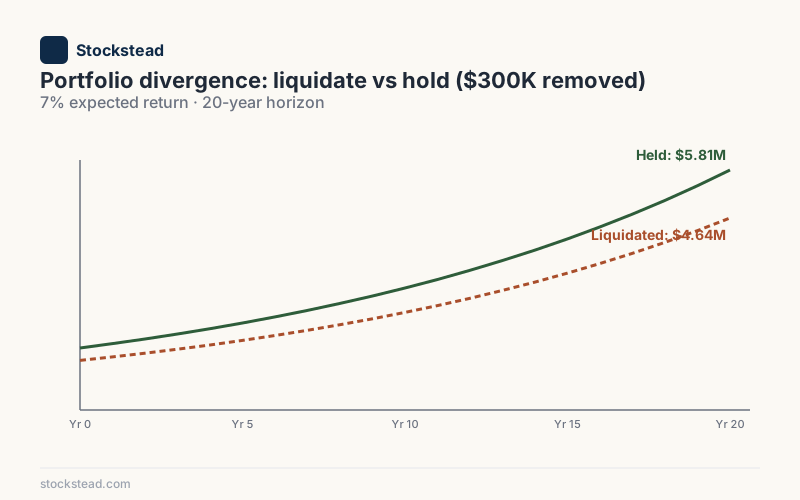
Every dollar you pull out of a well-positioned portfolio is a dollar that stops compounding. Over 10 years, that's significant. Over 20 years, it's transformative.
Using a conservative 7% annual return (in line with long-term S&P 500 averages after inflation):
| Capital Withdrawn | Years Out | Growth Foregone |
|---|---|---|
| $200,000 | 10 years | ~$193,000 |
| $200,000 | 20 years | ~$574,000 |
At the 10-year mark, the $200,000 you pulled for a down payment would have grown to nearly $394,000 if left invested. The difference—$194,000—is wealth you no longer have, not because the market failed you, but because you made a financing decision without accounting for this number.
Add it to the $33,100 tax hit, and your true cost of that "simple" down payment is closer to $227,000+—and climbing with every year you stay in the home.
Putting It Together: The Full Picture
Here's the complete accounting that most home buyers never see:
| Cost Component | Amount |
|---|---|
| Down payment principal | $200,000 |
| Capital gains taxes paid | ~$33,100 |
| Lost compound growth (10 years @ 7%) | ~$193,000 |
| True cost of this financing decision | ~$426,000 |
The number on your wire transfer said $200,000. The true cost to your balance sheet over 10 years is more than twice that.
This isn't an argument against buying a home. It's an argument for running the full calculation before deciding how to finance it.
Why Your Current Calculator Probably Doesn't Show This
Plug your situation into most mortgage calculators and you'll get monthly payment estimates, amortization tables, and total interest paid. Useful—but incomplete for investors.
Standard calculators assume you're choosing between a mortgage and cash. They don't account for:
- Your cost basis and effective tax rate on liquidation
- The compound growth trajectory of what you're selling
- Alternative financing structures like securities-backed lines of credit (SBLOCs) that let you borrow against your portfolio without triggering a taxable event
If you're carrying a significant taxable portfolio, these omissions matter enormously.
What Are Your Options?
Once you see the full cost of liquidation, three strategies emerge worth modeling:
1. Traditional mortgage with minimal liquidation. Keep your portfolio intact. Use a mortgage to finance most of the purchase. You pay interest, but your investments keep compounding. For investors with long time horizons, this often wins on a net-wealth basis.
2. Cash purchase. Fastest close, no interest, full ownership. But carries the full liquidation cost outlined above—and leaves you house-rich and portfolio-poor until you rebuild.
3. Securities-backed line of credit (SBLOC). Borrow against your portfolio without selling it. No capital gains event, portfolio stays invested, and interest rates are typically competitive with mortgage rates. It's not right for everyone—there are margin call risks and it's generally better for short-term bridge financing—but for the right situation, it can be a significant wealth preserver. Read our complete SBLOC vs. mortgage vs. cash comparison.
The right answer depends on your specific portfolio composition, tax bracket, state of residence, timeline, and risk tolerance. That's exactly why generic calculators come up short.
Run Your Own Numbers
The scenario above assumes a $2M portfolio with 50% cost basis. Your situation is different—different cost basis, different tax bracket, different state, different home price.
A $500K portfolio at 30% cost basis will produce a very different calculation than a $3M portfolio at 70% gains. The direction is the same. The magnitude varies widely.
Use the Stockstead calculator to model your specific situation. Enter your portfolio value, estimated cost basis, tax bracket, state, and target down payment amount. The tool will show you the capital gains tax hit, opportunity cost over time, and a side-by-side comparison of cash, mortgage, and SBLOC scenarios—so you're making a fully informed decision before you sign anything.
It's free. No signup required.
The Bottom Line
The average investor who liquidates investments for a down payment isn't making a $200,000 decision. They're making a $300,000+ decision—they just don't know it.
That gap isn't a flaw in home ownership. It's a flaw in how we calculate the cost of getting there. The good news is the math isn't complicated once you know what to include.
Run your numbers before you decide.
Frequently asked questions
- What happens when you liquidate investments to buy a house?
You trigger a taxable event on the appreciated portion of whatever you sell. Long-term capital gains are taxed at 0%, 15%, or 20% federally depending on your income bracket, plus 3.8% NIIT if your MAGI exceeds $200K single or $250K MFJ, plus state capital gains taxes that range from 0% (Texas, Florida) to 13.3% (California). Beyond the tax bill, you also lose the future compound growth on whatever you sell — typically the largest preventable cost in the decision. On a $200K liquidation with a 50% basis and a 33% combined rate, the tax bill alone is roughly $33,000.
- Is it better to liquidate investments or take a mortgage for a down payment?
It depends on your tax situation, cost basis, expected portfolio return, and time horizon. For investors with low-basis, long-held positions — common in HNW portfolios built from years of RSU vests or early-stage equity — a traditional mortgage typically preserves significantly more long-term wealth than liquidating, because the portfolio stays invested and the capital gains hit is avoided. For investors with high-basis, recently-contributed portfolios, the gap narrows because the realized gain is small. Use a calculator that accounts for both capital gains taxes and opportunity cost to compare; pretax rate alone is misleading.
- Can I use an SBLOC instead of liquidating for a down payment?
Yes, and it is often the wealth-maximizing path for HNW buyers with significant unrealized gains. A Securities-Backed Line of Credit lets you borrow against your portfolio without selling it — no capital gains event, the portfolio stays invested at full market rate, and rates are typically competitive with jumbo mortgage rates. The trade-off is margin call risk: if your portfolio drops significantly, you may need to cure within 3-5 business days by depositing cash, transferring securities, or paying down the line. For diversified portfolios drawn at 30% or less initial LTV, the structural risk is modest.
- How do I calculate the real cost of a down payment from a portfolio?
Three components stack: the capital you withdraw, the capital gains tax owed on the appreciated portion (federal LTCG plus NIIT plus state, typically 24-37% of the realized gain), and the compound growth you forgo over your holding period at your expected real return. On a $200K down payment with a 50% basis at 33% combined rate over a 10-year hold at 7% real return, the true cost works out to roughly $426,000 — about 2.1× the visible number on the wire transfer. Standard mortgage calculators do not model the opportunity-cost component.
- Does liquidating investments affect my tax bracket?
Yes. A large capital gain realization in a single tax year can push your taxable income into a higher bracket for that year, which raises the rate on subsequent ordinary income, exposes more of your investment income to NIIT, and may push long-term capital gains from the 15% bracket to the 20% bracket. The effect compounds in years when other income is also high — RSU vests, performance bonuses, partnership distributions. The same $300K liquidation in a high-comp year costs materially more in tax than the same $300K liquidated in a sabbatical or low-W-2 year.
Ready to run the numbers on your situation?
Calculate the tax cost of selling your stock →Related posts
Opportunity Cost of a Down Payment: $300K Costs $540K
The largest cost of a home down payment isn't the down payment. It's the wealth you don't have in twenty years because the down payment is no longer invested. Here's the math, tightly.
High Net Worth Home Buyer Financing: The Complete Guide
Cash, jumbo mortgage, SBLOC, hybrid, and asset-depletion — the five paths to fund an HNW home purchase. After-tax math, decision framework, and links to deeper guides.
Capital Gains Tax on Home Down Payments Explained
Federal LTCG, NIIT, and state taxes don't add — they stack. Here's how the layers compose, what your real combined rate is by state, and the bracket math that turned my own SBLOC research from 'is this cheaper' into 'is this avoidable.'