When NOT to Use an SBLOC for a Home Purchase
By Tyler Singletary · · in Risk & drawdown
Most of our writing here advocates for thinking carefully about SBLOCs as a tool in the HNW home-financing toolkit. That's the right framing most of the time — the SBLOC is underused relative to what the math would justify for the right buyer. But "most of the time" is not "all of the time." There is a specific list of situations where an SBLOC is the wrong answer, and the sophisticated move is to recognize them before you sign the pledge agreement.
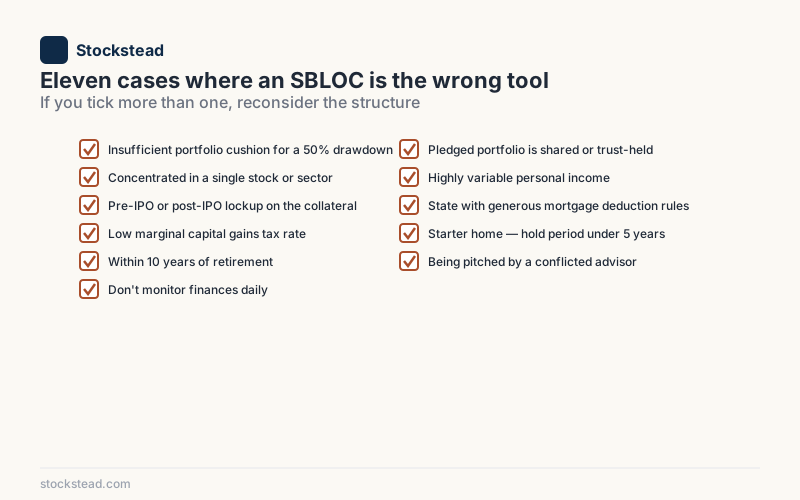
This post is the counterweight. If your situation fits one of these profiles, the SBLOC pitch is wrong for you, and you should choose a different structure.
You Don't Have Sufficient Excess Portfolio Cushion
The safe initial LTV on an SBLOC is 20–30% against a diversified portfolio. If the SBLOC you are considering pushes the LTV above 40%, you are in a margin-call-vulnerable structure, and a 30–40% market drawdown (which happens roughly once a decade) will trigger a call.
The practical test: model the line at a 50% portfolio drawdown. If the LTV at the bottom is within 10 percentage points of the maintenance threshold, you do not have enough cushion. Either reduce the draw or use a different financing structure.
A $2M portfolio supporting a $300K SBLOC is robust. A $2M portfolio supporting a $900K SBLOC is not. Buyers who want to borrow the larger amount often assume they can "manage" the risk through active monitoring. In practice, most retail investors cannot, and institutional investors charge steeply for the privilege of managing real market risk with a leveraged book.
Your Portfolio Is Concentrated in a Single Position
Pledging a portfolio with 40%+ in a single stock creates a correlated-risk structure that is qualitatively different from pledging a diversified book. When the stock moves 20% in a day, your LTV moves meaningfully. When the stock moves 40% in a week (which individual stocks do), your margin call window can close before you have time to respond.
Lenders understand this and impose lower advance rates on concentrated positions — typically 30–50% instead of the 65–75% available on diversified portfolios. Lower advance rates mean less available credit per dollar of portfolio, partially mitigating the risk, but not eliminating it.
If your portfolio is concentrated by choice (you believe in the company or have tax reasons not to sell), the SBLOC is still dangerous. The correlation between the stock performance, your employment (if it's your employer), and your liquidity needs is too high. A single negative event can cascade across all three at once.
The right structure for concentrated positions is usually a prepaid variable forward or a structured exchange fund — both of which are outside the scope of a standard SBLOC and available only through full-service private banks.
You're in Pre-IPO Lockup or Post-IPO Restrictions
If your major asset is company stock that is locked up (pre-IPO or post-IPO within the lockup window), an SBLOC against those shares is typically unavailable or priced punitively. Lenders know they cannot foreclose on locked-up shares during a margin call, so they price for the structural illiquidity.
A common situation: a tech employee whose net worth is $4M of locked-up shares plus $300K of diversified portfolio wants to use an SBLOC for a home purchase. The lendable portion against the locked-up shares is close to zero; the $300K diversified portfolio supports only $150K or so of safe borrowing. The math does not work.
The right answer here is usually to wait. The lockup expires, the restriction eases, and the SBLOC becomes available. Alternatively, bridge the purchase with cash from a less efficient source and refinance into an SBLOC post-lockup.
Your Marginal Tax Rate Is Low
The SBLOC pitch assumes that liquidating alternative assets produces a meaningful tax bill. If your marginal rate on long-term capital gains is 0% (low-income year, carried-interest gap, extended sabbatical), liquidating is free and the SBLOC's tax-deferral benefit disappears.
Similarly, if your cost basis on the assets you'd otherwise liquidate is high (recent purchases, small embedded gains), the tax cost of selling is minimal and the SBLOC's advantage shrinks.
The SBLOC math depends on a nontrivial after-tax cost of liquidation to justify the interest expense. If that cost is small, the analysis collapses to a simple rate comparison — and in most markets, a jumbo mortgage rate plus its deduction beats an SBLOC rate with no deduction.
You're Within 10 Years of Retirement
The SBLOC is a leveraged structure. The math works in your favor when your portfolio is compounding and your income is predictable. Both assumptions become shakier as you approach retirement.
Specifically:
- Your portfolio is transitioning from growth to income, often with a more conservative asset mix. Expected returns drop, making the interest cost relatively more expensive.
- Your income may drop (partial retirement, consulting only). Interest cover shrinks.
- Sequence-of-returns risk — the possibility that a bad market in your first retirement year permanently impairs your portfolio — is sharply elevated by leverage.
- Your time horizon for the leverage is shorter. A margin call at age 68 is operationally harder to handle than at age 38.
The operational rule: if you are within 10 years of retirement and you would not take on a similar amount of general leverage for investment purposes, don't take it on for a home purchase either. Pay cash or use a conservative mortgage.
You Don't Monitor Your Finances Daily
SBLOCs require active monitoring. Portfolio values change daily. Advance rates can change. Interest accrues continuously. A margin call can come with 3–5 business days of cure time, which is not much if you are traveling or otherwise disengaged.
For buyers who don't regularly check their portfolios — who review quarterly statements and largely ignore day-to-day market movement — the SBLOC is a poor structural match. The structure demands attention that the buyer will not give it, and the cost of inattention is a forced liquidation at the worst time.
This is not a skill issue; it is a lifestyle issue. Some buyers simply do not want to spend their time tracking LTV and monitoring market dislocation. For them, a mortgage — which has no margin call mechanism — is the right answer regardless of what the pure math says.
Your Portfolio Is Someone Else's
An SBLOC requires pledging the portfolio as collateral. If the portfolio is owned jointly with a spouse who is not aligned on the purchase, or if it's held in a trust where you are not the sole decision-maker, the pledge adds relationship and legal friction.
A common conflict: one spouse is enthusiastic about the SBLOC structure; the other is risk-averse and uncomfortable with the idea that the home is effectively secured by the shared investment portfolio. The conversation should happen before the loan documents, not after.
Trusts add their own complication: many trust instruments prohibit the trustee from pledging trust assets, or require beneficiary consent for pledges. Verify the trust terms before assuming the assets are available.
Your Career or Income Is Unusually Volatile
SBLOC interest is paid from cash flow. If your income is highly variable — a commissioned salesperson, a founder pre-revenue, an equity-heavy employee where comp can drop 50% in a tech winter — the line's interest cost can become a serious problem in a down year.
The stress test: assume your income drops to 50% of current levels for 18 months. Can you still service the interest on the SBLOC from non-portfolio income, or would you need to draw on the portfolio to pay interest (effectively compounding the leverage)?
If you would need to draw on the portfolio to service the line in a 50% income scenario, the structure is too aggressive for your income profile.
You Live in a State With Aggressive Mortgage Deduction Rules
Certain states allow the mortgage interest deduction on more than the federal $750K cap. California allows up to $1M. For a buyer with a mortgage between $750K and $1M in California, the marginal after-tax cost of jumbo is substantially below the SBLOC cost.
This is a specific state-level math check. If you are in California, New York, or another state with generous mortgage rules, run the jumbo math with the state benefit applied. The answer is often that the jumbo dominates.
The Home Purchase Is a Starter Home
SBLOCs carry real operational overhead: pledge agreements, ongoing monitoring, periodic rate resets, tax-season complications around deductibility. That overhead is worth carrying for a "forever home" you will hold for 20+ years. It is not worth carrying for a starter home you plan to sell in 5.
For a shorter-hold property, the simpler mortgage structure usually wins on total cost and certainly on operational simplicity. The compounding advantage of the SBLOC needs time to accumulate — in a 5-year hold, most of that compounding hasn't happened yet.
You're Over-Optimizing the Wrong Variable
Some buyers get absorbed in the SBLOC analysis because it is intellectually interesting — and miss the larger decision: whether this is the right house, the right price, the right time. A $200K improvement in financing structure is meaningless if you are buying a $3M house you should not be buying.
The order of operations for home purchase analysis should be:
- Is this the right house? (subjective, personal)
- Is this the right price? (market, comps)
- Is the purchase within a sane fraction of your net worth? (usually 20–40% for HNW)
- What is the right financing structure? (SBLOC vs jumbo vs hybrid)
If step 3 fails — the house is too expensive for your net worth — the SBLOC is not the solution. Step 3 failures are usually solved by buying less house, not by financing more aggressively.
You're Being Pitched by Someone With a Conflict
The SBLOC is a product. Brokerages, private banks, and wealth managers all earn fees on the line. Your advisor's incentives are not neutral.
Signs that you're getting a pitch rather than advice:
- The advisor jumps straight to the SBLOC without walking through the alternatives.
- The comparison to a jumbo mortgage is dismissed or done with a simplified (wrong) tax treatment.
- Margin call risk is hand-waved away.
- The pitch arrives right after a market decline "when the math is so good."
- The advisor is also the one selling you the house or managing the account where the SBLOC will live.
None of these are automatic disqualifiers — advisors who earn fees on SBLOCs are not universally self-dealing — but the presence of several should prompt you to get a second opinion from someone who is fee-only and has no economic interest in the structure.
The Summary Rule
An SBLOC is the right answer when: you have a diversified portfolio at least 3–4x the target draw, you are at least 10 years from retirement, your income is stable, your marginal capital gains rate is significant, and you have the operational discipline to monitor the line actively.
An SBLOC is the wrong answer when: any of the above is not true, or when you are being pitched rather than advised, or when the home purchase itself is misconceived. If you are working through that decision, our full SBLOC vs. mortgage vs. cash comparison walks through the criteria with worked examples.
The best use of this post is as a checklist to walk through before signing any SBLOC paperwork. If you tick more than one of these "wrong" boxes, step back and revisit the structure.
Get an Honest Model
Stockstead shows the tradeoffs neutrally. No one earns a fee on our analysis. If your situation fits an SBLOC, the model will show the SBLOC winning. If it doesn't, the model will show a jumbo or hybrid winning. The answer follows the math, not the pitch.
Compare Your Options with Stockstead →
The SBLOC is a specific tool for a specific set of facts. Use it when the facts fit. Walk away when they don't.
Frequently asked questions
- When is an SBLOC the wrong tool for a home purchase?
Eleven specific situations recur. Insufficient portfolio cushion (initial LTV above 40%). Concentrated single-position portfolios (40%+ in one stock). Pre-IPO or post-IPO lockup restrictions where lenders haircut to zero. Low marginal capital gains rate where liquidating is essentially free. Within 10 years of retirement where the leverage assumptions break down. Lifestyle that cannot accommodate daily portfolio monitoring. Portfolio jointly owned with an unaligned spouse or held in a restrictive trust. Volatile career or income that cannot service interest in down years. Starter home with a 5-year hold horizon where SBLOC overhead exceeds the benefit. State-level mortgage deduction rules (California, New York) that favor jumbo. Advisor with a conflict of interest pitching the structure.
- Should I use an SBLOC if I'm within 10 years of retirement?
Generally no. The SBLOC math depends on three assumptions that get shakier near retirement: a portfolio compounding faster than the borrowing rate, predictable income servicing the interest, and a long horizon to absorb leverage drag. Approaching retirement, your portfolio is transitioning from growth to income with lower expected returns, your earned income may drop with partial retirement or consulting, sequence-of-returns risk is sharply elevated by leverage, and a margin call at age 68 is operationally harder to handle than at 38. If you would not take on similar leverage for investment purposes, do not take it on for a home purchase.
- Why is an SBLOC dangerous for a concentrated single-stock portfolio?
Because the diversification math that protects diversified portfolios breaks down. A portfolio with 40%+ in one stock moves dramatically with that one position. When the stock moves 20% in a day, your LTV moves meaningfully. When it moves 40% in a week — which individual stocks do — the margin call window can close before you have time to respond. Lenders impose lower advance rates (30-50% versus 65-75% diversified) to compensate, but the correlation risk remains. If the position is your employer stock, your employment, liquidity needs, and collateral can all decline together in a single bad event.
- How do I tell if my advisor is pitching an SBLOC versus genuinely advising me?
Five signals point to a pitch rather than advice. The advisor jumps straight to the SBLOC without walking through the alternatives (cash, jumbo, hybrid). The comparison to a jumbo mortgage is dismissed or done with simplified tax treatment. Margin call risk is hand-waved away rather than modeled at a 50% drawdown. The pitch arrives right after a market decline 'when the math is so good.' The advisor is also the one selling you the house or managing the brokerage account where the SBLOC will live. None alone is disqualifying, but several together warrant a second opinion from a fee-only advisor with no economic interest in the structure.
- Does state tax treatment change the SBLOC versus jumbo decision?
Substantially. California allows mortgage interest deduction on up to $1M of acquisition indebtedness rather than the federal $750K cap. For a buyer with a mortgage between $750K and $1M in California, the marginal after-tax cost of the jumbo is significantly lower than federal-only calculations would suggest. New York has its own adjustments. If you are in a high-tax state with generous mortgage rules, run the jumbo math with both federal and state benefits applied. The answer often flips toward jumbo. In a no-income-tax state like Florida or Texas, the federal calculus is the whole game and the SBLOC's relative advantage looks different.
Ready to run the numbers on your situation?
Open the calculator →Related posts
How to Buy a Home Without Selling Investments
Four ways to fund a home purchase while keeping your portfolio invested — SBLOC, margin loan, asset-depletion mortgage, and hybrid structures. Mechanics, trade-offs, and how to choose.
Interactive Brokers Margin vs SBLOC for a Home Purchase
IBKR Pro margin is the cheapest leverage available to most retail investors. Here's when to use it for a home purchase — and when its enforcement model makes a slower SBLOC the better choice.
Schwab Pledged Asset Line for a Home Purchase: When It Wins, the Process, and the Rate Schedule
When a Schwab Pledged Asset Line beats a jumbo or IBKR margin for a home purchase: the application process, the two LTVs that govern safety, and a worked $1M example.