How an SBLOC Works: A Complete Guide for Investors
By Tyler Singletary · · Updated · in How it works
An SBLOC is, mechanically, a margin loan that's been moved into a different filing cabinet. The collateral is the same — your taxable brokerage account. The lender is usually the same — your existing broker. The risk profile is largely the same — if your portfolio drops far enough, the lender forces a sale at the worst possible time. What's different is the regulatory regime, the eligible uses of the proceeds, the rate, and the way the line is documented.
That distinction matters more than it sounds. Margin loans live inside the brokerage account and are governed by Federal Reserve Regulation T — which means they're designed to buy more securities and have explicit purchase rules. SBLOCs sit outside Reg T, are documented as standalone credit lines, and the proceeds can fund almost anything that isn't a marketable security. Including, for our purposes, a house.
This is the mechanical guide: what the lender is actually looking at, what the two numbers are that decide whether the line is safe, what a maintenance call looks like start to finish, and the specific places where I think most first-time SBLOC borrowers get the model wrong.
The 60-second version
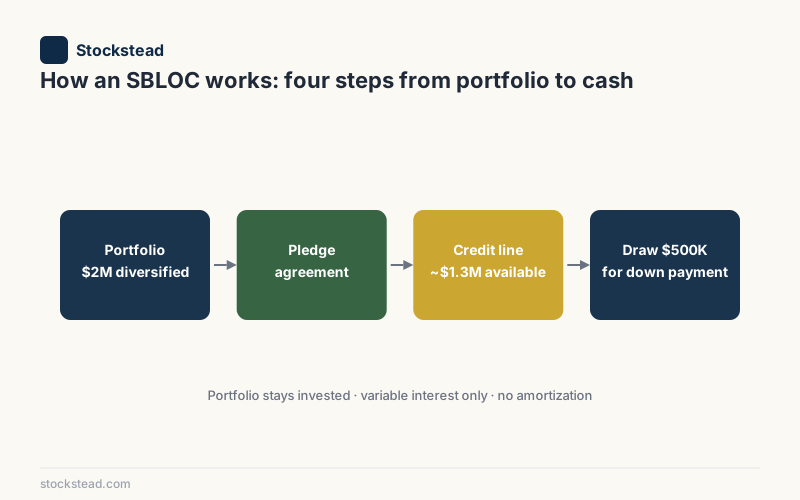
Before the deep dive: an SBLOC is a credit line secured by your investment portfolio. The lender sizes the line as a percentage of your portfolio's market value — typically 30–50%, sometimes higher for ultra-clean collateral. You can draw on the line at will, you pay interest only (no required principal), and the rate is variable, set as a spread over SOFR or prime.
Two numbers govern your safety: the initial LTV (how much you draw vs. the portfolio at the moment you draw) and the maintenance LTV (the threshold at which the lender forces a sale). Most calls happen because the denominator shrunk, not because the borrower drew more — meaning a 30% market drop can put a comfortably-sized line over the line.
If you're drawing at 25% LTV against diversified collateral, you have plenty of margin. If you're drawing at 65% LTV against a tech-concentrated portfolio in late 2025, you're a single tariff announcement away from a problem.
The rest of this post unpacks each piece.
Mechanically, what's actually happening
You sign two documents. The first is a pledge agreement — you're granting the lender a security interest in the brokerage account. The second is a credit line agreement that defines the line size, the rate, the maintenance ratio, and the lender's remedies if you breach. The brokerage account stays in your name. You can still trade in it, with restrictions. The lender takes a contingent claim on the assets.
When you draw, cash hits your linked deposit account. Interest accrues daily on the outstanding balance. Most lenders bill monthly. The minimum payment is interest only — there is no amortization schedule, no principal payment requirement, no fixed maturity in most cases. As long as you're paying interest and the collateral holds, the line stays open indefinitely.
This last point is the entire reason an SBLOC is interesting for a home purchase: you can structure a 30-year financing exposure that you control, without a 30-year commitment to a specific rate or principal schedule. You can pay it down whenever you want. You can pay it off in three years if a vesting cliff hits. You can carry it for 15 years and refinance into a mortgage when rates drop. The flexibility is the value.
It's also the trap. Variable rate, no maturity, no forcing function — those same features make it easy to leave the balance outstanding longer than you should and accumulate interest costs that quietly exceed what a fixed mortgage would have charged.
A worked example: $2M portfolio, $300K draw, ten years
To make the mechanics concrete, follow a specific buyer through the SBLOC lifecycle.
Day 0 — Setup. Buyer has a $2M taxable portfolio: 60% diversified equity ETFs, 30% individual large-cap stocks (no single position over 12% of the account), 10% Treasury ETF. Blended advance rate at the broker: roughly 65%. Maximum line size: $1.3M. The buyer requests a $750K line and draws $300K on Day 1 to fund a home down payment.
| Position | Value | Advance rate | Lendable |
|---|---|---|---|
| Equity ETFs (VTI, VXUS) | $1,200,000 | 70% | $840,000 |
| Large-cap stocks | $600,000 | 60% | $360,000 |
| Treasury ETF | $200,000 | 90% | $180,000 |
| Total | $2,000,000 | ~69% | $1,380,000 |
Initial LTV: $300K / $2M = 15%. Plenty of room. Maintenance LTV at this lender: 70%.
Year 1 — Steady carry. Portfolio compounds at 7% to $2.14M. Buyer pays an assumed SOFR + 1.25% = ~6.25% on $300K = $18,750 in interest. (That rate is illustrative. As of October 8, 2026, SOFR was 3.87% and Schwab's Pledged Asset Line list rate on a $1M-tier line was 6.77%.) LTV ends the year at $300K / $2.14M = 14%. Calm.
Year 3 — A correction. Tech-led 30% drawdown. Equity ETFs drop 32%, large-caps drop 40%, Treasuries hold. New portfolio value:
| Position | Value |
|---|---|
| Equity ETFs (-32%) | $816,000 |
| Large-caps (-40%) | $360,000 |
| Treasuries (flat) | $200,000 |
| Total | $1,376,000 |
Loan balance still $300K. New LTV: $300K / $1.376M = 21.8%. Still well below the 70% maintenance threshold. The buyer doesn't sweat. This is the normal case.
Year 5 — A worse drawdown. A 50% S&P drop with concentrated weakness in mid-cap. Equity ETFs −48%, large-caps −60%, Treasuries +5%. Portfolio drops to:
| Position | Value |
|---|---|
| Equity ETFs (-48% from $1.2M) | $624,000 |
| Large-caps (-60% from $600K) | $240,000 |
| Treasuries (+5% from $200K) | $210,000 |
| Total | $1,074,000 |
LTV is now $300K / $1.074M = 27.9%. Still under 70%. Even in a 50% market crash, a buyer who drew at 15% initial LTV against diversified collateral does not hit a maintenance call.
This is the single most under-appreciated fact about SBLOC mechanics: the buyer who draws conservatively is structurally safe even in 2008-style crashes. The forced-liquidation horror stories almost always come from buyers who drew at 50%+ initial LTV, who were concentrated in a single volatile position, or who drew further into the line during the drawdown.
Year 5 alternate — a more aggressive draw, same crash. Same buyer, but they drew $1.0M instead of $300K (initial LTV 50%). Same crash to a $1.074M portfolio. Loan balance $1.0M. LTV $1.0M / $1.074M = 93.1%, well above the 70% maintenance threshold.
The lender issues a maintenance call demanding $246K of cure (cash deposit, additional securities, or paying down the loan). The buyer has 3 business days to respond. If they don't, the broker liquidates positions of the broker's choosing. In a crashed market, those positions get sold at the bottom — and any embedded gains in those positions get taxed.
This is the difference between an SBLOC as a financing tool and an SBLOC as a leverage instrument. Same mechanics, very different outcomes.
Run the same draw against your own portfolio mix in the SBLOC vs mortgage vs cash comparison — the stress-test panel applies a 50% drawdown to each asset class and shows whether the resulting LTV breaches your maintenance threshold.
The four numbers that decide everything
If you remember nothing else from this post, remember these four numbers and where they come from.
1. The advance rate (per asset class). What percentage of each asset's market value the lender will lend against. Treasury ETFs get 80–95%. Diversified equity ETFs get 60–75%. Large-cap individual stocks get 50–70%. Concentrated single-stock positions over 20% of the account get 25–50%. Small-cap, international, or thinly traded names get 30–50%. Restricted securities (hello, RSUs that haven't vested or post-IPO lockup shares) often get 0%. Lenders publish the schedule but they all reserve the right to change it.
2. The blended advance rate (= max line size as % of portfolio). Weighted by holdings. A diversified portfolio blends to 65–75%. A tech-concentrated portfolio blends to 40–55%. Your "$2M portfolio" doesn't actually support an SBLOC of "$2M times advance rate." It supports a line equal to the blended advance rate against your specific mix.
3. The initial LTV (= what you draw / portfolio at draw). This is the number you control. Lenders cap it at the blended advance rate, but you don't have to draw that high. The lower the initial LTV, the more market drop you can absorb before a maintenance call. Conservative SBLOC use means drawing at 25% or less.
4. The maintenance LTV (= the call threshold). Set by the lender, typically 70–85% depending on collateral quality. The exact number is in your loan agreement; do not assume.
The relationship between these numbers tells you exactly how much market drop you can survive. Crude formula: a portfolio drop of 1 − (initial LTV / maintenance LTV) is the trigger point. At 25% initial LTV and 70% maintenance LTV, that's 1 − 0.357 = 64.3% — the portfolio would have to drop 64% before a call. At 60% initial LTV and 70% maintenance LTV, that's 1 − 0.857 = 14.3% — a normal correction triggers it.
What a maintenance call looks like, minute by minute
If a call happens, the sequence is fast.
Hour 0. Lender's risk system flags the LTV breach overnight (or intraday in fast markets). The relationship manager or automated system generates a call notice. You get an email or a phone call.
Hour 1–24. You have a defined window to cure — typically 1 to 5 business days, set in the loan agreement. The cure options are:
- Deposit cash. Wires are fastest. The deposit goes into the pledged account and reduces the loan-to-value.
- Transfer in additional eligible securities. Slower (ACATS takes days) and the new securities have to be in eligible form.
- Sell existing securities and pay down the loan. Fastest from your end, but you realize gains, you potentially trigger wash-sale problems, and you sell into a stressed market.
Day 3–5 (if you fail to cure). The lender sells securities at their discretion. Their discretion. The loan agreement gives them broad latitude on which positions to sell, in what order, at what price. They are not optimizing for your tax bill. They are optimizing for getting back to a safe LTV. They will often sell the most liquid positions first — which tend to also be the ones with the largest accumulated gains — and the tax bill lands in your inbox in February.
There's also a quiet escalation that doesn't make the headlines: even if you cure successfully, the lender often raises advance-rate haircuts on the same collateral going forward. A portfolio that supported a 70% line in the calm year may only support a 55% line after the call. Your available credit shrinks even though your loan balance is now smaller. This rarely matters for a buyer who's done with new draws, but it can matter a lot for a buyer who was planning to use the line revolving.
Three things I had to unlearn about SBLOC
I was researching all of this for my own potential home purchase, which means I was also figuring out how lenders actually behave — not how the marketing pages describe them. Three things stand out as the spots where my mental model was wrong:
1. The "30–50% advance rate" you read everywhere is the floor, not the ceiling. Diversified portfolios at clean institutions get advance rates in the 65–75% range, sometimes higher. The 30–50% number is what concentrated portfolios get. The number you should care about is the blended advance rate against your collateral mix, which only your lender can quote you.
2. The maintenance call doesn't usually come from drawing too aggressively. It comes from market drops shrinking the denominator. I'd been thinking about SBLOC risk as "what happens if I keep borrowing more." That's not how the calls happen in practice. The calls happen when the buyer drew once, kept the balance flat, and a market correction made the same balance look big against a smaller portfolio. The risk lives in volatility, not in your discipline.
3. The interest cost is rarely the biggest cost. I went into the research assuming the question was "is the SBLOC rate cheaper than the mortgage rate." That answer swings with the rate cycle. When I first wrote this, mortgages were typically 100–200 bps cheaper pre-tax. As of October 8, 2026, the 30-year fixed averaged 7.40%, while published $1M SBLOC rates included 4.93% at Interactive Brokers Pro margin and 6.77% at Schwab's PAL list price. Either way, the thing that makes an SBLOC win is avoiding the capital gains tax bill on the down payment. The interest is the line item; the avoided gain realization is the value. Once I started modeling it that way, the analysis actually made sense.
When this is the wrong tool
For everything I've said about SBLOCs being structurally safer than reputation suggests, there are profiles where they remain the wrong instrument:
- Concentrated single-position portfolios. If 60% of your account is one tech stock, the diversification math doesn't save you. A 30% drop in that one position drops your collateral disproportionately and the call comes fast.
- Portfolios where a substantial share is restricted or post-IPO-lockup. Lenders haircut these heavily, often to zero. Your "$2M portfolio" might support a $600K line if half of it is restricted.
- Buyers without independent debt service. If you can't pay the SBLOC interest from W-2 income or other liquid sources, you'll be tempted to capitalize interest into the loan or pay it from drawn principal — both of which accelerate you toward a call.
- Buyers in flat or declining return regimes. The SBLOC math assumes the portfolio compounds faster than the borrowing rate. In a sideways market, the carry erodes you.
Run the numbers, not the rule of thumb
Stockstead's SBLOC vs mortgage vs cash comparison models the after-tax decision for your specific cost basis, bracket, and rate environment. The calculator also stress-tests the LTV math against historical drawdowns — 2008, 2020, the 2022 tech selloff — so you can see whether your draw size is structurally safe or just safe in calm years.
The mechanics aren't actually complicated. They're just different from a mortgage in ways that matter, and the standard mortgage walkthrough doesn't tell you any of it.
Sources
- FINRA — Securities-Backed Lines of Credit (Investor Alert)
- SEC — Securities-Based Lending Investor Bulletin
- Federal Reserve Regulation T (12 CFR Part 220)
- IRS Publication 936 — Home Mortgage Interest Deduction
- IRS Publication 550 — Investment Income and Expenses
Educational, not financial advice. Tyler Singletary founded Stockstead while researching his own first home purchase. He's spent 20+ years in software product roles — currently as Product Specialist for AI/ML Startups at AWS, previously CPO/COO at Tagboard, and an executive at Klout (exited to Lithium in 2014) — and has been compensated in RSUs, ISOs, and post-IPO equity at high-growth tech companies for two decades. He is not a licensed financial advisor or CPA. Consult a fiduciary advisor and a tax professional before sizing or signing an SBLOC.
Frequently asked questions
- What is the difference between an SBLOC and a margin loan?
Mechanically they are nearly identical — both are credit lines collateralized by your taxable brokerage account, both let the lender force a sale if the portfolio drops too far. The differences are regulatory and use-case. A margin loan lives inside the brokerage account, is governed by Federal Reserve Regulation T, and its proceeds are designed to buy more securities. An SBLOC is a non-purpose loan documented separately, sits outside Reg T, and its proceeds can fund almost anything that isn't a marketable security. For a home purchase, the SBLOC structure is the right fit.
- What is a blended advance rate and why does it matter for SBLOC sizing?
The blended advance rate is the weighted average of per-asset advance rates across your specific portfolio mix. Treasury ETFs typically get 80-95%, diversified equity ETFs 60-75%, large-cap individual stocks 50-70%, and concentrated single-position holdings 25-50%. Your maximum line size is the blended rate applied to your portfolio, not a flat percentage. A diversified $2M portfolio might support a $1.3M line at a 65% blend; a tech-concentrated $2M portfolio might only support $900K. The rule-of-thumb 'SBLOCs lend 30-50%' is the floor for concentrated portfolios, not the ceiling for clean ones.
- How much can my portfolio drop before an SBLOC margin call?
The crude formula is 1 minus (initial LTV divided by maintenance LTV). At a 25% initial LTV with a 70% maintenance threshold, you can absorb a 64.3% portfolio drop before a call. At a 50% initial LTV with the same threshold, only a 28.6% drop. At a 65% initial LTV, a 14.3% drop is enough — barely a normal correction. This is why initial LTV matters more than rate. A 25% draw against diversified collateral survives 2008-level events; a 60% draw against the same collateral does not.
- Why are most SBLOC margin calls caused by market drops rather than overborrowing?
The LTV ratio has two moving parts: loan balance (numerator) and portfolio value (denominator). Most borrowers draw once, keep the balance flat, and never increase it. But the denominator shrinks every time the market sells off. A $300K loan against a $2M portfolio is a comfortable 15% LTV; the same $300K against a $450K portfolio after a crash is 67% — close to maintenance even though the borrower never drew another dollar. The risk lives in volatility, not in your discipline. Sizing the initial draw to survive a 50% drawdown is the protective move.
- When is an SBLOC the wrong tool for a home purchase?
Four profiles where it routinely backfires. Concentrated single-position portfolios where 60%-plus of the account is one stock — a 30% drop in that position blows through the cushion immediately. Portfolios where a substantial share is restricted or post-IPO-lockup, since lenders haircut those heavily, often to zero. Buyers without independent debt service from W-2 income, who end up capitalizing interest into the loan and accelerating toward a call. And buyers in flat or declining return regimes where the portfolio compounds slower than the borrowing rate, so the carry erodes wealth instead of preserving it.
Ready to run the numbers on your situation?
Open the calculator →Related posts
What Are the Odds an SBLOC Actually Gets Called? A Century of Market Paths
Stress tests tell you whether a crash would call your line. They do not tell you how likely a call is over ten years of holding it. We resampled a century of monthly market returns to find out — and the answer depends far more on what you pledged than on how much you drew.
SBLOC vs Mortgage vs Cash: The Complete HNW Guide
Four ways to fund a $300K down payment from a $2M portfolio, the 10-year math on each at current rates, and the failure mode standard mortgage calculators hide.
Schwab Pledged Asset Line for a Home Purchase: When It Wins, the Process, and the Rate Schedule
When a Schwab Pledged Asset Line beats a jumbo or IBKR margin for a home purchase: the application process, the two LTVs that govern safety, and a worked $1M example.