SBLOC Stress Test: Surviving a 2008-Level Drawdown
By Tyler Singletary · · in Risk & drawdown
The pitch for an SBLOC always assumes a normal market. Diversified portfolio, modest volatility, expected returns above the cost of borrowing. Under those assumptions, the math works cleanly and the SBLOC dominates the alternatives.
The interesting question is not what happens in a normal market. It is what happens in a 2008. If you carry an SBLOC for ten years, you will encounter at least one significant drawdown. The question is whether your structure survives that drawdown, or whether it forces you to crystallize losses at the worst possible moment.
This post is a backtest. It walks through the actual price history of the S&P 500 from October 2007 through March 2009 and shows how a typical HNW SBLOC would have behaved at three different initial loan-to-value ratios. The conclusions should inform how aggressively you size your draw on day one.
The 2007–2009 Drawdown, Briefly
The S&P 500 peaked at 1565 on October 9, 2007. It bottomed at 676 on March 9, 2009 — a 56.8% peak-to-trough decline over 17 months.
The drawdown was not linear. The market lost about 10% in the first six months, another 30% in the next six months, and another 25% in the final five months. There were bear-market rallies of 15–20% along the way that retraced quickly. By the bottom, virtually every diversified portfolio holding US equities had lost half its value.
Diversified portfolios with international exposure fared similarly. EAFE indices dropped about 60%. Emerging markets dropped over 60%. Investment-grade bonds were one of the few asset classes that held up — long-term Treasuries actually gained value through the worst of it.
For the purposes of this stress test, I'll model an "average HNW portfolio" of 80% US equities (proxied by the S&P 500) and 20% intermediate Treasuries. This portfolio's peak-to-trough drawdown over the same window was approximately 45%.
The Three Test Scenarios
Same hypothetical buyer in October 2007:
- $2M pledged portfolio (80/20 stocks/bonds).
- $750K SBLOC drawn for a home down payment.
- Maintenance LTV: 75%.
- Cash reserves outside the pledged account: $0 (worst case for the test).
Three initial LTVs to compare:
- Scenario A: 25% initial LTV. Loan: $500K against $2M portfolio.
- Scenario B: 37.5% initial LTV. Loan: $750K against $2M portfolio. (The base case in this stress test.)
- Scenario C: 50% initial LTV. Loan: $1M against $2M portfolio. (Aggressive but within typical lender allowance.)
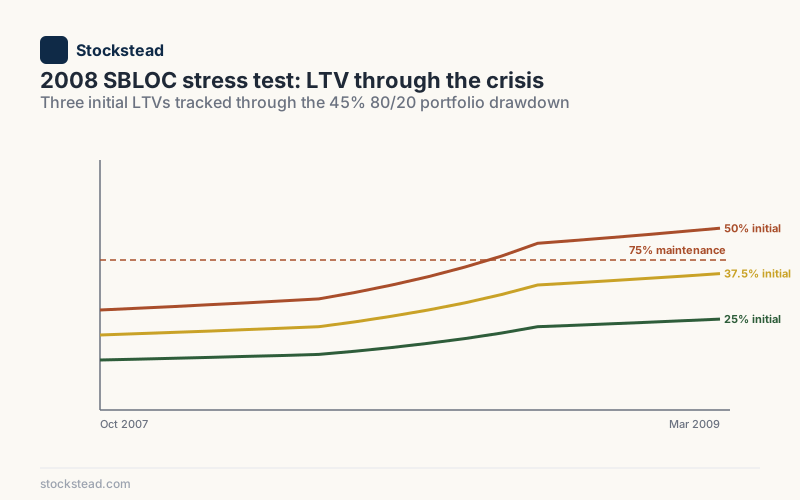
I will track the LTV month-by-month from October 2007 through March 2009 and flag the first time each scenario crosses the 75% maintenance threshold.
Scenario A: 25% Initial LTV
Starting position: $500K loan / $2M portfolio = 25% LTV. Maintenance threshold of 75% would not be crossed until the portfolio drops to $666K — a 67% portfolio decline.
Through the entire 2007–2009 drawdown, the 80/20 portfolio bottomed at roughly $1.10M (a 45% drawdown). LTV at the bottom: $500K / $1.10M = 45.5%.
Result: no margin call. Comfortable cushion throughout.
The borrower in Scenario A could have ridden out the entire crisis without taking any defensive action. By March 2009, the loan was still well under maintenance and the borrower could have held until the recovery.
Scenario B: 37.5% Initial LTV
Starting position: $750K loan / $2M portfolio = 37.5% LTV. Maintenance threshold of 75% would be crossed when the portfolio drops to $1.0M — a 50% portfolio decline.
The 80/20 portfolio's bottom of $1.10M is just above this threshold. LTV at the bottom: $750K / $1.10M = 68.2%.
The portfolio came within 8 percentage points of triggering a call but did not cross. However, the borrower would have been in a high-stress state for several months — staring at LTV in the 65–70% range, watching the maintenance threshold get closer with each market down-day.
In real life, lenders often raise advance rates on individual positions during a sustained drawdown, effectively reducing available credit even when the headline LTV is below maintenance. A borrower at 68% LTV during the worst week of October 2008 might have been told that their actual available line had dropped, putting them above maintenance even without a price move.
Result: no formal margin call in the simulation, but real-world risk of a "soft" call from advance-rate adjustments. High operational stress.
Scenario C: 50% Initial LTV
Starting position: $1.0M loan / $2M portfolio = 50% LTV. Maintenance threshold of 75% would be crossed when the portfolio drops to $1.33M — a 33% portfolio decline.
The 80/20 portfolio crossed this threshold around October 2008, when the cumulative drawdown reached 35%. From that point through March 2009, the borrower would have been in a margin call state continuously, with LTV reaching as high as $1.0M / $1.10M = 91% at the absolute bottom.
By the time the portfolio recovered to the maintenance threshold (mid-2009), the borrower would have already received multiple call notifications and likely been forced to liquidate.
Result: confirmed margin call in late 2008. Borrower forced into one of three actions:
- Deposit cash — but the test scenario assumed zero external reserves.
- Sell securities to pay down the loan — at the worst possible market prices, crystallizing 35–45% losses.
- Wait and let the lender liquidate — same loss outcome but without control over which positions get sold.
Any of these outcomes destroys real wealth. The forced liquidation in March 2009 would have cost the borrower the entire 2009–2013 recovery on the liquidated portion — roughly a 100% gain.
The Direct Lesson
A 25% initial LTV survived the worst 17-month drawdown in 80 years with no action required. A 50% initial LTV did not. The difference between the two structures was not subtle — one was workable, one was a wealth-destruction event.
The takeaway for any HNW borrower considering an SBLOC for a home purchase: initial LTV matters more than rate. A 25% draw at 6.75% (Schwab PAL pricing) is structurally safer than a 50% draw at 5.00% (IBKR pricing). The savings on the rate at the higher LTV evaporate the first time the market does what the market does every decade or so.
What About a Less Diversified Portfolio?
The stress test above assumed an 80/20 diversified portfolio. Real HNW portfolios are often more concentrated. Common variations:
100% US equities. Peak-to-trough drawdown: 56.8%. At 25% initial LTV, the LTV at the bottom is $500K / $864K = 57.9% — still under maintenance. At 37.5% initial LTV, the bottom LTV is $750K / $864K = 86.8% — clear margin call. At 50% initial LTV, $1.0M / $864K = 115.7%, which is technically a default-eligible event.
Concentrated tech equity. A portfolio dominated by tech names lost 60–80% in the same window. At 25% initial LTV against an 80% drawdown, LTV becomes $500K / $400K = 125%. Margin call.
The diversification of the pledged portfolio matters as much as the initial LTV. A 25% draw against a diversified portfolio is safe. A 25% draw against a concentrated tech portfolio is not.
What About Other Drawdowns?
2008 is the most severe modern stress case but not the only one to model. Quick comparisons:
2000–2002 dot-com bust. S&P 500 drawdown of 49%. NASDAQ drawdown of 78%. A diversified 80/20 portfolio lost about 25%. Less severe than 2008 for diversified investors. Borrowers concentrated in tech were severely impacted.
March 2020 COVID. S&P 500 drawdown of 34% in 5 weeks. Recovery began within months. A 25% LTV survived comfortably. A 50% LTV would have triggered a call in late March 2020 had the borrower been unable to deposit cash quickly.
Q4 2018. S&P 500 drawdown of 19% over 3 months. No margin call risk for any normal LTV. Useful example of a "normal" correction that disciplined borrowers absorbed without action.
The Operational Reality
Worth distinguishing between the math (LTV crossed maintenance) and the operational outcome (you actually got called). In 2008, several private banks effectively paused enforcement for weeks during the worst of the crisis. They worked with clients to extend cure periods, accepted partial cures, and in some cases waived enforcement entirely.
Discount brokers (especially IBKR-style algorithmic enforcement) did not. They liquidated.
This is the most important practical reason HNW borrowers pay 100–200 bp more for a private bank SBLOC than they would for IBKR margin: the lender's discretion in a crisis. The math of the stress test is brutal at IBKR — algorithmic enforcement does not care that the market is recovering next month. The math at Morgan Stanley or Goldman is the same on paper, but the enforcement may pause for the borrower.
If you intend to carry leverage through a possible market event, the venue matters as much as the numbers.
What This Means for Your Plan
If you are sizing an SBLOC for a home purchase and you intend to carry it for more than 5 years, model the stress case explicitly:
- Assume a 50% drawdown in the pledged portfolio over an 18-month window starting next year.
- Calculate your LTV at the bottom.
- Identify the cure resources you would actually deploy: cash reserves, transferable securities, salary that can be redirected.
- Confirm those resources are sufficient to cover the gap between your peak LTV and the maintenance threshold.
If the answer is "I have $50K in cash and would need $500K of cure resources at the bottom," your structure is too aggressive. Either reduce the initial draw, increase the pledged portfolio, or commit to a higher cash reserve.
A well-structured SBLOC survives a 2008-level event. A poorly-structured one does not. The difference is on day one of the line.
Run Your Own Stress Test
Stockstead includes a stress-test mode that backtests your specific portfolio and SBLOC structure against historical drawdowns from 2000, 2008, and 2020. You will see the LTV trajectory week by week and the specific point at which a call would have been triggered. If your structure survives the 2008 case, it survives almost everything. The full SBLOC vs. mortgage vs. cash comparison puts the stress-test result in cost context against the alternatives.
Stress-Test Your SBLOC with Stockstead →
A 50% drawdown happens roughly once a generation. If you are planning to carry the loan for two decades, you will see one. Plan as if you will, not as if you won't.
Frequently asked questions
- Would my SBLOC have survived the 2008 financial crisis?
Depends entirely on your initial LTV. At 25% initial LTV against a typical 80/20 HNW portfolio that drew down 45% over the 17-month window, the LTV at the bottom would have been 45.5% — comfortably below the 75% maintenance threshold, no margin call. At 37.5% initial LTV, the LTV peaked at 68.2% — no formal call but high operational stress. At 50% initial LTV, the portfolio crossed maintenance in October 2008 and the borrower would have been in a margin call state continuously through March 2009, with peak LTV reaching 91%.
- What initial LTV is safe enough to survive a 50% market drawdown?
Roughly 25% initial LTV against a diversified portfolio. The math: a 25% draw with a 75% maintenance threshold means the portfolio can drop 67% before a call, and a typical 80/20 HNW mix only dropped 45% in 2008. A 30-37.5% initial LTV survives 2008 mathematically but with thin cushion during the worst weeks of October 2008 — high stress, possible advance-rate haircuts even without a formal call. The conservative posture for a multi-decade SBLOC carry is 25-30% initial LTV. The savings from drawing more aggressively rarely compensate for the wealth destruction of being called at the bottom.
- How did SBLOC enforcement actually behave during the 2008 crisis?
Differently depending on the lender. Private banks (Morgan Stanley, Merrill, Goldman, JPMorgan) effectively paused enforcement for weeks during the worst stretches — extending cure periods, accepting partial cures, and in some cases applying temporary waivers when market events were clearly transient. Discount brokers, especially those with algorithmic enforcement, did not. They liquidated when LTV crossed maintenance and the algorithm processed the cure window. This is the most important practical reason HNW borrowers pay 100-200 bp more for a private bank SBLOC than IBKR margin — the discretion to pause is real and material during a crisis.
- Would my SBLOC have triggered a margin call in March 2020?
A 25% initial LTV survived March 2020 comfortably — the S&P 500 dropped 34% in 5 weeks, and the recovery started within months. A 50% initial LTV would have triggered a margin call in late March 2020 if the borrower lacked cash to deposit quickly. The COVID drawdown is the modern stress case for SBLOC borrowers: fast, severe, then mercifully reversed. The borrowers who got through it without action drew conservatively and had standby cash. The borrowers who got called were aggressive on initial draw and concentrated in the wrong assets.
- Does the diversification of my portfolio change SBLOC stress-test results?
Substantially. The 80/20 stress test in this post assumes a diversified portfolio. A 100% US equity portfolio dropped 56.8% in 2008 versus 45% for 80/20. At 25% initial LTV, a 100% equity portfolio at the bottom would have been at 57.9% LTV — still under maintenance, but with much less cushion. A concentrated tech equity portfolio that dropped 60-80% would have crossed maintenance even at a 25% initial LTV, ending the period at 125% LTV — clearly a margin call. The diversification of the pledged collateral matters as much as the initial draw size.
Ready to run the numbers on your situation?
Open the calculator →Related posts
What Are the Odds an SBLOC Actually Gets Called? A Century of Market Paths
Stress tests tell you whether a crash would call your line. They do not tell you how likely a call is over ten years of holding it. We resampled a century of monthly market returns to find out — and the answer depends far more on what you pledged than on how much you drew.
Interactive Brokers Margin vs SBLOC for a Home Purchase
IBKR Pro margin is the cheapest leverage available to most retail investors. Here's when to use it for a home purchase — and when its enforcement model makes a slower SBLOC the better choice.
Selling Stock to Cover a Margin Call: Why the Math Sometimes Fails
Selling pledged stock to cure an SBLOC collateral call is not a simple paydown — the sale shrinks your collateral and the tax leaks out of the proceeds. Past a certain embedded gain, no sale of any size cures the call.