The $750K Mortgage Interest Deduction Cap for HNW
By Tyler Singletary · · Updated · in Tax & deductions
The 2017 Tax Cuts and Jobs Act made one change to mortgage interest deductibility that quietly reshaped HNW home-financing math: it lowered the cap on deductible acquisition indebtedness from $1,000,000 to $750,000 for loans originated after December 15, 2017. That cap was scheduled to expire after 2025. The One Big Beautiful Bill Act, signed July 4, 2025, made it permanent at $750,000, so this math is no longer a temporary quirk.
For most middle-income borrowers, the change was invisible — their mortgages were already below the new cap. For HNW buyers carrying $1.5–4M jumbos, the change took the after-tax cost of a mortgage and pushed it materially higher than most borrowers realize.
This post walks through exactly how the cap works, what the math looks like at different mortgage sizes, and how to think about it relative to alternatives like SBLOCs and HELOCs. For the broader picture — how the deduction cap reshapes the choice between jumbo, SBLOC, and asset-depletion underwriting — see our complete guide to high net worth home buyer financing.
The Mechanics of the Cap
Under IRC Section 163(h)(3), interest on "acquisition indebtedness" — debt incurred to buy, build, or substantially improve a qualified residence and secured by that residence — is deductible up to a cap on the principal balance of the debt.
For loans originated after December 15, 2017: the cap is $750,000 of acquisition indebtedness across the taxpayer's primary and qualifying second residence combined.
For loans originated on or before December 15, 2017 (or refinances of such loans, in some cases): the cap is $1,000,000.
Interest on home-equity debt that is not used to buy, build, or substantially improve the home (a HELOC used for a car or tuition, say) is not deductible, and the 2025 law made that permanent too.
A taxpayer can deduct interest on the deductible portion only. If your mortgage balance is $1,500,000, you can deduct interest on the first $750,000 and not on the remaining $750,000.
The mechanics of the calculation:
- Determine the deductible portion: minimum of mortgage balance or $750K cap.
- Calculate the deductible fraction: deductible portion / total mortgage balance.
- Apply the deductible fraction to interest paid.
- Multiply by your marginal federal tax rate to get the federal benefit.
- Add state benefit if your state allows mortgage deduction.
What This Looks Like Across Mortgage Sizes
Assume a 30-year jumbo at 7.39% (the MBA 30-year jumbo average for the week of Oct 2, 2026), a 37% federal bracket (joint taxable income above $768,700), a 9% state (a high-tax-state HNW profile), a state that allows the mortgage deduction up to the federal cap, and a buyer who already itemizes. In the 37% bracket ($640,600 for single filers), the One Big Beautiful Bill Act's new IRC Section 68 limit cuts itemized deductions by 2/37 starting in 2026, so each deductible dollar is worth 35% federally, not 37%, and the federal column below reflects that. Year-one interest comes from a standard amortization schedule, and the deductible fraction is measured against the balance as it pays down during the year.
| Mortgage Size | Year 1 Interest | Deductible Fraction | Year 1 Federal Benefit | Year 1 State Benefit | After-Tax Effective Rate |
|---|---|---|---|---|---|
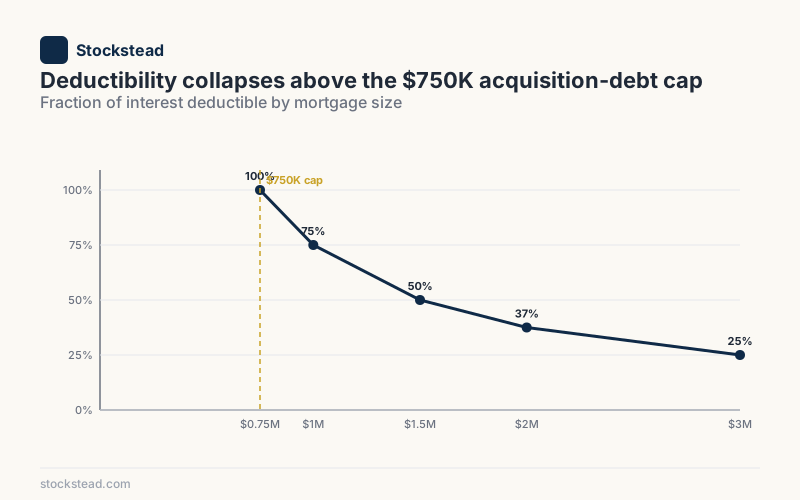
| $750,000 | $55,189 | 100% | $19,316 | $4,967 | 4.14% |
| $1,000,000 | $73,585 | 75.3% | $19,399 | $4,988 | 4.94% |
| $1,500,000 | $110,378 | 50.2% | $19,399 | $4,988 | 5.76% |
| $2,000,000 | $147,170 | 37.7% | $19,399 | $4,988 | 6.17% |
| $3,000,000 | $220,756 | 25.1% | $19,399 | $4,988 | 6.57% |
The pattern is striking. At $750K, the after-tax effective rate is 4.14%, well below the 7.00% prime rate. At $3M, it climbs past 6.5%, within 82 basis points of the 7.39% headline. On Oct 8, 2026, SBLOC quotes on a $1M draw ran from 4.93% at IBKR Pro to 6.77% at Schwab PAL (list), so at $3M every one of those venues except Schwab's list rate is cheaper than the jumbo's after-tax cost, and at $2M IBKR Pro and Morgan Stanley are cheaper while Fidelity is roughly even. Current quotes: 4.93% to 6.77% as of October 8, 2026, with the jumbo average at 7.39%.
The "mortgage is cheap" intuition that HNW borrowers carry into a home purchase comes from the world where the deduction applied to most of the loan. Above the cap, the marginal cost of additional mortgage debt is pretax, the full 7.39% in this example.
Why This Reshapes the SBLOC Comparison
The examples in this section assume a 7.39% jumbo (the MBA average for the week of Oct 2, 2026) and the $1M-draw SBLOC quotes of Oct 8, 2026: 4.93% at IBKR Pro, 5.40% at Morgan Stanley (a fixed promotional rate), 6.22% at Fidelity, and 6.77% at Schwab PAL (list). The answer depends on which lender you use.
The standard analysis assumes a fully-deductible mortgage. With that assumption, a 7.39% jumbo at a 37% federal bracket has an after-tax cost of about 4.80% (35% federal after the Section 68 limit), cheaper than every SBLOC quote above, though only by 13 basis points against IBKR.
Run the analysis with the actual deductibility math on a $2M jumbo and the picture changes. The year-one after-tax rate is about 6.17% for a buyer who already itemizes, and about 6.59% if SALT at the $10,000 floor is their only other deduction. That makes the SBLOC cheaper at IBKR Pro and Morgan Stanley by roughly 75 to 165 basis points, roughly even with Fidelity, and more expensive only at Schwab's list rate. The SBLOC also has zero capital gains drag from any down payment liquidation. What it does not have is a fixed rate (Morgan Stanley's promo aside) or protection from margin calls.
For a buyer above $1.5M of mortgage debt, the marginal cost of borrowing more in jumbo form is the full 7.39%, which is now above every broker SBLOC quote we track. This is the math that makes hybrid structures, a jumbo up to $750K plus SBLOC for the rest, compelling on the right facts.
The Hybrid Structure That Captures the Cap
A strong structure for a $2M+ home purchase with a sizable taxable portfolio often looks like:
- Take a jumbo mortgage of exactly $750,000. Every dollar of interest is deductible.
- Fund the remainder of the home from a combination of cash savings and SBLOC drawn against the portfolio.
- The jumbo provides cheap, fully-deductible permanent financing for the maximum tax-advantaged size.
- The SBLOC provides flexible, non-amortizing financing for the portion above the deduction cap.
Worked example: $2M home purchase by a buyer with $250K cash savings, 37% federal plus 9% state, already itemizing. It assumes a 7.39% jumbo (the MBA average for the week of Oct 2, 2026) and the $1M-draw SBLOC quotes of Oct 8, 2026.
- Down payment from cash: $250K.
- Jumbo mortgage: $750K (fully deductible, sized to the cap).
- SBLOC draw: $1M, interest-only.
Year-one jumbo cost: $55,189 of interest, all deductible, so $24,283 of federal-plus-state benefit at 44% (35% federal after the Section 68 limit, plus 9% state) and a net cost of $30,906. Compare that to a single $1.75M jumbo at 7.39%: $128,774 of year-one interest, about 43.0% of it deductible, for a net after-tax cost of $104,387 (5.99%).
| SBLOC venue (rate on $1M) | Hybrid year-one after-tax cost | Blended rate on $1.75M | Year-one saving vs single jumbo | 10-year saving |
|---|---|---|---|---|
| IBKR Pro (4.93%) | $80,206 | 4.58% | $24,181 | $188,639 |
| Morgan Stanley (5.40% fixed promo) | $84,906 | 4.85% | $19,481 | $141,639 |
| Fidelity (6.22%) | $93,106 | 5.32% | $11,281 | $59,639 |
| Schwab PAL list (6.77%) | $98,606 | 5.63% | $5,781 | $4,639 |
The hybrid wins at every venue at these rates, but the size of the win ranges from trivial to meaningful. Break-even is an SBLOC rate of about 6.82%. Schwab's tier for draws between $500K and $1M (SOFR + 3.40%, or 7.27% on Oct 8, 2026) would lose to the single jumbo, as would any SBLOC whose floating rate rises about 190 basis points from IBKR's current level. The 10-year figures hold the SBLOC rate flat and keep the SBLOC balance at $1M; the single jumbo also retires about $134K more principal over those ten years, which is a balance-sheet difference, not a cost. The savings do not change if SALT is your only other deduction, because both structures clear the standard deduction by the same amount.
State Rules That Modify the Cap
The federal cap is $750K, but several states use different limits:
- California: allows mortgage deduction on up to $1,000,000 of acquisition indebtedness. Higher than federal. Improves the after-tax cost on $750K–$1M jumbos.
- New York: generally conforms to federal but with its own AMT-like adjustments. Effective treatment can be more restrictive.
- Texas, Florida, Washington, Tennessee, Nevada: no state income tax, so the federal cap is the only one that matters. After-tax cost on big jumbos is correspondingly higher because there is no state benefit on the deductible portion.
For a borrower in California with an $850K mortgage, the federal deduction applies to the first $750K and the California deduction applies to all $850K. At a 7.39% rate and a 9% state rate, the state-only benefit on the $100K above the federal cap adds about $640 of tax savings in year one.
These adjustments are small relative to the federal benefit but worth modeling correctly.
The Refinance Trap
A specific situation that catches HNW borrowers: you have an old $1.0M mortgage originated before December 15, 2017, with $1M of deductible indebtedness under the older cap. You refinance to take advantage of lower rates.
If the refinance amount equals or is less than the existing balance, the old $1M cap is grandfathered — you keep the higher deduction limit on the new loan.
If the refinance amount exceeds the old balance — even by a dollar — the loan is treated as a new origination subject to the $750K cap, and you lose the $250K of additional deductibility on the existing balance.
This grandfathering rule is a real planning consideration. A homeowner with a grandfathered $950K mortgage should think carefully before refinancing for cash-out at $1.1M; the loss of grandfathered status can be more expensive than the rate savings.
The Charitable Deduction Interaction
For high-income HNW borrowers, the mortgage interest deduction is one of the larger itemized deductions on the return. It interacts with the SALT cap, charitable deductions, and other Schedule A items.
The SALT cap changed in 2025. The One Big Beautiful Bill Act raised it to $40,400 for 2026, rising 1% a year, but it phases down by 30% of modified AGI above $505,000 to a $10,000 floor, reached at about $606,333 of MAGI, and reverts to $10,000 for everyone in 2030. A household with $250K to $505K of MAGI gets the full cap. A household in the 37% bracket assumed in this post is past the floor, so its SALT deduction is still effectively $10,000.
The standard deduction in 2026 is $32,200 for married filing jointly. To get any benefit from the mortgage interest deduction, your total itemized deductions must exceed it. For a top-bracket buyer whose only other itemized deduction is $10,000 of SALT, the first $24,040 or so of deductible mortgage interest simply replaces the standard deduction (the $22,200 gap, plus about $1,840 because the Section 68 limit also trims the itemized total), which costs $8,414 a year of federal benefit. On the $2M example above, that moves the year-one after-tax rate from 6.17% to 6.59%.
For HNW buyers with significant charitable giving on top of SALT and mortgage interest, itemizing is virtually always the better choice, and the full federal rate applies to each dollar of deductible interest, 35% rather than 37% in the top bracket after the Section 68 limit. Run the full Schedule A in any scenario analysis.
How This Changes the Decision Framework
The pre-2018 assumption was: "Mortgage interest is fully deductible at marginal rate. Get the biggest mortgage you can comfortably service and use the cheap money." This is no longer the right heuristic for HNW buyers.
The post-2017 framework, now permanent, should be:
- Size the mortgage to the $750K cap when possible — that is the cheapest dollar of debt you can carry.
- For amounts above $750K, evaluate whether the marginal cost of additional jumbo (pretax) is cheaper than alternatives (SBLOC, HELOC, cash from portfolio).
- Consider hybrid structures that combine a $750K-sized jumbo with another financing source for the excess, and price the excess at your actual SBLOC quote. At a 7.39% jumbo, the hybrid's edge ranges from trivial at Schwab's list rate to six figures over ten years at IBKR.
- Run the math at your actual marginal rate, including state, against the standard deduction baseline, and at the SALT cap your MAGI actually produces.
- Account for the cap when planning future home purchases or refinances — the limit applies across all qualifying residences combined.
This framework looks more complicated than the pre-2018 version, but it produces materially better outcomes on real HNW math.
Model the Cap Correctly
Most home calculators ignore the deduction cap entirely. They either assume 100% deductibility (which overstates the mortgage advantage on big loans) or 0% deductibility (which overstates SBLOC competitiveness).
Stockstead applies the cap correctly out of the box. Mortgage interest above $750K is treated as non-deductible; below the cap, it gets the full federal-plus-state benefit. The math reflects what your return will actually look like.
Compare Your Options with Stockstead →
The $750K cap is the most underappreciated change in HNW home finance. Models that ignore it will keep producing the wrong answer.
Frequently asked questions
- What is the $750K mortgage interest deduction cap?
Under IRC Section 163(h)(3), as amended by the 2017 Tax Cuts and Jobs Act and made permanent by the One Big Beautiful Bill Act of 2025, interest on acquisition indebtedness — debt incurred to buy, build, or substantially improve a qualified residence and secured by it — is deductible only on the first $750,000 of principal balance for loans originated after December 15, 2017. The cap applies across primary and qualifying second residence combined. Loans originated on or before that date retain the older $1,000,000 cap as long as the original loan is not refinanced into a larger balance. The cap is a hard ceiling on the principal — interest above the cap is not deductible — and it is no longer scheduled to revert to $1M. Interest on home-equity debt not used to buy, build, or substantially improve the home is permanently non-deductible.
- How does the deduction cap change the after-tax cost of a jumbo mortgage?
Dramatically as the loan size grows. At a 7.39% jumbo rate (the MBA average for the week of Oct 2, 2026), a 37% federal bracket, and a 9% state allowing the deduction up to the federal cap, for a buyer who already itemizes: a $750K mortgage has a year-one after-tax rate of 4.14% because every dollar is deductible (at 35 cents federally, after the 2026 Section 68 limit on itemized deductions in the 37% bracket). A $1.5M mortgage with about 50% of interest deductible is at 5.76%. A $3M mortgage with about 25% deductible is at 6.57%. On Oct 8, 2026, $1M-draw SBLOC quotes ran from 4.93% (IBKR Pro) to 6.77% (Schwab PAL list), so above roughly $1.5M of mortgage, several SBLOC venues are cheaper than the jumbo even after tax. The 'mortgage is cheap' intuition that HNW borrowers carry into a home purchase comes from the world below the cap, not above it.
- Why does the cap make hybrid jumbo plus SBLOC structures attractive?
Because the marginal cost of jumbo debt above $750K is pretax, not after-tax. A common structure for a $2M+ home purchase: take a jumbo of exactly $750K (every dollar of interest deductible), fund the down payment from cash, and draw an SBLOC for the remainder. On a $2M home with $250K cash, at a 7.39% jumbo and Oct 8, 2026 SBLOC quotes, the hybrid ($750K jumbo + $1M SBLOC) saves $5,781 (Schwab PAL list, 6.77%) to $24,181 (IBKR Pro, 4.93%) of after-tax interest in year one versus a single $1.75M jumbo, or about $5,000 to $189,000 over a 10-year hold. Break-even is an SBLOC rate of about 6.82%; above that the single jumbo is cheaper. The SBLOC half floats with SOFR and carries margin-call risk, so the savings are not guaranteed.
- Does my state allow a higher mortgage interest deduction than the federal cap?
California allows the mortgage deduction on up to $1,000,000 of acquisition indebtedness — higher than the federal $750K cap. For an $850K mortgage in California, federal allows deduction on the first $750K and California allows deduction on all $850K; the state-only benefit on the $100K above the federal cap adds about $640 of year-one tax savings at a 7.39% rate and a 9% state rate. New York generally conforms to federal with its own AMT-like adjustments. No-income-tax states (Texas, Florida, Washington, Tennessee, Nevada) have no state benefit either way — the federal cap is the only one that matters, and after-tax cost on big jumbos is correspondingly higher.
- Will refinancing my pre-2018 mortgage cost me the grandfathered $1M cap?
Only if the refinance amount exceeds the existing balance. The grandfathering rule preserves the older $1M cap on refinances at or below the original balance. Refinance at $999K against a $1M existing balance and the $1M cap stays in place. Refinance at $1,001K — even by a single dollar — and the entire loan is treated as a new origination subject to the $750K cap. For a homeowner with a grandfathered $950K mortgage, that loss of $250K of grandfathered deductibility can outweigh the rate savings from refinancing. Worth modeling carefully before signing.
Ready to run the numbers on your situation?
Open the calculator →Related posts
Is SBLOC Interest Tax Deductible? The Rules Explained
A clear walkthrough of the tracing rules, investment interest deduction limits, and home acquisition indebtedness rules that determine whether your SBLOC interest is deductible.
Property Tax Mortgage Calculator: HNW High-Tax State Math
Property tax mortgage calculator for HNW buyers in CA, NY, NJ, MA, FL: $3M worked examples and how the 2026 SALT cap phase-down hits after-tax cost.
Mortgage Calculator for High Net Worth: Complete 2026 Guide
HNW mortgage calculator guide: jumbo PITI above $832,750, asset depletion income, after-tax rates under the $750K cap, and SBLOC vs. mortgage comparisons.