Is SBLOC Interest Tax Deductible? The Rules Explained
By Tyler Singletary · · Updated · in How it works
The most common question asked about Securities-Backed Lines of Credit for home purchases is whether the interest is tax-deductible. The answer most borrowers hear — from brokers, from social media, from a half-read article — is "it depends on how you use the money." That is technically true and practically useless.
This post walks through the three specific categories of interest deductibility under the Internal Revenue Code, explains which ones an SBLOC can fall into, and lays out the specific documentation and tracing moves that determine whether the interest you paid on a six-figure line actually makes it onto your Schedule A.
Before we start: this is not tax advice. The rules are complex, the IRS has not issued definitive guidance on every SBLOC edge case, and the deduction math interacts with your specific return. Talk to a tax advisor before filing.
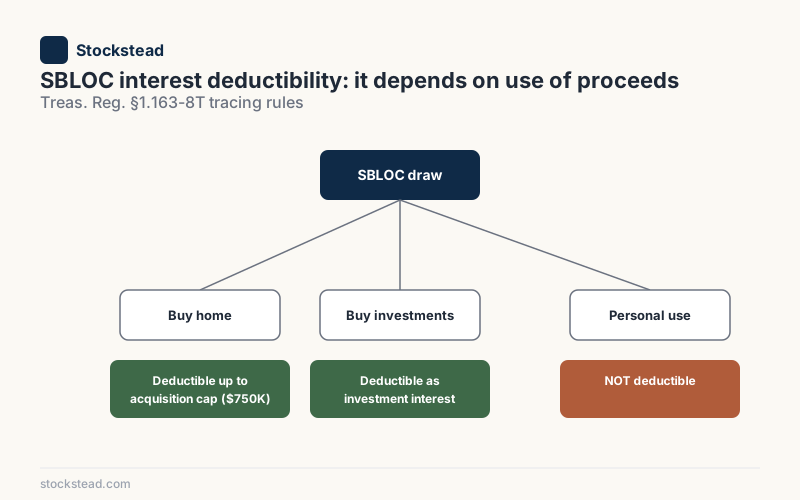
The Three Categories of Deductible Interest
Under current law, interest paid on an individual's debt falls into one of four categories. Three are potentially deductible; one is not.
Home mortgage interest under IRC Section 163(h)(3). Deductible for a primary residence and one secondary residence, on up to $750,000 of acquisition indebtedness (for loans originated after December 15, 2017). Subject to the overall $750K cap and the requirement that the loan be secured by the qualified residence.
Investment interest under IRC Section 163(d). Deductible against investment income (dividends, interest, short-term capital gains; long-term capital gains only if you elect to treat them as ordinary). Deduction is capped at the taxpayer's net investment income for the year. Excess carries forward.
Business interest under IRC Section 162/163(j). Deductible against business income if the debt is properly allocated to a trade or business. Subject to the 163(j) limitations on business interest for larger taxpayers.
Personal interest under IRC Section 163(h)(1). Not deductible. Credit card interest, car loans, and personal use of a line of credit all fall here.
An SBLOC used to fund a home purchase can in theory fall into any of these categories, depending on how the loan is structured and documented. The default category — if nothing else is done — is personal interest, which is not deductible.
Why SBLOC Interest Is Not Mortgage Interest
The first instinct for most home buyers is: "I borrowed to buy a home, so the interest is mortgage interest." This is wrong and expensive to get wrong.
To qualify as home mortgage interest under 163(h)(3), the debt must be secured by the qualified residence. "Secured by" means a recorded mortgage or deed of trust on the home that gives the lender a perfected interest.
An SBLOC is secured by your portfolio, not your home. There is no recorded mortgage. The lender has no interest in the property. The debt therefore cannot qualify as acquisition indebtedness regardless of what the proceeds were used for. (For the underlying mechanics — what "secured by the portfolio" actually means for advance rates, LTV, and margin-call risk — see how an SBLOC actually works.)
A borrower who assumes their SBLOC interest is mortgage interest and deducts it on Schedule A is taking an undefensible position. On audit, the deduction will be disallowed, penalties may apply, and the borrower will owe the tax plus interest on the underpayment.
This is the single most common mistake in the HNW SBLOC space. Do not make it.
Tracing Rules: The Key to Any Deduction
If the interest is not mortgage interest, the only path to deductibility runs through the tracing rules under Treasury Regulation §1.163-8T. The tracing rules determine the classification of interest based on how the proceeds of the debt are used.
The mechanics:
- The proceeds of a loan are traced to a specific use.
- The interest on the loan is classified according to that use.
- If a loan is used for multiple purposes, the interest is allocated proportionally based on the uses.
If you draw $500K from an SBLOC and use it to buy stocks, the interest on that $500K is investment interest (category 163(d)) because the proceeds were used to acquire investment property.
If you draw $500K from an SBLOC and use it to buy a home, the interest on that $500K is personal interest (not deductible) because the proceeds were used for personal purposes.
If you draw $500K and wire $300K to closing for a home purchase and $200K to buy ETFs, the interest is allocated 60/40 — 60% personal, 40% investment.
This is why the sound-bite answer "it depends on how you use the money" is technically correct. The use determines the classification.
The Sophisticated Tracing Play
Some borrowers with good advisors use a tracing structure to convert otherwise non-deductible SBLOC interest into deductible investment interest. The move:
- Open the SBLOC and draw the full amount needed for the home purchase.
- Wire the SBLOC proceeds to a separate investment account.
- Simultaneously wire cash from a different account to the home closing.
The SBLOC proceeds were used to acquire investment property (the new investments). The interest on the SBLOC is therefore investment interest under 163(d), subject to the net-investment-income limitation.
This is aggressive. It works only if the tracing is clean — the SBLOC proceeds must be identifiably used for investment purposes, and the cash used for the home must come from an independent source. Commingling defeats the tracing.
It also requires that the borrower have enough net investment income to absorb the deduction. If you have $60K of dividends and $80K of SBLOC interest, $20K of the interest carries forward — you cannot deduct it in the current year.
Finally, the structure requires reasonable business-purpose substance. If the IRS concludes the arrangement exists solely to convert non-deductible personal interest into deductible investment interest, they can challenge the tracing under general tax principles. The defense is that the SBLOC genuinely funded new investments, not that you moved money around to dress up the paperwork.
Talk to a tax advisor before attempting this. The structure works, but the execution has to be clean.
When SBLOC Interest Clearly Is Deductible
Three scenarios where the deduction is unambiguous:
Investment purchase. You draw on the SBLOC and buy securities. Interest is investment interest, deductible against net investment income. Straightforward.
Trade or business use. You draw on the SBLOC and fund an active trade or business. Interest is business interest, deductible on Schedule E, Schedule C, or against partnership/S-corp income depending on the structure. This requires genuine active-business substance.
Rental real estate. You draw on the SBLOC and buy a rental property. Interest is allocable to the rental activity and deductible against rental income on Schedule E. This is the one way the "home" use actually can produce a deduction — but only if it is a rental, not a primary residence.
The State Tax Wrinkle
Most states conform to the federal interest deductibility rules, but with variations. A few that matter:
- California does not conform to the federal $750K mortgage interest cap. California still allows deductions on up to $1M of acquisition indebtedness. This widens the gap between state and federal treatment but does not change SBLOC classification — interest still needs to meet the state's definition of deductible interest.
- New York conforms more closely to federal rules but has its own quirks on investment interest limitations.
- States with no income tax (Texas, Florida, Washington, etc.) obviously have no state deduction to worry about, which makes the federal calculus the whole game.
If you are in a high-tax state, the federal deduction analysis is more valuable because the state treatment typically follows. If you are in a no-tax state, a deduction saves you roughly 35% (federal only), even in the top bracket: under OBBBA's new IRC Section 68 limit, starting in 2026 a 37%-bracket filer loses 2/37 of the smaller of their itemized deductions or their taxable income above the 37% threshold ($768,700 joint, $640,600 single), so once income clears that threshold by at least the itemized total, each deducted dollar saves 35%, not 37%. That limit applies to itemized deductions generally, so it caps mortgage interest and investment interest under 163(d) alike. In California, the combined rate can push the value close to 50%.
Practical Documentation Requirements
To defend any SBLOC interest deduction on audit, you need:
- Loan documents. Copy of the SBLOC agreement and any amendments.
- Draw records. Statements showing the amount and date of each draw.
- Use tracing. Wire confirmations, closing statements, or purchase records showing where each draw's proceeds went.
- Allocation math. If the line has been used for multiple purposes, a clean schedule showing the allocation of each month's interest across the use categories.
- Interest statements. Annual interest summaries from the lender.
If you are planning to deduct SBLOC interest — especially if you are attempting an investment-interest tracing structure — build the documentation habit from the first draw. Reconstructing tracing after the fact is difficult and often fails on audit.
How This Affects the Home-Purchase Math
For most HNW borrowers using an SBLOC to fund a home purchase, the interest is not deductible. Full stop. This is the working assumption for Stockstead's calculator and for any realistic modeling of the strategy.
Assuming non-deductibility changes the after-tax cost comparison meaningfully. Take an illustrative SBLOC at 6.5% interest. For reference, published $1M rates as of October 8, 2026 included 4.93% at IBKR Pro margin and 6.77% for Schwab's PAL at list price (see the SBLOC rates at Schwab, Fidelity, IBKR, and Morgan Stanley), and the 30-year fixed averaged 7.40%. Fully non-deductible, the 6.5% SBLOC costs the borrower the full 6.5%. A traditional mortgage at the same illustrative 6.5%, with most interest falling within the $750K deductible cap, costs the borrower roughly 4.2% after-tax at a 37% federal bracket, with the deduction worth 35% after the Section 68 limit (ignoring state for simplicity).
The apples-to-apples comparison is not SBLOC rate vs. mortgage rate. It is SBLOC rate vs. after-tax mortgage rate, layered against the cost of liquidating to pay cash. A borrower who misses this adjustment will systematically overstate the SBLOC's advantage.
Stockstead models this correctly out of the box. The mortgage scenario applies the interest deduction up to the cap; the SBLOC scenario treats the interest as non-deductible personal interest. You can override both assumptions if your situation is different.
The Bottom Line
For a standard HNW home purchase using an SBLOC:
- The interest is not mortgage interest. Do not claim it as such.
- The interest is not automatically investment interest. Tracing determines classification.
- Used for a personal residence with no tracing structure, the interest is personal interest and not deductible.
- With a sophisticated tracing structure and a tax advisor who understands the rules, some borrowers successfully convert the interest to investment interest — but this requires careful execution and documentation.
For the honest model of the cost, assume the interest is not deductible and size the SBLOC accordingly. If your tax advisor can deliver a clean tracing structure, that is incremental upside — treat it as a bonus, not a baseline.
Model the Real After-Tax Cost
Stockstead applies the correct tax treatment to each scenario: mortgage interest deductibility up to the cap, SBLOC interest non-deductible by default, and an override toggle if your tax advisor has delivered a tracing structure.
Compare Your Options with Stockstead →
The deductibility question is the difference between a 4% effective mortgage and a 6.5% effective SBLOC. Don't leave it to vibes.
Frequently asked questions
- Is SBLOC interest tax-deductible when used for a home purchase?
Generally no. Without a sophisticated tracing structure, SBLOC interest used to fund a personal residence is classified as personal interest under IRC Section 163(h)(1) and is not deductible. The instinct to treat it as mortgage interest because the proceeds bought a home is wrong — and an expensive mistake to make on a return. For a standard HNW home purchase, the working assumption should be that the SBLOC interest is fully non-deductible. Anything else requires careful execution with a tax advisor and is incremental upside, not a baseline.
- Why is SBLOC interest not considered mortgage interest?
Because mortgage interest under IRC Section 163(h)(3) requires the debt to be secured by the qualified residence — meaning a recorded mortgage or deed of trust on the property that gives the lender a perfected interest. An SBLOC is secured by your pledged investment portfolio, not your home. There is no recorded mortgage on the property. The lender has no legal interest in the real estate. The debt therefore cannot qualify as acquisition indebtedness regardless of what the proceeds were used for. A borrower who deducts SBLOC interest on Schedule A is taking an undefensible position on audit.
- Can I make SBLOC interest deductible through tracing rules?
Sometimes, with care. Treasury Regulation §1.163-8T classifies interest based on how the loan proceeds are used. The sophisticated play: draw the SBLOC and wire the proceeds to an investment account to acquire new securities, then fund the home closing from a different cash source. If the tracing is clean, the SBLOC interest becomes investment interest under Section 163(d), deductible against net investment income. The structure works but requires genuine investment substance, separate cash flows that do not commingle, and enough net investment income to absorb the deduction. Carrying excess interest forward is allowed.
- What documentation do I need to deduct SBLOC interest?
Five categories at minimum. The SBLOC agreement and any amendments. Statements showing the date and amount of each draw. Wire confirmations, closing statements, and purchase records tracing each draw's proceeds to a specific use. A clean allocation schedule if the line was used for multiple purposes, splitting each month's interest proportionally across the use categories. Annual interest summaries from the lender. The IRS expects documentation that lets them trace every dollar of interest to a specific deductible category. Reconstructing tracing after the fact is difficult and frequently fails on audit, so build the habit from the first draw.
- How does interest deductibility change the SBLOC vs mortgage comparison?
Substantially. For example, a traditional mortgage at 6.5% with most interest falling within the $750K deductible cap costs roughly 4.2% after-tax at a 37% federal bracket, where the 2026 limit on itemized deductions makes each deducted dollar worth 35 cents. The same nominal 6.5% rate on an SBLOC — non-deductible by default — costs the full 6.5%. The apples-to-apples comparison is not SBLOC rate versus mortgage rate. It is SBLOC rate versus the after-tax mortgage rate, then layered against the cost of liquidating to pay cash. Borrowers who skip the after-tax adjustment systematically overstate the SBLOC's advantage.
Ready to run the numbers on your situation?
Compare SBLOC vs HELOC after tax →Related posts
Schwab Pledged Asset Line for a Home Purchase: When It Wins, the Process, and the Rate Schedule
When a Schwab Pledged Asset Line beats a jumbo or IBKR margin for a home purchase: the application process, the two LTVs that govern safety, and a worked $1M example.
The $750K Mortgage Interest Deduction Cap for HNW
The $750K mortgage interest cap, now permanent, is why a $2M jumbo costs more than buyers expect. How to model it, SALT phase-down included.
SBLOC vs Mortgage vs Cash: The Complete HNW Guide
Four ways to fund a $300K down payment from a $2M portfolio, the 10-year math on each at current rates, and the failure mode standard mortgage calculators hide.