Tax-Loss Harvesting Before a Home Purchase: Playbook
By Tyler Singletary · · Updated · in Tax & deductions
Most HNW home-buying guidance focuses on the financing side: jumbo vs. SBLOC, cash vs. bridge, deductible vs. non-deductible. The tax side gets less attention — and that's where some of the largest preventable costs show up. If you are planning to liquidate taxable investments to fund a home purchase, the tax-loss harvesting pass you run in the 6–12 months before you sell is often worth more than 50 bp of rate shopping.
This post is the specific playbook. What to harvest, when to harvest it, how to avoid the wash-sale traps, and how to coordinate the harvest with the liquidation schedule so the offset lands in the right year. For the broader HNW financing landscape this playbook plugs into — jumbos, SBLOCs, hybrid structures — see our complete guide to high net worth home buyer financing.
Why Harvesting Matters More Before a Home Sale
Normal tax-loss harvesting runs on autopilot: you harvest through the year, bank the carryforward, and use up to $3,000 of ordinary-income offset annually. The losses that exceed the $3K cap carry forward indefinitely and eventually get used up against future gains.
When you are about to realize a large capital gain — exactly what happens when you liquidate portfolio assets for a down payment — the math changes. Every dollar of realized loss offsets a dollar of realized gain, dollar for dollar. There is no cap. A $300K loss harvested in year 1 fully cancels a $300K gain realized on liquidation in year 1.
For an HNW buyer liquidating $500K–$1M of appreciated positions, a well-executed harvest can shelter a meaningful slice of the gain. At a 30% combined federal-plus-state rate on long-term gains, every $100K of harvested loss is worth $30K of tax savings. It adds up fast.
The Timing Rule
The offset has to land in the same tax year as the gain. If you sell the house in June 2026 and realize $400K of gain funding the down payment, the losses you harvest have to be recognized in 2026 as well. A loss harvested in 2025 that carries forward into 2026 works; a loss harvested in 2027 does not.
This has a direct implication for planning: start the harvest pass at least 6 months before the planned liquidation. That window gives you time to:
- Identify harvestable positions in your portfolio.
- Execute sales in an orderly way without tax-tail-wagging-dog.
- Navigate wash-sale rules if you want to maintain the same economic exposure.
- Reassess at the end of the year and pull more losses if needed.
Starting the harvest pass two weeks before the liquidation is too late. You will be forced to sell at whatever prices exist at that moment and you will not have time to manage the wash-sale clock.
What Qualifies for Harvesting
A capital loss is realized when you sell an asset below its cost basis. The asset has to be held in a taxable account — losses inside an IRA or 401(k) are meaningless for this purpose.
Typical harvesting candidates:
- Individual stocks that have dropped below your purchase price. Look at every position with an unrealized loss, even modest ones.
- Recently-purchased ETFs or mutual funds that are currently below cost.
- Positions acquired in tax lots at high prices (particularly DCA-style purchases during a market peak).
- Bond positions trading at prices below par when interest rates have risen.
- International or sector ETFs that have underperformed.
A well-managed portfolio at 37 years old probably has dozens of individual tax lots, many of which are underwater while the position as a whole is profitable. Harvesting requires selling the specific underwater lots — this is the "specific identification" method — and leaving the appreciated lots alone.
The Wash-Sale Trap
The IRS imposes a wash-sale rule that disallows a loss if you acquire "substantially identical" securities within 30 days before or after the sale. If you sell AAPL at a loss on June 1 and buy AAPL back on June 15, the loss is disallowed and is instead added to the basis of the replacement shares.
The wash-sale rule applies across all accounts owned by you and your spouse, including IRAs and 401(k)s. A sale in your taxable account followed by an automated purchase in your IRA within 30 days disallows the loss. Worse, the disallowed loss is added to the IRA basis, which is effectively lost forever because IRA distributions are taxed as ordinary income regardless of cost basis.
The rule applies to "substantially identical" — which for individual stocks means the same ticker. For ETFs, the interpretation is fuzzier but practically: the same ETF is substantially identical; different ETFs tracking the same index are often treated as substantially identical in the current enforcement environment; different ETFs tracking similar-but-distinct indexes are generally safe.
Maintaining Economic Exposure Through a Harvest
The most common wash-sale workaround for HNW investors is to sell the specific underwater position and immediately buy a similar-but-not-identical replacement. This maintains your portfolio's equity exposure while crystallizing the loss.
Common substitution pairs that most practitioners treat as non-identical:
- SPY (S&P 500) → VOO (S&P 500) — these may be risky; many advisors consider them identical.
- SPY → IVV (S&P 500) — same risk as above.
- SPY → VTI (Total US Market) — different underlying index; generally safe.
- VTI → SPTM (Total Market) — different index family; generally safe.
- QQQ → Technology Select Sector SPDR (XLK) — different index construction; generally safe.
- VXUS (Total Intl) → IXUS (Total Intl) — same issue as S&P 500 ETFs.
- VWO (Emerging Markets) → IEMG (Emerging Markets, different index) — generally safe.
For individual stocks, the only clean substitution is a related company in the same sector. Selling AAPL and buying MSFT is not a wash sale; selling AAPL and buying an Apple preferred or convertible is likely a wash sale.
The safest approach: sell the loss, wait 31 days, buy back the original. You accept 31 days of market exposure to a slightly different position (or no position) in exchange for a clean loss recognition.
How Much Can You Realistically Harvest?
The answer depends on portfolio composition and market history. Rough heuristics:
In a bull market with no recent correction: a well-managed portfolio might have 5–15% of its value in positions with unrealized losses. On a $2M portfolio, that is $100–300K of potential harvest.
After a recent correction (like 2022 or any 10%+ drawdown): harvesting potential rises to 20–40% of portfolio value. On a $2M portfolio, $400K–$800K of harvestable losses is realistic.
During a sustained bear market: harvesting can cover nearly the full gain on a liquidation. The irony is that bear markets also hurt the portfolio you are not liquidating, which is why the offset is so valuable.
The practical implication: harvesting opportunity is correlated with market dislocation. If you are planning a home purchase during or shortly after a correction, the offset math is particularly compelling. If you are buying at a market peak after a long bull run, there may be less to harvest.
The Coordination Problem
The harvest pass and the liquidation need to be planned together, not in isolation.
Step 1: Identify all the positions you need to liquidate for the down payment. These are your "gain-side" trades.
Step 2: Identify all the harvestable loss positions in the portfolio. These are your "loss-side" trades.
Step 3: Match losses to gains by tax year. The total losses you harvest should be at or below the total gains you realize. Harvesting losses far in excess of gains wastes the offset — the excess carries forward and gets used at $3K/year for ordinary income, which is much less valuable than offsetting future capital gains.
Step 4: Execute the harvest trades 31+ days before the liquidation trades to avoid wash-sale issues and to allow the market to settle.
Step 5: Execute the liquidation trades at the same prices as planned.
Step 6: At year-end, review the realized gain/loss and decide whether to harvest additional losses before December 31 to fine-tune the balance.
A Worked Example
Buyer planning a $2M home purchase in June 2026. Needs $400K for down payment from portfolio. Cost basis on the $400K target lot is $200K, so $200K of unrealized gain.
Portfolio at start of 2026: $3M total. Positions with unrealized losses total $180K across 8 individual stocks and 3 ETFs.
Harvest pass, January–March 2026:
- Sell the $180K of loss positions (gross losses of $180K).
- Simultaneously buy replacement ETFs for equity exposure to avoid market risk during the waiting period.
- Wait 31 days, buy back the original positions if desired.
Liquidation, June 2026:
- Sell $400K of appreciated positions. Realized gain: $200K.
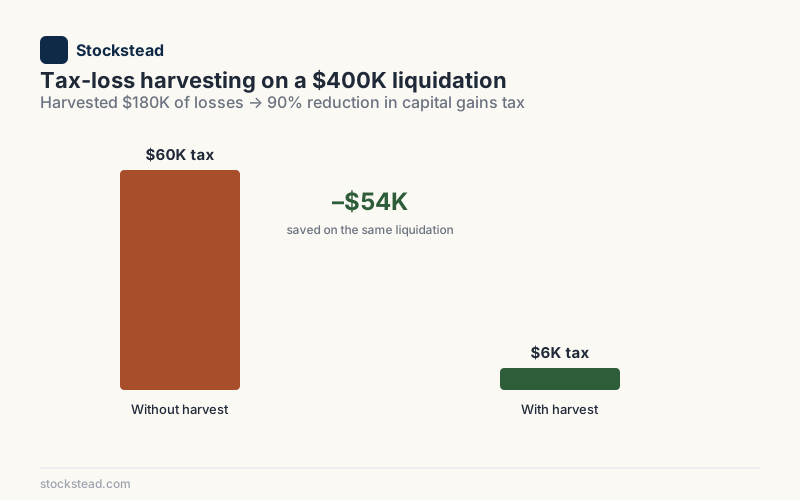
Net 2026 capital gain: $200K − $180K harvested losses = $20K net gain.
Tax on $20K net gain at 30%: $6,000.
Compare to: liquidate $400K without harvest. Realized gain: $200K. Tax at 30%: $60,000.
Tax savings from the harvest: $54,000.
The harvest took a few hours of analyst work plus a few trades. It saved more money than the buyer would save by rate-shopping their jumbo for 6 months.
The Charitable Giving Twist
If you have highly appreciated positions you intend to donate anyway, the math shifts. Rather than sell a position to fund a down payment (realizing the gain), sell a loss position and gift the appreciated position to a donor-advised fund (DAF). The DAF sells the position tax-free and you get the full fair-market-value deduction.
Applied to a home-purchase context: harvest all the losses you can, then use the resulting tax-offset capacity to sell the gains you need for the down payment. Separately, gift the most appreciated lots to a DAF to use up your annual charitable deduction at full value. The combined effect is the same down-payment funding with less of your wealth lost to taxes.
This is only worth doing if you were going to make the charitable contribution anyway. The DAF path is not a way to generate a tax advantage out of thin air — it only works if the dollars are truly going to charity.
Common Mistakes
Harvesting in an IRA. Losses in IRAs are meaningless for this purpose. They do not offset capital gains elsewhere. Don't bother.
Violating the wash-sale rule across accounts. Check your spouse's accounts. Check your IRA auto-investment schedule. Check your employer-sponsored 401(k) rebalancing. The rule applies across all of these. A 401(k) target-date fund that includes AAPL is not a wash-sale concern because it holds thousands of stocks, but an automated purchase of a sector ETF or a specific stock in an IRA is.
Harvesting too close to the liquidation. The 31-day clock must clear before you can restart the original position. If you harvest on May 15 and liquidate on June 1, you are mid-wash-period and complications arise.
Harvesting without a plan. Realizing $500K of losses to offset $200K of gains wastes $300K of offset capacity. Match the harvest to the actual gain you expect to realize.
Not using specific identification. Your broker defaults to average-cost or FIFO for some account types. You must elect "specific identification" to pick the specific tax lot you want to sell. Make sure your broker has this election on file before the trade.
Short-term losses paired with long-term gains. Short-term losses first offset short-term gains, and then excess offsets long-term gains. If you are realizing long-term gains on the liquidation, short-term harvested losses are a less-efficient offset (because short-term losses are more valuable — they would otherwise offset short-term gains at ordinary rates). Prefer long-term loss harvesting when possible.
When TLH Does Not Help
Not every scenario benefits from an aggressive harvest pass:
Low or zero embedded losses. If you have been investing in the same low-cost index fund for 15 years during a strong market, you may have no positions with unrealized losses. Nothing to harvest.
Very small liquidation. If you are liquidating $50K and expect $10K of gain, the harvest effort may cost more in transaction friction and tracking complexity than it saves.
Already at the $0 long-term capital gains bracket. If your income is low enough that you are paying 0% on long-term gains (a rare situation for HNW buyers, but possible in a sabbatical year or a carried-interest gap year), harvesting losses is actively bad because it wastes them against a 0% tax rate.
Inherited portfolio with full step-up. If the portfolio was inherited recently and has stepped-up basis on most positions, there is little or no gain to realize on a sale. No harvest needed because no tax bill.
You choose to borrow instead of sell. An SBLOC sidesteps the realized-gain problem entirely — the portfolio stays whole and you draw against it. For the underlying mechanics, see how an SBLOC actually works; for the cost picture today, the 2026 lender-by-lender rate breakdown across Schwab, Fidelity, IBKR, and Morgan Stanley is the right starting point. This is a different problem shape — interest cost vs. realized-gain cost — and the right answer depends on the after-tax math against your specific portfolio.
How to Execute
The basic operational playbook:
- Pull a cost-basis report from each taxable account that shows all open tax lots and their current unrealized gain/loss.
- Sort lots by unrealized loss (largest loss first).
- Identify the top 10–20 loss lots and verify they are legitimate harvesting candidates (no wash-sale restrictions, no pending announcement, etc.).
- Decide on replacement positions for each to maintain market exposure through the 31-day waiting window.
- Execute the harvest trades in a single session to minimize market movement.
- Mark the calendar: no repurchases of original positions until day 31+.
- On day 31+, repurchase the originals or keep the replacements depending on preference.
- Track the aggregate realized loss and compare against planned liquidation gains.
- In November, reassess and execute an additional harvest pass if needed to fine-tune.
This takes 4–6 hours of focused time for a typical HNW portfolio. It is one of the highest-ROI activities you can perform in the months before a home purchase.
Run the Full Scenario
The right way to plan a home purchase funded from a taxable portfolio is to model the liquidation and the harvest together. Stockstead's scenario builder supports both sides: specify the liquidation target, the harvestable loss pool, and the tax year the transactions land in, and see the after-tax cost with and without the harvest.
Plan Your Purchase with Stockstead →
A disciplined harvest pass is one of the biggest preventable savings on any HNW home purchase. If you are inside 12 months of the purchase, start now.
Frequently asked questions
- How much can tax-loss harvesting save on a home down payment liquidation?
On a $400K liquidation with $200K of realized gain at a 30% combined rate, a buyer with $180K of harvestable losses can shelter nearly the entire gain. Net capital gain after offset: $20K. Tax at 30%: $6,000 — versus $60,000 without the harvest. That is a $54,000 savings from a few hours of analyst work plus a handful of trades. The harvest pass is often worth more in tax savings than six months of rate-shopping your jumbo mortgage. The offset is dollar-for-dollar — every $1 of realized loss cancels $1 of realized gain in the same tax year.
- What is the wash-sale rule and how does it affect harvesting?
The IRS disallows a capital loss if you acquire substantially identical securities within 30 days before or after the sale. The disallowed loss is added to the basis of the replacement shares rather than being deductible immediately. The rule applies across all accounts you and your spouse own, including IRAs and 401(k)s — an automated purchase of the same stock in an IRA within 30 days of a taxable-account sale disallows the loss, and worse, the disallowed loss is added to the IRA basis where it is effectively lost forever because IRA distributions are taxed as ordinary income.
- When should I start the harvest pass before a home purchase?
At least 6 months before the planned liquidation, ideally 12. That window gives you time to identify harvestable positions across all tax lots, execute sales in an orderly way without tax-tail-wagging-dog, navigate the 31-day wash-sale clock if you want to maintain the same economic exposure, and reassess at year-end to fine-tune the offset. Starting the harvest pass two weeks before the liquidation is too late — you will be forced to sell at whatever prices exist at that moment and you will not have time to manage wash-sale rules cleanly.
- Can I harvest losses in my IRA or 401(k) to offset capital gains?
No. Losses inside an IRA or 401(k) are meaningless for offsetting capital gains in your taxable accounts — the tax-deferred wrapper means realized losses inside the account produce no tax benefit. Worse, automatic investments inside your IRA or 401(k) can trigger wash-sale violations against your taxable-account harvest trades and disallow the loss. Check your spouse's accounts, IRA auto-investment schedules, and 401(k) target-date fund composition before harvesting. Target-date funds holding thousands of stocks are generally not a wash-sale concern; sector ETFs or individual stocks in tax-deferred accounts are.
- Which ETF substitutions are safe under the wash-sale rule?
Different ETFs tracking different indexes are generally safe — SPY to VTI (S&P 500 to Total Market) works because the underlying indexes are different. Different ETFs tracking the same index are likely treated as substantially identical in current enforcement: SPY to VOO, SPY to IVV (all S&P 500) are risky. Different index families are generally safe — VTI to SPTM (different total-market indexes), QQQ to XLK (different technology constructions), VWO to IEMG (different emerging markets indexes). The safest approach is to sell the loss, wait 31 days, then buy back the original — accepting 31 days of exposure to a slightly different position.
Ready to run the numbers on your situation?
Calculate the tax cost of selling your stock →Related posts
Capital Gains Tax on Home Down Payments Explained
Federal LTCG, NIIT, and state taxes don't add — they stack. Here's how the layers compose, what your real combined rate is by state, and the bracket math that turned my own SBLOC research from 'is this cheaper' into 'is this avoidable.'
RSUs and Buying a Home: A Tech Employee's Playbook
RSU-heavy comp creates a specific home-buying problem: paper wealth that turns into a tax bill the moment you touch it. Here's the playbook tech employees use.
Concentrated Stock + Home Purchase: Avoid a Tax Disaster
If most of your wealth is one stock, buying a home means navigating tax, diversification, and lender constraints simultaneously. Here's the playbook.