Jumbo Mortgages for HNW Buyers: When Banks Still Win
By Tyler Singletary · · Updated · in Tax & deductions
Much of the HNW home-financing conversation has shifted toward SBLOC and pledged-asset structures, and for good reason — they solve real problems that traditional mortgages can't. But the center of gravity for most $1M–5M home purchases still belongs to the jumbo mortgage. For a large majority of HNW buyers, a well-structured jumbo at the right lender is cheaper, operationally simpler, and less risky than a portfolio-backed alternative.
This post is a counterweight to the SBLOC enthusiasm. It walks through when a jumbo wins, which lenders actually serve the HNW market well, and the specific structuring moves that let a traditional mortgage outperform a portfolio-backed loan on an after-tax basis.
What Qualifies as a "Jumbo" in 2026
A jumbo mortgage is any loan above the conforming loan limit set by the Federal Housing Finance Agency. The 2026 conforming limit in most counties is $832,750. In high-cost areas (much of California, NYC metro, Seattle, DC), the limit rises to $1,249,125.
Any mortgage above these thresholds is a jumbo. Unlike conforming loans, jumbos are not eligible for Fannie Mae or Freddie Mac securitization, so they sit on the lender's balance sheet or get sold into private-label MBS channels. That distinction matters because jumbo pricing reflects the lender's own risk and funding costs rather than agency pricing.
Why Jumbo Can Beat SBLOC on Real Cost
The sound-bite comparison runs: "the SBLOC is cheaper, so the SBLOC wins." As of October 8, 2026, the 30-year jumbo average was 7.39%, and published SBLOC rates on a $1M draw ran from 4.93% at Interactive Brokers Pro margin to 6.77% at Schwab Pledged Asset Line list price. So before tax, every published line was cheaper than the average jumbo. Three adjustments close the gap or reverse the ranking, and how far they go depends on loan size. The figures below use a 7.39% jumbo, the MBA average for the week of Oct 2, 2026; check the math against your own quotes.
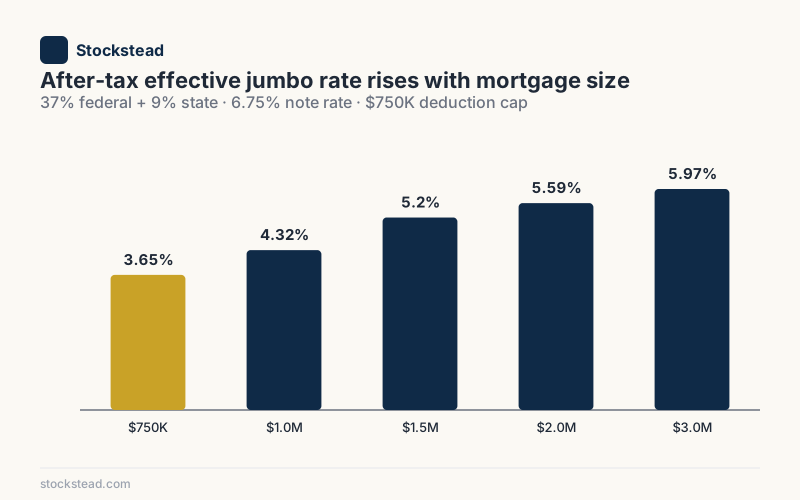
Mortgage interest deduction. Interest on up to $750,000 of acquisition indebtedness secured by a primary residence is deductible, a cap the One Big Beautiful Bill Act made permanent. For a borrower in the 37% federal bracket with a $750K mortgage, the after-tax effective rate on a 7.39% jumbo drops to about 4.80%, below every published SBLOC rate. That uses 35%, not 37%: OBBBA's new IRC §68 limit disallows 2/37 of the lesser of a top-bracket filer's itemized deductions or taxable income above $768,700 (joint; $640,600 single), so each deducted dollar is worth 35% once taxable income clears that line by the itemized total. For the portion of a mortgage above $750K, the deduction does not apply, so the blended rate climbs with size: about 6.10% on a $1.5M mortgage for that 37%-bracket buyer (5.76% if the state also allows the deduction at 9%). The deduction only helps if you itemize; with the SALT deduction at its floor for most high earners, mortgage interest has to carry the itemized total past the $32,200 joint standard deduction.
SBLOC interest is generally not deductible (see our post on SBLOC deductibility). The sticker rate is the effective rate.
On a pure after-tax basis, a 7.39% jumbo near the cap is cheaper than any published SBLOC. On a $1.5M-$2M mortgage, it beats list-priced lines like Fidelity's and Schwab's but not the cheapest margin-style pricing.
Fixed-rate certainty. Almost every jumbo offered in the HNW market is available as a 15- or 30-year fixed. Once you lock, your payment is set for decades. Almost every SBLOC is variable. Over a 10-year horizon, the cost difference between a fixed mortgage and a variable SBLOC depends on where rates go. If SOFR rises 200 bp over your hold, your SBLOC gets that much more expensive; your mortgage does not.
Zero margin call risk. This is the unpriced advantage of a mortgage. The lender does not mark your home to market daily. The lender cannot call the loan because the housing market dropped 20%. Your liquidity is protected from the forced-liquidation risk that makes SBLOC stressful in drawdowns.
The Lenders That Serve HNW Well
Not every jumbo lender is a good match for an HNW borrower. The ones that consistently deliver on price, service, and structure are a short list:
JPMorgan Chase Private Client / Private Bank. JPMorgan is typically the aggressive jumbo pricer among the large banks. Private Client relationships (which require $150K in deposits and investments) get meaningful rate concessions — typically 25–50 bp below the published jumbo rate. Private Bank clients (typically $10M+ relationships) can negotiate further.
Bank of America / Merrill Lynch. Merrill's Loan Management Account and integrated mortgage offerings are tightly coupled. The bank will offer rate concessions on the mortgage in exchange for moving investment assets to Merrill — the bundled pricing can be very competitive.
First Republic (now JPMorgan). Pre-2023, First Republic was the single most competitive HNW mortgage lender in the country, with famously low rates and white-glove service. Post-acquisition, JPMorgan has largely maintained the pricing discipline for legacy First Republic clients. Worth asking about if you are in the San Francisco / LA / NYC / Boston footprint.
Citi Private Bank. Similar to JPMorgan Private Bank — high-touch, relationship-driven pricing, excellent for clients with broader wealth-management needs.
Wells Fargo Private Mortgage Banking. Historically strong in jumbo, particularly for portfolio-held loans that stay on the bank's balance sheet rather than getting sold.
Morgan Stanley Private Bank. Often paired with a Liquidity Access Line. Best for clients who want all their borrowing — jumbo + SBLOC — under one roof.
Credit unions (Navy Federal, Penfed, SECU). For eligible borrowers, credit unions sometimes beat the private banks on pure rate, though service levels are less white-glove. If you qualify, it is worth getting a quote for comparison.
Local portfolio lenders. In certain metros, community banks and regional lenders originate and hold jumbo loans on their balance sheet. They can be flexible on terms and aggressive on rate for the right borrower profile.
The Rate Concessions That Actually Matter
A published jumbo rate is not a real jumbo rate for HNW buyers. The concessions available at the top of the market:
Relationship-based pricing. Moving assets to the lender (typically $250K–$1M in deposits, brokerage, or wealth management) unlocks 25–75 bp of rate reduction. The breakeven math is straightforward: a 50 bp reduction on a $2M mortgage is $10,000/year. If moving the assets costs you anything under $10K/year in forgone opportunity, the math works.
Portfolio advance / delayed financing. Some jumbo lenders will extend the mortgage shortly after a cash purchase, allowing you to buy all-cash (winning the negotiation) and then refinance with a mortgage within 6 months of the purchase. Pricing is typically the same as a traditional jumbo.
Interest-only periods. High-end jumbos often offer 5- or 10-year interest-only periods, reducing the monthly payment and letting the borrower preserve more liquidity. The rate is usually 25–50 bp higher than a fully amortizing loan, but the cash-flow flexibility can be worth it.
ARM options with HNW-friendly caps. 7/1 and 10/1 ARMs are typically 25–75 bp cheaper than 30-year fixed. For a buyer who expects to refinance or sell within the fixed-rate window, the savings can be material without much duration risk.
When the Jumbo Is Clearly Right
Your mortgage is near or under the $750K deduction cap. All or most of the interest is deductible. At a 7.39% jumbo, the after-tax rate is about 4.1-4.9% up to a loan just under $1M for a 37%-bracket buyer in a 9% state, at or below the cheapest published SBLOC rate. Jumbo wins cleanly.
Your portfolio is concentrated or volatile. The margin-call risk on an SBLOC against a concentrated position is too high for comfort. A mortgage isolates the home financing from the portfolio risk.
You are not a sophisticated operator. If you are not going to monitor LTV daily and respond to a margin call, a mortgage is the right call. The operational demands of an SBLOC are not trivial.
You want to preserve liquid portfolio capacity for other uses. An SBLOC uses up collateral on one purpose. A mortgage leaves the portfolio unencumbered and available for other opportunities — a business investment, a second home, a partnership buy-in.
You live in a high-tax state with favorable mortgage deduction rules. California, for example, allows the deduction on up to $1M of acquisition indebtedness (versus the federal $750K cap). For a buyer in that regime, the after-tax cost of a jumbo drops further.
Rates on jumbo have dropped recently. Jumbo rates fluctuate faster than SBLOC rates relative to each other. In a period when jumbo is 25 bp below SBLOC and SBLOC is variable while jumbo is fixed, the math is clear.
When a Hybrid Works Better
The best-designed HNW home purchases often combine a jumbo and an SBLOC rather than choosing one. Common hybrid structures:
Jumbo + SBLOC for down payment. Take a traditional jumbo at 70–80% LTV. Fund the 20–30% down payment from an SBLOC rather than liquidating the portfolio. This captures the mortgage deduction while deferring capital gains on the portfolio.
Jumbo + SBLOC for renovation. Take a jumbo at purchase; use an SBLOC later to fund a renovation while keeping the mortgage intact. Avoids refinancing friction and captures the mortgage deduction on the original principal.
Cash offer + delayed jumbo. Use an SBLOC or cash to buy all-cash (winning a competitive negotiation), then take out a jumbo within 6 months via delayed financing. Maximizes negotiating power while ending up with a mortgage-structured loan.
The Qualifier List Matters
Jumbo mortgages, despite the HNW branding, still come with full documentation requirements. Typical asks:
- 2 years of tax returns (K-1s if self-employed)
- 3 months of bank and brokerage statements
- Employment verification and paystubs
- Debt-to-income calculation including all other obligations
- Credit score minimum 700 (sometimes 720 for best pricing)
- Asset statements showing reserves (typically 6–12 months of mortgage payments in liquid assets)
- Appraisal, title search, and usual closing paperwork
A borrower with complex income (carried interest, partnership distributions, RSU-heavy comp) should assume the underwriting is going to take longer than they expect. Allow 45–60 days from application to close, not the 30 days a standard conforming loan might take.
The Bottom Line
For HNW purchases where the mortgage is near the $750K deduction cap, a well-priced jumbo from the right bank is the right answer on rate alone. Between roughly $1M and $2M of mortgage debt, it depends on which SBLOC you can get: at October 2026 rates the jumbo still beats list-priced lines like Fidelity's and Schwab's after tax, but not the cheapest margin-style pricing. Above that, the rate case shifts toward the portfolio line. What the jumbo keeps at every size is a fixed rate and no margin calls, and for many buyers those are worth paying for. The SBLOC is a powerful tool, but it should not be the default. It is a specific solution for a specific set of facts.
Run both analyses, honestly. If the after-tax cost of the jumbo is cheaper than the SBLOC and you do not have a compelling reason to preserve the full portfolio base, take the jumbo. If the SBLOC genuinely saves you real dollars after-tax and risk-adjusting, use it. Do not choose based on which sounds more sophisticated.
See Both Side-by-Side
Stockstead models both paths with the right tax treatment: mortgage interest deduction up to the cap, SBLOC interest as non-deductible personal interest, and explicit toggles for state rules and deduction variations. The comparison is clean.
Compare Your Options with Stockstead →
The SBLOC is new and exciting. The jumbo mortgage has been the workhorse of HNW home finance for a hundred years. Sometimes the workhorse is still the right horse.
Frequently asked questions
- What qualifies as a jumbo mortgage in 2026?
Any loan above the FHFA's conforming loan limit. The 2026 conforming limit is $832,750 in most counties and $1,249,125 in high-cost areas including much of California, the New York metro, Seattle, and the DC area. Jumbos are not eligible for Fannie Mae or Freddie Mac securitization, so they sit on the lender's balance sheet or get sold into private-label MBS channels. That structural difference is why jumbo pricing reflects the lender's own funding costs and risk appetite rather than agency pricing — and why relationship banks with deep balance sheets can offer materially better terms than commodity originators.
- Which banks serve HNW jumbo borrowers best?
A short list. JPMorgan Chase Private Client and Private Bank are typically the most aggressive jumbo pricers among large banks. Bank of America / Merrill Lynch bundles mortgage pricing with investment AUM. First Republic (now JPMorgan) historically delivered the lowest published HNW rates; legacy clients largely retain that pricing. Citi Private Bank operates similarly to JPMorgan PB. Wells Fargo Private Mortgage Banking is strong in portfolio-held jumbos. Morgan Stanley Private Bank pairs jumbo with the Liquidity Access Line. Credit unions like Navy Federal and PenFed sometimes beat private banks on pure rate. Local portfolio lenders in specific metros can be flexible for the right borrower.
- How much rate concession can I negotiate on a private bank jumbo?
25-75 basis points below the published rate, typically tied to assets under management. Moving $250K-$1M of deposits, brokerage, or wealth management to the lender unlocks the concession. The breakeven math: a 50 basis point reduction on a $2M mortgage is $10,000 per year. If moving the assets costs you less than $10K per year in forgone opportunity, the math works. Private Bank clients (typically $10M+ relationships) can negotiate further still. Always ask for the concession directly — published rates are starting points for HNW borrowers, not endpoints.
- When does a jumbo beat an SBLOC on an after-tax basis?
It depends on loan size and on which SBLOC you can actually get. Interest on the first $750,000 of acquisition debt is deductible; SBLOC interest generally is not. At a 7.39% jumbo (the MBA average for the week of Oct 2, 2026), a 37% federal bracket (where OBBBA's limit on itemized deductions holds the federal benefit to 35% per dollar) and a 9% state rate, the after-tax rate is about 4.14% on a loan at the cap, 4.95% at $1M, 5.76% at $1.5M, 6.17% at $2M, and 6.58% at $3M. Against list-priced lines (Fidelity at 6.22%, Schwab PAL at 6.77% on a $1M draw as of October 8, 2026), the jumbo stays cheaper after tax up to roughly $2.1M and $3.9M of mortgage debt. Against the cheapest published lines (Interactive Brokers margin at 4.93%, a 5.40% Morgan Stanley fixed promotion), it loses on rate above roughly $1.0M to $1.2M. Below about $1M, the jumbo wins on rate against all of them, and it keeps its fixed-rate and no-margin-call advantages at every size.
- Are credit unions competitive with private banks on jumbo rates?
Sometimes, on rate alone. Navy Federal, PenFed, and SECU occasionally beat private banks on the pure interest rate, though they lack the relationship-driven concessions and white-glove service that high-end private banks deliver. Eligibility requirements (military affiliation, government employment, state residence) limit access. For borrowers who qualify and are not seeking integrated wealth management alongside the mortgage, a credit union quote is worth pulling as a benchmark. The published rate is often the headline — and unlike private banks, what you see is closer to what you actually pay.
Ready to run the numbers on your situation?
Open the calculator →Related posts
High Net Worth Home Buyer Financing: The Complete Guide
Cash, jumbo mortgage, SBLOC, hybrid, and asset-depletion — the five paths to fund an HNW home purchase. After-tax math, decision framework, and links to deeper guides.
$2M Portfolio, $2M Home: A Case Study in Three Financing Paths
A fully worked $2M-portfolio / $2M-home case study — built originally as my own modeling exercise — with the surprises called out: the path that costs $2.26M, the path that ends up $1.3M richer, and the assumption that secretly decides which is which.
Mortgage Calculator for High Net Worth: Complete 2026 Guide
HNW mortgage calculator guide: jumbo PITI above $832,750, asset depletion income, after-tax rates under the $750K cap, and SBLOC vs. mortgage comparisons.