Using an SBLOC as a Bridge Loan: When It Actually Makes Sense
By Tyler Singletary · · Updated · in How it works
You found the house. The seller wants a non-contingent offer. Your current home will close in 90 days, and the proceeds from that sale are earmarked for the new purchase. The problem is obvious: you need the cash now, and the cash is locked up in a house you have not sold yet.
The traditional solution is a bridge loan from a bank. Rates are high — typically 8–12%. Origination fees are thousands of dollars. Underwriting takes 2–4 weeks and asks every uncomfortable question the bank can think of. And the loan is secured by the home you are trying to sell, which creates its own complications at the eventual closing.
If you have a taxable investment portfolio, there is a cleaner option: use a Securities-Backed Line of Credit as your bridge. The rate is lower. The origination is faster. The collateral is a separate portfolio, so it does not interfere with the sale of your current home. And because the structure is revolving, you can pay it off in a single lump when your old home closes with no prepayment friction.
This post walks through when an SBLOC bridge makes sense, the specific structure HNW buyers use, and the operational risks to manage.
The Classic Bridge Use Case
The textbook scenario:
- You own your current home outright or with a small mortgage.
- You find a new home you want to buy before the old one sells.
- The seller of the new home wants non-contingent cash, not a deal contingent on your existing home closing.
- You have a taxable portfolio large enough to secure the gap.
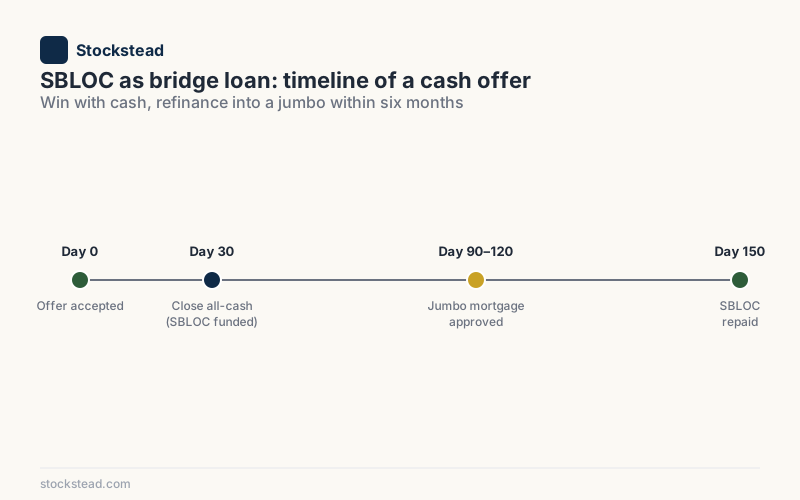
- Your plan is to pay off the bridge financing when the current home sells, 30–120 days later.
Every piece of the structure is short-dated. You are not financing a 30-year home purchase with a securities-backed line. You are using the line for 30–120 days to solve a timing problem.
The short duration changes the math significantly. The rate matters less because it applies for a few months, not years. The operational risk of a margin call is compressed into a window short enough to survive most market events. The interest deduction question becomes less important because the dollar amounts are smaller.
Why SBLOC Beats a Traditional Bridge Loan
Bridge loans from banks are one of the worst-priced products in HNW lending. The rate structure reflects the bank's perception of risk — you are a customer in transition, the collateral is a home that has not been sold yet, and the duration is uncertain.
Specifically:
Rate. Traditional bridge loan rates are typically 9–12%. Published SBLOC rates on a $1M draw as of October 8, 2026 were 4.93% at IBKR Pro margin, 5.40% for Morgan Stanley's promotional fixed LAL rate, 6.22% at Fidelity, and 6.77% for Schwab's PAL at list price — the lender-by-lender breakdown across Schwab, Fidelity, IBKR, and Morgan Stanley has the detail. The spread on a $1M bridge for 90 days is roughly $7,500 to $17,500 in interest savings.
Fees. Bridge loans often carry origination fees of 1–2% ($10–20K on a $1M loan). SBLOCs have no meaningful origination fee.
Time to fund. Bridge loans require appraisals, title searches, and underwriting on both homes. Time to fund is 2–4 weeks. SBLOCs can fund in 1–2 weeks or less if the portfolio account is already at the lender.
Complexity at the sale closing. A bridge loan secured by your current home must be paid off at the sale closing out of the sale proceeds. This adds complexity to the closing statement and creates dependency on the sale timing. An SBLOC is secured by the portfolio, is unrelated to the sale, and is paid off by wiring cash from the sale proceeds whenever you choose.
The SBLOC bridge is cleaner, cheaper, and faster on every dimension.
The Concrete Math on a $1M Bridge
You need $1M for 90 days to close on the new home before your old home sells. This example uses illustrative rates: 10.5% plus a 1.5% fee for the bank bridge, and 6.75% for the SBLOC. As of October 8, 2026, Schwab's published PAL rate on a $1M-tier line was 6.77% before relationship discounts. Compare the two paths:
Traditional bridge loan path:
- Rate: 10.5%
- Origination fee: 1.5% = $15,000
- Interest for 90 days: $1M × 10.5% × (90/365) = $25,890
- Total cost: $40,890
SBLOC bridge path (illustrative Schwab PAL rate of 6.75%):
- Rate: 6.75%
- Origination fee: $0
- Interest for 90 days: $1M × 6.75% × (90/365) = $16,644
- Total cost: $16,644
Savings: $24,246 on a 90-day hold. Roughly 60% cheaper.
On a $1.5M bridge or a 120-day hold, the savings scale proportionally. For longer holds (180–365 days), the absolute dollar savings grow further, though the operational risk of carrying the line through a possible market event also grows.
The Operational Structure
A clean SBLOC bridge works like this:
-
Open the SBLOC in advance. If you are starting to look at homes seriously, open the SBLOC now, not when you are in the middle of a bidding war. Lenders can fund a facility in 1–2 weeks, but that is the worst time to be waiting on paperwork.
-
Keep the initial draw conservative. Target an initial LTV of 30% or lower. A $1M draw against a $3.5M pledged portfolio is a 29% LTV and gives you meaningful cushion if the market moves during the bridge window.
-
Wire to closing directly. On the new home's closing day, wire the SBLOC proceeds directly from the lender to the title company. Keep the paper trail clean for any subsequent tax analysis.
-
Maintain the cushion. During the bridge window (30–120 days), do not use the SBLOC for other purposes. The line is earmarked for this specific purpose and will be paid off from the sale proceeds.
-
Pay off in full at the sale. When the current home sells, wire the net proceeds to pay down the SBLOC in full. Keep the SBLOC open for future use — do not close the facility just because this specific need is resolved.
The total operational overhead is roughly 2–3 hours spread over the planning and execution window. Compared to the 10–20 hours of back-and-forth a bridge loan typically requires, the time savings are as real as the cost savings.
The Risk to Manage: Short-Window Margin Calls
The main risk of an SBLOC bridge is that a market correction occurs during the bridge window and triggers a margin call. At 30% initial LTV, your portfolio would need to drop roughly 60% to hit a 75% maintenance threshold — a scenario that is extremely unlikely over a 90-day window. (For the full mechanics of advance rates, the two LTVs that govern margin-call timing, and what a maintenance call looks like operationally, see how an SBLOC actually works.)
Historical perspective: even the steepest 90-day drawdown in the modern record (Q4 2008 / March 2020) involved a roughly 34% S&P 500 decline. A well-diversified portfolio drew down more like 25–30% in those windows. At 30% initial LTV, that still leaves the LTV safely under the 75% maintenance threshold.
The risk is not zero, but it is manageable with a conservative initial LTV. A borrower who draws at 60% LTV on a bridge is taking real risk that a 20% correction during the window creates a call. That is a borrower who should either reduce the draw size, increase the pledged portfolio, or pay the higher price for a traditional bridge.
When NOT to Use an SBLOC Bridge
The structure breaks down in specific scenarios:
Your old home sale is very uncertain. The whole structure assumes the bridge window is short and ends with a known inflow. If your current home has been on the market for six months with no offers, the bridge is not a bridge — it is a structural funding source, and the SBLOC risk profile changes accordingly.
Your portfolio is thin. Using an SBLOC to bridge $1M against a $1.5M portfolio puts the LTV at 67%, which is too aggressive for the risk. Either reduce the bridge size, add assets to the pledged account, or pay for a traditional bridge.
You have concentrated collateral. An SBLOC against a single-stock portfolio carries outsized risk during the bridge window. If the concentrated position is volatile, even a 90-day window is long enough to encounter a 20–30% drawdown in that specific name.
You cannot absorb interest during the bridge. SBLOC interest accrues daily. At the example's 6.75% on a $1M balance, that is $185/day. If you cannot service this from regular income during the bridge period, you are already under pressure, and adding leverage complicates the situation.
The Double Dip: SBLOC + Mortgage
A more sophisticated version of the same structure, for buyers who want to avoid refinancing friction later:
- Use the SBLOC to close the new home for cash (no mortgage at initial closing).
- Old home sells; pay off a portion of the SBLOC.
- After closing on the sale, take out a delayed-financing mortgage on the new home at current rates.
- Use the mortgage proceeds to pay off the remaining SBLOC balance.
This structure gives you a cash-offer advantage on the new home (often worth 2–5% in negotiated price), clean timing around the sale of the current home, and eventual permanent mortgage financing on the new home. It is operationally the most demanding of the SBLOC bridge variants but can deliver real value on a meaningful deal.
The Tax Angle
For a 90-day bridge, the tax analysis is usually simple: the interest is personal interest and not deductible. The dollar amounts are small enough that tracing structures usually do not justify their overhead.
For longer bridges (180+ days) or larger balances, consult a tax advisor. Some bridge structures can be layered with investment interest tracing to create a partial deduction, but the execution complexity rises quickly.
See the Full Comparison
A bridge loan and an SBLOC bridge look similar on a brochure but cost very different amounts over a 90-day window. Stockstead does not directly model traditional bridge loans, but the SBLOC model can be parameterized to a bridge scenario — short duration, specific draw size, and a scheduled paydown — to show you the real interest cost. For the broader picture, see the full SBLOC vs. mortgage vs. cash comparison.
Compare Your Options with Stockstead →
Bridge financing is the moment when an SBLOC is at its best. Short duration, known paydown, clear alternative. If you are buying before you sell, the portfolio is usually the cheapest money in the room.
Frequently asked questions
- How much cheaper is an SBLOC bridge than a traditional bridge loan?
Using illustrative rates on a $1M, 90-day bridge: an SBLOC at 6.75% costs about $16,644 in interest with no origination fee, and a traditional bridge loan at 10.5% with a 1.5% origination fee costs about $40,890. The SBLOC path is roughly 60% cheaper, saving around $24,000 on a 90-day hold. For reference, Schwab's Pledged Asset Line list rate on a $1M-tier line was 6.77% as of October 8, 2026.
- When does an SBLOC bridge make sense?
When you own your current home outright or with a small mortgage, you have found a new home you want to buy before selling, the seller wants non-contingent cash, you have a taxable portfolio large enough to secure the gap, and you plan to pay the line off from the sale proceeds within 30–120 days.
- What is the main risk of using an SBLOC as a bridge loan?
A short-window margin call. At a conservative 30% initial loan-to-value ratio, the pledged portfolio would need to drop roughly 60% to hit a 75% maintenance threshold — extremely unlikely over a 90-day window. Even the steepest 90-day drawdowns in the modern record (Q4 2008, March 2020) saw diversified portfolios fall about 25–30%, leaving meaningful cushion. The risk is real but manageable with a conservative draw.
- How fast can an SBLOC bridge fund compared to a traditional bridge loan?
An SBLOC can fund in 1–2 weeks, or faster if the pledged portfolio account is already at the lender. A traditional bridge loan typically takes 2–4 weeks because it requires appraisals, title searches, and underwriting on both the home you are buying and the home you are selling.
- When should I NOT use an SBLOC bridge?
Avoid the structure when your current home sale is very uncertain (no offers after months on market), when your portfolio is thin relative to the bridge size (LTV above roughly 50%), when your collateral is concentrated in a single volatile stock, or when you cannot service the daily interest from regular income during the bridge period.
Ready to run the numbers on your situation?
Open the calculator →Related posts
High Net Worth Home Buyer Financing: The Complete Guide
Cash, jumbo mortgage, SBLOC, hybrid, and asset-depletion — the five paths to fund an HNW home purchase. After-tax math, decision framework, and links to deeper guides.
$2M Portfolio, $2M Home: A Case Study in Three Financing Paths
A fully worked $2M-portfolio / $2M-home case study — built originally as my own modeling exercise — with the surprises called out: the path that costs $2.26M, the path that ends up $1.3M richer, and the assumption that secretly decides which is which.
SBLOC vs HELOC for HNW Homeowners: An After-Tax Comparison
A Home Equity Line of Credit and a Securities-Backed Line of Credit sound similar but behave very differently — and for HNW homeowners, the after-tax math frequently reverses the headline rate gap. Here's the comparison, six variables, and three borrower profiles where the answer is obvious.