RSUs and Buying a Home: A Tech Employee's Playbook
By Tyler Singletary · · Updated · in Buyer profiles
If you are a mid- or senior-level employee at a large tech company, your compensation is probably stock-heavy. Six-figure annual RSU vests, a sizable portion of net worth in unsold vested shares, maybe some options that have not been exercised yet. On paper, you have the wealth to buy a home. In practice, touching that wealth creates a tax problem that nobody warned you about in onboarding.
This post is for the Google / Meta / Amazon / Microsoft / Apple / NVIDIA / Nvidia-adjacent engineer or PM who wants to buy a home in a HCOL metro and is staring down the question: "Do I sell my RSUs? Do I borrow against them? Do I wait?"
For the broader HNW context — how RSU strategies fit alongside SBLOCs, jumbo mortgages, and concentrated-stock approaches — see our complete guide to high net worth home buyer financing.
The Specific Tax Problem
RSUs create a double-taxation pattern that most tech employees understand only partially.
At vest: The full market value of the vesting shares is ordinary income. If 100 RSUs vest at $300/share, you have $30,000 of ordinary income on your W-2. Your employer withholds a default federal rate (typically 22% or 37% depending on supplemental income rules) plus Medicare, Social Security, and state. The withholding is usually insufficient for high earners, which is why many tech employees end up owing additional tax every April.
At sale: Whatever you sell above the cost basis (the price at vest) is capital gains. Short-term if held less than a year, long-term otherwise. If the stock has run up since vest, the capital gain can be significant.
The typical pattern for a long-tenured tech employee: you held the shares through appreciation, which created significant long-term capital gains on top of the ordinary income already recognized at vest. Now you want to sell to fund a home, and the long-term gain is the tax you owe on the sale.
The Specific Home Problem
Tech employees in HCOL metros (Bay Area, Seattle, NYC, Austin) typically face home prices in the $1.5M–4M range for the quality of home they want. A 20% down payment is $300–800K. That is a lot of RSU to liquidate, especially at peak-career comp levels where the marginal tax rate is high.
The second problem: tech employee comp is correlated with tech stock prices. When the stock drops, so does your RSU value, and in a real downturn your bonus and future comp might also be affected. Financing a home purchase entirely from employer stock concentrates risk in a way that is not obvious until something goes wrong.
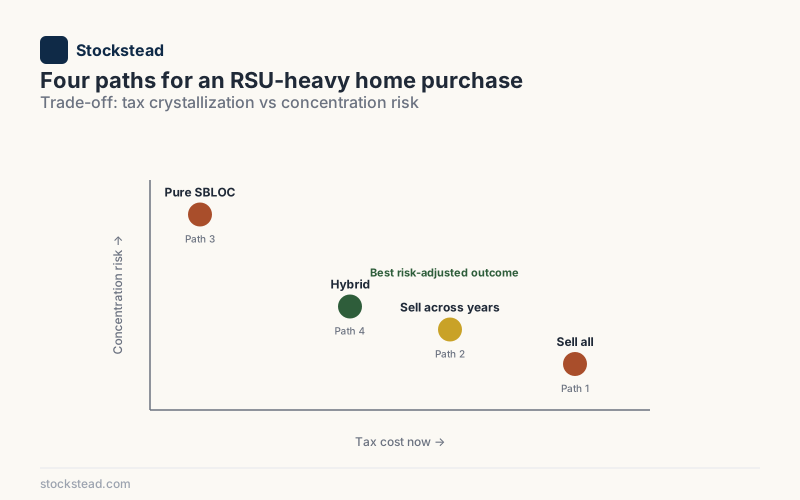
The Four Paths
Path 1: Sell RSUs, Pay Tax, Large Down Payment
The default path. Sell enough vested RSUs to fund a 20–30% down payment, pay the capital gains, take a jumbo mortgage on the rest.
Pros: simple, clean, one tax event, diversifies away from employer concentration, done.
Cons: big tax bill in a single year, often at the 20% LTCG bracket plus 3.8% NIIT plus state. California tech employees commonly pay 32.8–37.1% on RSU gains.
Who this fits: employees whose RSU gains are moderate (not 10x), who have already diversified some, and who can absorb the tax hit in one year without blowing up their broader financial plan.
Path 2: Sell RSUs Across Tax Years
Spread the liquidation across 2–3 tax years. Sell a portion in December of Year 1, the rest in January of Year 2 (or later). The gains land in separate tax years, potentially keeping more of them in the 15% federal capital gains bracket and avoiding the worst stacking of marginal rates.
This path requires you to close on the home before the full liquidation is complete, which means bridging the gap. A short-term SBLOC covers the bridge for 60–180 days while the Year 2 sales complete.
Pros: materially lower effective tax rate across the liquidation; preserves more of the portfolio.
Cons: requires precise planning; the bridge carries interest and some margin risk; depends on the stock holding its value between sales.
Who this fits: employees in the 20%+ federal capital gains bracket whose RSU gains are large enough that multi-year planning materially reduces the tax cost.
Path 3: SBLOC Against RSUs, No Sale
Open an SBLOC against the vested RSU portfolio. Draw enough to fund the down payment. Do not sell.
Pros: zero immediate tax cost; RSU position continues to grow (for better or worse); preserves step-up in basis for estate planning.
Cons: SBLOCs against concentrated stock positions carry reduced advance rates (often 30–50% vs. 65%+ for diversified); concentrated single-stock risk is amplified by leverage; margin call risk is material during tech drawdowns.
Who this fits: employees with very low cost basis (early joiners, founders) for whom the tax cost of selling is enormous, and who can tolerate the concentration and leverage risk.
Path 4: Hybrid — Partial Sale + SBLOC
Sell enough RSUs to fund part of the down payment while the capital gains are manageable. Use an SBLOC to fund the rest. Over time, continue selling RSUs on a schedule to pay down the SBLOC.
Pros: balances the tax-deferral benefit of an SBLOC with the diversification benefit of selling; the ongoing paydown prevents the SBLOC from becoming a permanent leverage structure.
Cons: operationally more complex; requires consistent discipline to execute the paydown schedule.
Who this fits: most HNW tech employees. The hybrid path usually beats the extremes on total tax cost and risk-adjusted outcome.
A Worked Example
Senior engineer at a large tech company, age 38. Vested RSU position: $1.2M at $400/share, cost basis $180K (so $1.02M of unrealized gain). Other taxable investments: $400K diversified. Home purchase: $2M in the Bay Area. Household taxable income before any sale: about $650K, married filing jointly, which is above the $613,700 point where the 20% long-term rate starts in 2026, so every dollar of gain is taxed at 20%. Combined tax rate on long-term gains: 32.8% (20% federal, 3.8% NIIT, about 9% state).
Rate assumptions: this example assumes a 6.25% SBLOC rate for a short bridge and 6.75% for a line backed mostly by concentrated stock. Those are illustrative inputs, not current quotes. As of October 8, 2026, broker SBLOC pricing on a $1M draw runs from 4.93% (Interactive Brokers Pro margin) to 6.77% (Schwab Pledged Asset Line, list price); smaller draws and concentrated collateral typically price higher. The dollar figures below are not recomputed at current rates.
Path 1 (sell all needed):
Sell $400K of RSUs for a 20% down payment. Gain: $400K − ($400K × 15%) = $340K. Federal tax: $340K × 23.8% = $80,920. State tax: $340K × 9% = $30,600. Total tax: $111,520.
Net proceeds: $400K − $111,520 = $288,480. Buyer must top up $111,520 from cash or other investments to reach $400K at closing. Remaining RSU position: $800K.
Path 2 (sell across two years):
December sale: $200K. Gain: $170K. Federal tax: $170K × 23.8% = $40,460. Deferred portion of the liquidation happens in January for $200K more.
January sale: $200K. Gain: $170K. Federal tax: $170K × 23.8% = $40,460. State tax similar split.
The cross-year split doesn't reduce tax rate since both years are at the 20% bracket for a high earner, but it does smooth cash flow and keeps net investment income manageable for NIIT purposes. The real value here is if you are right at the top of the 15% LTCG bracket — splitting can save 5 percentage points on a meaningful slice.
A short-term SBLOC bridges the 3–4 weeks between the December sale and the January sale. At the assumed 6.25% SBLOC rate on $200K for 30 days: interest cost is about $1,028.
Total tax: $111,520 (same as Path 1 in this bracket). Bridge cost: ~$1,028. Marginal saving in this scenario: minimal. Different brackets produce more dramatic savings.
Path 3 (SBLOC, no sale):
Open SBLOC against $1.2M RSU + $400K diversified = $1.6M total portfolio. Advance rate against concentrated tech stock: 35%. Available line: $560K. Draw $400K for down payment. Initial LTV: 25%.
Annual interest at the assumed 6.75% (concentrated-stock SBLOC tends to price at the high end): $27,000. No capital gains tax. RSU position continues.
Cost over 5 years of carrying the line: $135,000 in interest. If RSU position grows 8%/year during that period, $1.2M grows to $1.76M — portfolio gain of $560K. Net benefit of not selling: $560K growth − $135K interest = $425K positive.
Risk: if RSU stock drops 40% over the 5 years (a realistic tech-downturn scenario), the portfolio falls to $720K. LTV becomes $400K / $720K = 55.6%, well above the 50% maintenance threshold for concentrated-position loans. Margin call likely. The borrower is then forced to sell RSUs during the downturn, crystallizing the gains at the worst possible time.
Path 4 (hybrid):
Sell $200K of RSUs now (gain $170K, tax $40K + $15K = $55K). Draw $255K from SBLOC to complete the $400K down payment. Initial LTV against $1M remaining RSU + $400K diversified = $1.4M: draw $255K = 18.2% LTV. Much safer than pure SBLOC.
Over 5 years, sell $100K of RSUs per year in a disciplined schedule, using proceeds to pay down the SBLOC. By year 3, the SBLOC is paid off and the RSU position is materially smaller (but still meaningful).
This path trades some immediate tax cost for much lower margin call risk and a clear exit from the leverage.
Timing Relative to Vest
An often-missed point: RSU sales closest to the vest date carry the smallest capital gain (because the cost basis is close to current price). Selling shares from a recent vest costs you almost nothing in capital gains tax.
If you are planning a home purchase, time the sales to coincide with recent vests rather than selling long-held shares with big embedded gains. This is a common gap in tech-employee financial planning — they sell the old highly-appreciated shares when they should be selling the newest freshly-vested ones first.
The same logic applies to sell-to-cover on vest. If you have the cash flexibility, let the company sell to cover withholding on vest and then hold the net shares rather than opportunistically selling long-held shares at higher tax cost.
The Downside Scenarios Nobody Models
Most home-buying spreadsheets assume stable stock prices. Tech employee stock rarely follows that assumption.
Layoffs + stock drop. In a tech downturn, your company may lay off staff (including possibly you) at the same time the stock drops 40%. Your SBLOC margin call arrives the same month your job does. This is not hypothetical; it happened to thousands of tech employees in 2022.
Lockup after IPO / secondary. If your company is pre-IPO or recently IPO'd, you may have lockup restrictions that prevent selling for 6–24 months. An SBLOC against locked-up shares is either unavailable or carries very punitive advance rates. Plan the home-purchase timing around the lockup, not around the vesting schedule.
Concentration with your bank. If your employer stock is at Fidelity and your SBLOC is also at Fidelity, a crisis at the company could trigger action on both the employment side and the lending side simultaneously. Diversify custodians for large positions.
The Practical Rule
For most tech employees buying a home in a HCOL metro, the hybrid path (Path 4) is the right answer. Sell enough RSUs to cap the tax cost at a manageable level, use an SBLOC to bridge the rest, and commit to a disciplined multi-year paydown schedule.
The extremes — sell everything you need (Path 1) or sell nothing (Path 3) — are usually wrong. Path 1 crystallizes too much tax. Path 3 concentrates too much risk. The middle path captures most of the benefit on both sides.
Model Your Specific Situation
Stockstead handles the RSU scenario correctly: adjustable cost basis, concentrated-position advance rates, and the after-tax cost of each financing path. Plug in your vest history, your cost basis, and your expected RSU growth, and see how the four paths compare.
Compare Your Options with Stockstead →
RSUs are a home-buying tool if you use them carefully. They are a tax and concentration trap if you do not.
Frequently asked questions
- Should I sell my RSUs to fund a home down payment?
It depends on the gap between your cost basis (the price at vest) and the current price. Selling shares from a recent vest carries almost no capital gains because the basis is close to current value. Selling long-held appreciated RSUs at 5-10× the vest price can produce a six-figure tax bill at the 32.8-37.1% combined rate typical for high-bracket tech employees in California or New York. The right answer for most HNW tech employees is a hybrid: sell enough recently-vested RSUs to cap the tax cost, use an SBLOC for the rest, and commit to a disciplined multi-year paydown.
- Why is selling recently-vested RSUs cheaper than selling long-held shares?
Because RSUs create a two-stage tax pattern. At vest, the full market value of the shares is recognized as ordinary income on your W-2 — that becomes your cost basis. Any sale above that basis is capital gains. Recently-vested shares have a basis close to the current market price, so a sale realizes a tiny capital gain. Long-held shares that have appreciated 5-10× since vest have a low basis relative to current price, so a sale crystallizes the entire run-up as capital gain. Always sell newest-vested shares first if your goal is to minimize the tax hit.
- What's the risk of using an SBLOC against employer stock?
Triple-correlated exposure. In a tech downturn, your company's stock price drops, the company may lay off staff (including possibly you), and your SBLOC margin call arrives in the same month your job does. This is not hypothetical — it happened to thousands of tech employees in 2022 when Tesla dropped 65% and Meta dropped 75%. Lenders compensate by reducing advance rates on concentrated single-stock positions to 30-50% (versus 65-75% for diversified portfolios), but the structural risk remains. If your employer stock is over 50% of net worth, the SBLOC concentration risk usually outweighs the tax-deferral benefit.
- How do I spread an RSU liquidation across tax years to reduce the bill?
Sell a portion in December of Year 1, the rest in January of Year 2. The gains land in separate tax years, potentially keeping more of them in the 15% federal capital gains bracket and reducing NIIT exposure. The technique requires you to close on the home before the full liquidation is complete, which means bridging the gap — typically with a short-term SBLOC for 60-180 days while the Year 2 sales complete. Bridge cost is modest (a few thousand dollars on a $200K bridge at SBLOC rates). The technique works best if you are near the top of the 15% LTCG bracket and a year-split keeps you below the 20% threshold.
- What is the hybrid RSU strategy for a home purchase?
Sell enough RSUs now to fund part of the down payment while the tax cost stays manageable — typically the most recently-vested lots with the smallest embedded gain. Use an SBLOC to fund the rest. Over the next 3-5 years, sell additional RSUs on a disciplined schedule, using proceeds to pay down the SBLOC. This caps immediate tax cost, keeps SBLOC LTV conservative (low-single-digit percent of the broader portfolio), gives you a clear exit from the leverage, and naturally diversifies away from the concentrated position over time. Right answer for most mid- and senior-level tech employees in HCOL metros.
Ready to run the numbers on your situation?
Calculate the tax cost of selling your stock →Related posts
Concentrated Stock + Home Purchase: Avoid a Tax Disaster
If most of your wealth is one stock, buying a home means navigating tax, diversification, and lender constraints simultaneously. Here's the playbook.
Tax-Loss Harvesting Before a Home Purchase: Playbook
If you're about to liquidate portfolio assets for a home down payment, a disciplined tax-loss harvesting pass can save six figures. Here's the timing and the playbook.
The $200K Mistake: Liquidating Stock for a Down Payment
See how capital gains taxes and opportunity cost can turn a $200K down payment into a $301K decision. Use our free calculator to compare options.