SBLOC Margin Calls: Triggers and How to Avoid Them
By Tyler Singletary · · Updated · in Risk & drawdown
Every SBLOC agreement contains a paragraph, usually on page six or seven, that gives the lender broad discretion to sell your securities if the collateral value drops. Most borrowers skim it. A small percentage of borrowers live through it, and they all describe the experience the same way: fast, ugly, and expensive.
This post walks through the exact mechanics of a Securities-Backed Line of Credit margin call. What triggers one. How much warning you will get. What your options are. And the specific moves HNW borrowers use to prevent a call from ever happening.
The Trigger: How Maintenance LTV Works
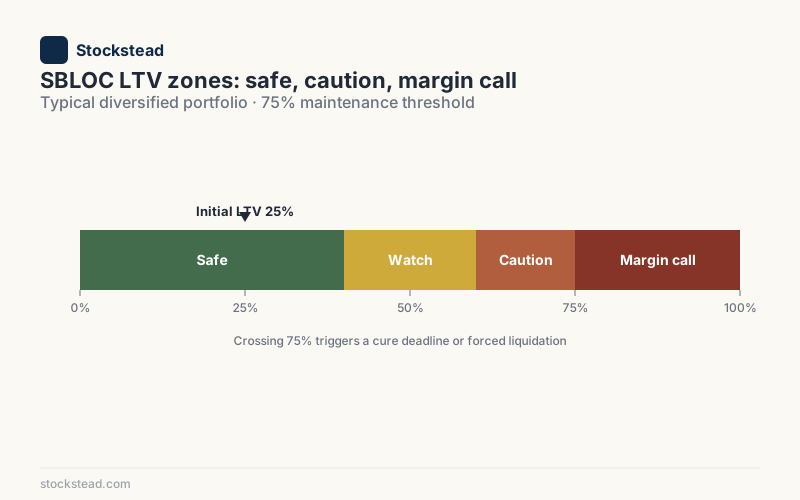
Every SBLOC has two important ratios. The initial LTV is the cap on what the lender will advance when you first draw. The maintenance LTV is the ceiling the loan balance cannot cross against the current collateral value, regardless of how you got there.
A line might have an initial LTV of 50% and a maintenance LTV of 75%. That means:
- You can draw up to $500,000 against a $1,000,000 portfolio on day one.
- You trigger a call if the portfolio drops to $667,000 or lower (because $500K / $667K = 75%).
- The cushion from initial to maintenance absorbs a 33% portfolio decline before a call.
If you draw at a higher initial LTV — say 65% — the cushion shrinks dramatically. At 65% initial and 75% maintenance, a 13% portfolio decline is enough to trigger the call. In the context of historical equity volatility, a 13% drawdown is a bad week, not a generational event.
The single most important decision in opening an SBLOC is the initial LTV. Everything else — rate, venue, documentation — is secondary to the cushion you set on day one.
What a Margin Call Actually Looks Like
The sequence depends on the lender, but the pattern is consistent:
- Automated alert. The brokerage or bank's system flags the account when LTV crosses the maintenance threshold. This usually happens intraday, often at market close.
- Notification. You receive an email, a portal message, and in some cases a phone call. The notification quantifies the shortfall — the dollar amount you must cure — and states the cure deadline.
- Cure window. You have a set number of business days to resolve the call. At Schwab and Morgan Stanley, this is typically 3–5 business days. At Fidelity, 2–3. At Interactive Brokers, it can be hours or minutes depending on the severity.
- Forced liquidation. If you miss the deadline, the lender sells securities in the pledged account at their discretion to pay down the loan. You do not pick the lots. You do not pick the tax treatment. You do not pick the timing.
The fourth step is where the damage happens. The lender's algorithm is designed to protect the lender's collateral position, not your tax bill or your long-term plan. They will sell whatever is liquid — often the positions with the lowest cost basis and the largest embedded gains.
The Three Ways to Cure a Call
You have three tools to satisfy a call, and most sophisticated borrowers end up using some combination:
Deposit cash. Paying down the principal of the SBLOC is the fastest cure. A $100K cash deposit reduces the loan balance by $100K and immediately changes the LTV. If you have cash outside the brokerage, wire it.
Transfer in additional eligible securities. Moving securities from another account — a spouse's brokerage, an IRA is not eligible, a separate taxable account — increases the collateral denominator. A $100K securities transfer at a 70% advance rate adds $70K to your available line.
Sell securities to pay down the loan. This is the last resort because it crystallizes gains. But if you must sell, you want to do it yourself before the deadline — that way you can pick specific tax lots, use high-basis shares, or harvest losses if you have them.
The hierarchy is straightforward: cash first, transfers second, sales only if nothing else works.
Why HNW Borrowers Get Blindsided
Three patterns account for most of the bad outcomes:
Too aggressive on the initial draw. The borrower sets the initial LTV at 60–65% to minimize the amount they have to leave on the table. The math works on day one, but the cushion is thin enough that a normal correction puts them in trouble.
Concentrated collateral. The portfolio is pledged as collateral, but it is heavily concentrated in one position — often employer stock. The portfolio's beta is 1.5 or 2.0, which means the "normal" volatility looks nothing like the S&P 500. A 15% SPX drawdown can mean a 30–40% portfolio drawdown, blowing through the cushion immediately.
No external liquidity. The borrower has no meaningful cash outside the pledged account and no other brokerage to transfer from. When the call arrives, they have no cure options except selling — at the worst time, under duress, at the lender's discretion if they delay.
If you find yourself in more than one of these three patterns, your SBLOC is not set up to survive a standard-issue market correction.
The Preventive Playbook
Borrowers who use SBLOCs successfully treat the loan as an operational system, not a one-time transaction. The moves they make, roughly in order of importance:
Set initial LTV at 30–40%, not 50%+. This is the single most consequential choice. At 35% initial and 75% maintenance, you can absorb a 50%+ portfolio drawdown before a call. That is a 2008-level event, not a routine correction.
Pre-fund a cash reserve outside the pledged account. Hold 10–15% of the line amount in cash in a separate bank account. A $1M line should have $100–150K of standby cash. This is the first-line defense and the reason the call never becomes a problem.
Keep a second brokerage account with eligible securities. A secondary taxable account with $250–500K of diversified ETFs can be transferred into the pledged account in days to cure a call. This is your second-line defense.
Monitor LTV weekly, not annually. Most brokerages expose the LTV in real time. A 15-minute check-in during volatile weeks catches problems before the call arrives.
Avoid concentrated collateral. If your pledged account holds a single position over 20% of the portfolio, the lender is already applying a reduced advance rate. A correction in that one position can trigger a call even if the rest of the portfolio is flat.
Carry payment capacity. The interest on the line should be serviceable from regular income without tapping the portfolio. If the line is self-funding from portfolio sales, you are already in a bad place before any market event.
What to Do When the Call Actually Arrives
Assume for the moment that you did not follow the playbook and a call has arrived. The playbook from there:
- Don't panic-sell. The worst move is to dump positions at market the morning of the notification to "get it over with." You have days, not minutes, in most cases.
- Check the math yourself. Confirm the lender's cure amount against your own LTV calculation. Mistakes happen.
- Call the lender and ask for extension. On a first call, most lenders will extend the window by 1–2 business days if you have a credible plan. This is where a relationship banker at Morgan Stanley or Schwab earns their keep.
- Execute the cure in the right order. Cash first (from an external source), transfers second (from another brokerage), sales only as a last resort.
- If you must sell, pick the lots. Select highest-basis shares first, harvest losses if you have any, and avoid triggering short-term gains on anything you have held less than a year.
- Document everything. Keep a log of the notification time, cure deadline, and your actions. Margin call disputes do happen, and the paper trail matters.
The Second-Order Effects of a Call
Even if you satisfy a call cleanly, the downstream effects can last months:
The lender may reduce your advance rates on affected positions, effectively lowering your available credit for a period. The tax event from any forced sale shows up on your 1099 the following January. Your banker relationship takes a hit — call history is tracked, and it affects future rate negotiations. And in severe cases, the lender may terminate the line entirely, requiring you to pay off the balance within a defined period.
None of these are fatal. But they compound. A borrower who gets called twice in a year may find their advance rate cut by 10–20 percentage points, their rate bumped, and their account flagged for heightened monitoring.
The Quiet Benefit of Never Getting Close
The borrowers who use SBLOCs most effectively are the ones for whom a call is not a thinkable event. They drew at 30%. They have cash. They have a backup brokerage. They carry modest balances. They treat the line as a tax-deferral tool, not a leverage tool.
This is the posture that turns an SBLOC into a multi-decade asset — a tool that funds a home, a bridge, a business investment, a major gift, and never once requires emergency action.
Stress-Test Your Situation
A margin call is the worst case of an SBLOC. Modeling whether you could survive one before you open the line is free. Modeling it after the fact is not.
Stockstead includes a stress-test mode that shows you the LTV trajectory of your pledged portfolio under three historical drawdowns — 2000–2002, 2008, and 2020. If your initial LTV is too aggressive, you will see the call threshold crossed long before the market recovered. For the side-by-side cost comparison against cash and mortgage paths, see our complete SBLOC vs. mortgage vs. cash analysis.
Model Your SBLOC Stress Case with Stockstead →
A margin call is survivable. It is much easier to prevent.
Frequently asked questions
- What actually triggers an SBLOC margin call?
A loan-to-value ratio that crosses the maintenance threshold, almost always because the portfolio (the denominator) dropped, not because the borrower drew more. A typical SBLOC has an initial LTV cap of 50% and a maintenance LTV around 75%. At 50% initial, a 33% portfolio drop is enough to reach the maintenance line. At 65% initial, a 13% drop does it — barely a normal correction. The math is simple once you accept that volatility, not borrower behavior, drives most calls. The decision that protects you is the one you make on day one when you choose how much to draw.
- How long do I have to cure an SBLOC margin call?
Depends on the venue. Schwab PAL and Morgan Stanley LAL typically give 3-5 business days. Fidelity margin runs 2-3 days. Interactive Brokers can be hours or minutes — IBKR's enforcement is algorithmic, no human review, no negotiation. Private banks with relationship enforcement may extend the cure window by 1-2 business days on a first call if the borrower has a credible plan. In 2020's March selloff, several private banks effectively paused enforcement for 48-72 hours. The cure window is the single biggest reason HNW borrowers pay 100-200 bp more for a private bank PAL than for IBKR margin.
- What is the safest initial LTV for an SBLOC?
30-40%, against diversified collateral. At a 35% initial LTV with a 75% maintenance threshold, you can absorb a 53% portfolio drop before a margin call — larger than the 45% peak-to-trough drawdown an 80/20 portfolio experienced through 2008. At 25% initial LTV, the cushion handles essentially any drawdown short of a generational crash. Drawing at 50%+ shrinks the cushion to a normal correction. The rate savings at the more aggressive LTV evaporate the first time the market does what it does every decade. Initial LTV is more consequential than which broker you choose.
- What are my options when an SBLOC margin call arrives?
Three tools, in descending order of preference. Cash deposit — wire money to the pledged account; it reduces the principal immediately and is the cleanest path. Securities transfer — move eligible securities from another taxable brokerage (ACATS takes days, so this is the slow option). Sell positions to pay down the loan — last resort because it crystallizes gains, but if you must sell, do it yourself before the deadline so you can pick high-basis lots and harvest losses. Letting the lender liquidate is the worst case: they pick the lots, they optimize for their collateral position, your tax bill is collateral damage.
- How can I prevent an SBLOC margin call entirely?
Treat the line as an operational system, not a one-time transaction. Set initial LTV at 30-40%, never 50%+. Pre-fund a cash reserve outside the pledged account equal to 10-15% of the line size. Keep a second brokerage account with $250-500K of diversified ETFs available for transfer if needed. Monitor LTV weekly during volatile periods, not annually. Avoid concentrated collateral — any single position over 20% of the pledged portfolio increases call risk disproportionately. Carry interest payment capacity from regular income, never from drawing further on the line itself.
Ready to run the numbers on your situation?
Open the calculator →Related posts
What Are the Odds an SBLOC Actually Gets Called? A Century of Market Paths
Stress tests tell you whether a crash would call your line. They do not tell you how likely a call is over ten years of holding it. We resampled a century of monthly market returns to find out — and the answer depends far more on what you pledged than on how much you drew.
SBLOC Rates 2026: Schwab, Fidelity, IBKR, Morgan Stanley
Published SBLOC rates at Schwab, Fidelity, IBKR, and Morgan Stanley as of October 8, 2026, with side-by-side cost on a $1M draw.
How an SBLOC Works: A Complete Guide for Investors
An SBLOC is a margin loan that's been moved into a different filing cabinet. This guide walks through the actual mechanics — advance rates, the two LTVs that matter, what a maintenance call looks like minute by minute, and when the math stops working.