Opportunity Cost of a Down Payment: $300K Costs $540K
By Tyler Singletary · · Updated · in Decision frameworks
A $300,000 down payment is not a $300,000 cost.
It is a $300,000 visible cost, plus everything that $300,000 would have produced if it had kept compounding for the life of the home. At a 7% real return — the long-run S&P average per Shiller's data — that's roughly $590,000 ten years out, $1.16M at twenty, and $2.28M at thirty. The buyer who liquidated $300K to pay down a house and the buyer who didn't are not living in the same financial reality at year twenty.
Standard mortgage calculators don't model any of this. They were built for a buyer whose down payment comes out of a checking account, where the opportunity cost is small enough to round to zero. For a portfolio-funded down payment, the opportunity cost is the largest single variable in the decision, and it is not in the calculator.
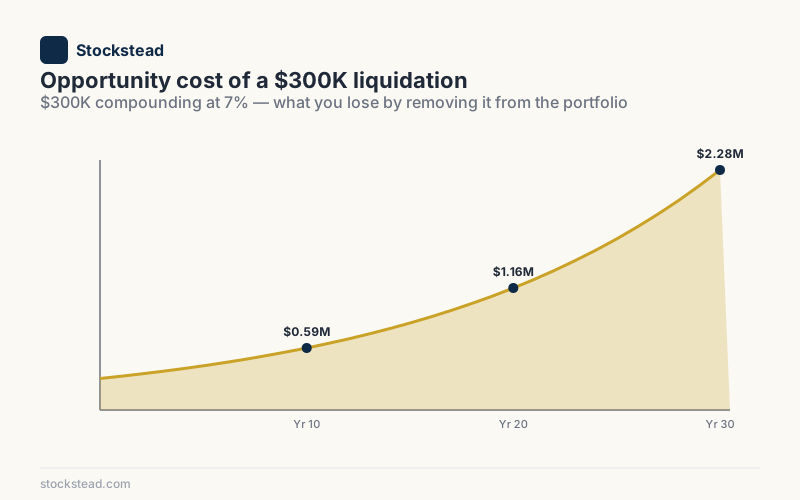
The number, and what it does over time
Forgone compounding on $300K, by horizon and assumed return:
| Return | 10 years | 20 years | 30 years |
|---|---|---|---|
| 4% real | $144K | $358K | $673K |
| 5% real | $189K | $496K | $996K |
| 7% real (Shiller LT avg) | $290K | $860K | $1,980K |
| 9% real | $410K | $1,381K | $3,679K |
Read the bolded row. At twenty years, the opportunity cost of removing $300K from a 7%-real portfolio is $860K. That is almost three times the down payment itself, and it does not include the capital gains tax bill the buyer also paid to liquidate the position. Add taxes back in and the realistic 20-year wealth gap between the buyer who liquidated and the buyer who didn't is comfortably north of $900K, on a $300K decision.
Why this isn't theoretical
The temptation when reading numbers like these is to assume "well, that's just compound interest math — same logic applies to anything." It does, but two things make the home-purchase application different from the abstract case.
First, sequence-of-returns risk amplifies the gap. The 7% figure is an average. Real markets deliver +30% one year and -20% the next. If the buyer liquidates at the bottom of a drawdown, they crystallize the loss and miss the recovery — and the recovery is the part of the long-run average where the wealth is actually made. The S&P doubled between March 2009 and March 2014. Buyer A who funded a closing in early 2009 by selling and Buyer B who kept everything invested are no longer playing the same game; the gap between them at year twenty is much larger than the average suggests.
Second, the alternative — borrowing instead of selling — is cheap relative to the avoided opportunity cost. An SBLOC at an assumed 6.25% on $300K interest-only for twenty years costs $375K cumulative. (That rate is an illustrative input; as of October 8, 2026, broker SBLOC pricing on a $1M draw runs from 4.93% at Interactive Brokers Pro to 6.77% at Schwab's Pledged Asset Line list price, and a $300K draw typically prices higher.) Forgone compounding on the same $300K at 7% real over twenty years costs $860K. Even if you account for the SBLOC interest as a real cost, the buyer who borrowed against the portfolio rather than selling it is hundreds of thousands of dollars ahead at the end of the holding period. (For the full SBLOC mechanics that make this work without forced-liquidation risk, see how an SBLOC actually works.)
What changed how I thought about my own purchase
I was researching this for myself when I figured out it wasn't really an "opportunity cost" question at all. It's a tax-timing question wrapped in compound interest.
The question I'd been asking — "what does it cost to take $300K out of the market for the next twenty years" — was framed wrong. The buyer who borrows against the portfolio and pays SBLOC interest also takes capital out of the market in some sense — the interest payments come from somewhere, often from cash flow that could otherwise have been invested. The two paths look more equivalent than they really are.
What's actually different is when the tax event happens. The liquidating buyer realizes capital gains in 2026, in a year their W-2 already has them in 23.8%-federal-LTCG-plus-state-plus-NIIT territory. The SBLOC buyer doesn't realize the gain — they can defer it indefinitely, or harvest it in a year they deliberately engineer for it (sabbatical, low-W-2 year, post-retirement). For an equity-compensated tech worker who's been receiving RSUs, ISOs, and post-IPO grants for a decade, that timing optionality is worth real money. Possibly more than the compounding gap.
That re-framing is the one that made me build Stockstead. The simple "compounding lost" pitch is true but incomplete. The full pitch is "compounding lost plus tax bracket arbitrage opportunity gone."
When this argument loses
The opportunity-cost case for borrowing instead of selling is strongest when expected returns are high, cost basis is low, and the buyer's tax bracket is high. It weakens fast in the opposite scenarios:
- Very low gain on the position being liquidated. If $300K of liquidation produces $10K of gain, the tax cost is trivial and the math collapses to "is the SBLOC rate cheaper than my expected return." Often it isn't.
- Conservative portfolios. If most of your account is in bonds or T-bills earning 3–5% real, the SBLOC rate (broker pricing on a $1M draw ran 4.93% to 6.77% as of October 8, 2026) can be more expensive than the forgone return. Liquidate.
- Approaching retirement. Sequence-of-returns risk cuts both ways, and carrying leverage into the years your earnings end is rarely worth the marginal compounding benefit.
- A genuine preference for zero debt. This is a legitimate choice. The opportunity cost of that preference is real, and now you know roughly what it costs you. If you accept it eyes-open, that's fine.
Model your own number
Stockstead's calculator runs the opportunity cost on your specific portfolio, cost basis, expected return, and time horizon — alongside the SBLOC and traditional-mortgage paths — so you can see the wealth difference at year ten, year twenty, year thirty. The compounding math isn't complicated; the assumptions just have to be yours, not the example's.
The down payment was $300K. The actual lifetime cost depends entirely on what the $300K would have done if you'd left it alone. Pick a return, run the years, and decide whether you want to know.
Sources
- Robert Shiller — Long-run S&P 500 data
- IRS Topic 409 — Capital Gains and Losses
- IRS — Net Investment Income Tax (NIIT)
Educational, not financial advice. Tyler Singletary founded Stockstead while researching his own first home purchase. He's spent 20+ years in software product roles — currently as Product Specialist for AI/ML Startups at AWS, previously CPO/COO at Tagboard, and an executive at Klout (exited to Lithium in 2014) — and has been compensated in RSUs, ISOs, and post-IPO equity at high-growth tech companies for two decades. He is not a licensed financial advisor or CPA. Talk to a fiduciary advisor and a tax professional before acting on any of these figures.
Frequently asked questions
- What is the true cost of a $300K down payment over 20 years?
At a 7% real return — the long-run S&P average per Shiller's data — the forgone compounding on $300K of liquidated portfolio is roughly $860K at 20 years and $1.98M at 30 years. That is on top of the visible $300K down payment itself and the capital gains tax paid to liquidate the position. At 4% real returns the 20-year opportunity cost is $358K; at 9% real returns it is $1.38M. The wealth gap between the buyer who liquidated and the buyer who kept the portfolio invested at 20 years is comfortably north of $900K on a $300K decision.
- Is opportunity cost a real cost or just theoretical?
Real, and the gap is larger than the compounding math alone suggests because of sequence-of-returns risk. The 7% figure is a long-run average; real markets deliver +30% one year and -20% the next. A buyer who liquidates at the bottom of a drawdown crystallizes the loss and misses the recovery — the part of the long-run average where wealth is actually made. The S&P doubled between March 2009 and March 2014; a buyer who funded a closing in early 2009 by selling versus one who kept everything invested are no longer playing the same game by year twenty.
- How does the opportunity-cost case compare to SBLOC interest?
Favorably, by a wide margin. An SBLOC at an assumed 6.25% on $300K, interest-only for 20 years, costs roughly $375K cumulative (as of October 8, 2026, broker SBLOC pricing on a $1M draw runs 4.93% to 6.77%; smaller draws price higher). The forgone compounding on the same $300K at 7% real over 20 years costs $860K. Even after accounting for SBLOC interest as a real cost, the buyer who borrowed against the portfolio rather than selling it is hundreds of thousands of dollars ahead at the end of the holding period. The framing changes once you realize the SBLOC question is not really 'is this cheaper' — it is 'is this avoidable' — and the answer to avoidable is almost always yes.
- When does the opportunity-cost argument for keeping the portfolio fail?
Four scenarios. Very low embedded gain on the position being liquidated — if $300K of liquidation produces $10K of gain, the tax cost is trivial and the math collapses to a simple rate comparison. Conservative portfolios — if most of your account is in bonds or T-bills earning 3-5% real, the SBLOC rate (broker pricing on a $1M draw ran 4.93% to 6.77% as of October 8, 2026) can exceed the forgone return and leverage becomes a drag. Approaching retirement — sequence-of-returns risk cuts both ways and carrying leverage into the years your earnings end rarely justifies the marginal compounding benefit. A genuine preference for zero debt — a legitimate choice, now with the cost made explicit.
- Why is opportunity cost missing from most mortgage calculators?
Because standard mortgage calculators were built for buyers whose down payment comes out of a checking account, where the opportunity cost is small enough to round to zero. For a portfolio-funded down payment, opportunity cost is the largest single variable in the decision and dominates over the loan-side variables most calculators focus on (rate, term, monthly payment). A calculator that does not model what your $300K would do if it kept compounding is answering the wrong question for an HNW buyer with substantial taxable investments.
Ready to run the numbers on your situation?
Open the calculator →Related posts
The $200K Mistake: Liquidating Stock for a Down Payment
See how capital gains taxes and opportunity cost can turn a $200K down payment into a $301K decision. Use our free calculator to compare options.
Tax-Loss Harvesting Before a Home Purchase: Playbook
If you're about to liquidate portfolio assets for a home down payment, a disciplined tax-loss harvesting pass can save six figures. Here's the timing and the playbook.
Capital Gains Tax on Home Down Payments Explained
Federal LTCG, NIIT, and state taxes don't add — they stack. Here's how the layers compose, what your real combined rate is by state, and the bracket math that turned my own SBLOC research from 'is this cheaper' into 'is this avoidable.'