Concentrated Stock + Home Purchase: Avoid a Tax Disaster
By Tyler Singletary · · in Buyer profiles
If most of your taxable wealth is in a single stock — long-tenured employer equity, founder shares from a successful startup, an inherited concentrated position — buying a home is harder than it looks. The same scale of wealth that makes the home affordable creates a thicket of tax, diversification, and lender problems that none of the standard home-buying frameworks address.
This post walks through the specific structure HNW investors with concentrated stock positions use to fund home purchases. The goal is to navigate three constraints at once: minimize taxes on the eventual diversification, fund the home without crystallizing a massive tax bill, and avoid putting the concentrated position into a structure that will get force-liquidated in a downturn.
For the broader landscape of HNW financing options that don't require liquidating the position, see our complete guide to high net worth home buyer financing.
Why a Concentrated Position Changes the Math
The standard HNW home-purchase analysis assumes a diversified portfolio. The math falls apart when 60–90% of your portfolio is one stock for three reasons:
Tax cost of selling is disproportionate. A diversified portfolio with 50% cost basis pays tax on 50% of the proceeds on any given liquidation. A concentrated employer stock position with 5% cost basis pays tax on 95% of the proceeds. Selling $400K of a low-basis position can produce a $90K+ federal tax bill alone.
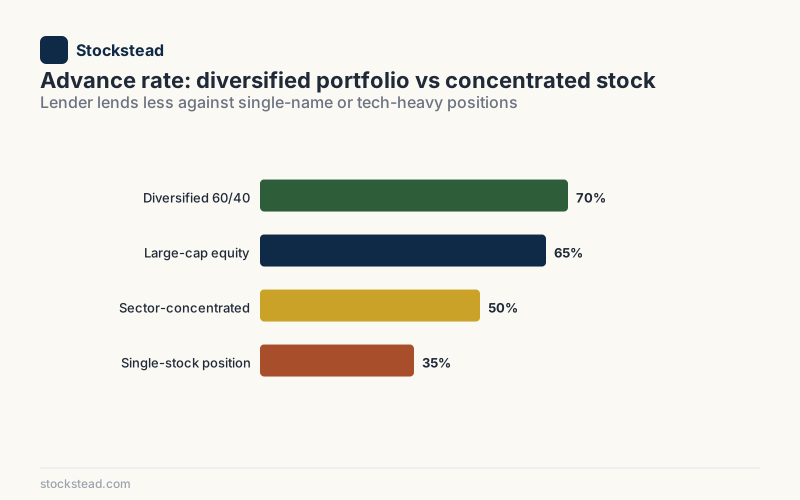
Lender treatment is harsher. SBLOC and PAL providers underwrite concentration. A diversified portfolio gets a 65–70% advance rate. A portfolio dominated by a single position over 25% of the account often gets 30–50% advance rates, sometimes lower depending on the stock's volatility. The borrowing capacity is materially smaller than the headline portfolio value would suggest.
Volatility is wider. A concentrated position can drop 30–40% in a quarter without anything fundamental changing. The same drawdown in a diversified portfolio is a generational event. Any leverage against a concentrated position needs much more cushion than leverage against a diversified portfolio.
Future estate planning is complicated. If you are holding the concentrated position partly for the step-up in basis at death, any sale today defeats that planning. The home purchase needs to be designed in a way that minimizes interference with the long-term estate strategy.
Three Common Profiles
Most concentrated-position homebuyers fall into one of three profiles.
Profile 1: Tech employee with vested company stock. Five to fifteen years at a successful tech company. RSUs and ISOs vested over the years and never sold. Position is now $2–10M, basis varies. Worried about diversification but trapped by the tax cost of selling.
Profile 2: Founder post-liquidity event. Sold a startup or did a secondary several years ago. Took stock or ISOs as part of the consideration, plus retained shares. Position is now $5–50M, basis is often near zero. May be subject to QSBS exclusion on some portion. Cannot sell aggressively without triggering massive taxes.
Profile 3: Inherited concentrated position. Inherited a position with stepped-up basis, then watched it grow significantly. Basis is moderate, not zero. Has more flexibility to sell than the other two profiles but still wants to be tax-efficient.
The home-purchase strategy is similar across all three but the parameters differ.
The Playbook
Step 1: Quantify the True Borrowing Capacity
Do not assume the headline portfolio value translates to lendable collateral. Pull the actual concentrated-position advance rate from your prospective lender before designing the financing.
A $5M portfolio that is 80% one stock typically supports a line in the $1.5–2.0M range, not the $3.0–3.5M you would expect from a diversified portfolio. Some lenders will simply not lend against single positions over 50% of the portfolio. Get this number from the lender directly, in writing.
Step 2: Diversify Selectively Before the Home Purchase
If your timeline allows (12+ months out from the planned purchase), use the runway to diversify a portion of the concentrated position. A few useful structures:
Year-over-year selling against the rate brackets. Capital gains rates are tiered. The 20% federal bracket starts at roughly $610K of taxable income for married-filing-jointly. Selling enough to keep your gains within the 15% bracket each year, sustained over 2–3 years, can save 5+ percentage points on a meaningful slice of the position.
Charitable giving. Donating appreciated stock to a donor-advised fund eliminates the capital gains tax entirely on the donated portion and produces a deduction at fair market value. For a buyer who already gives charitably, front-loading the giving via DAF before a home purchase is highly tax-efficient.
Direct indexing with tax-loss harvesting. Move a portion of the concentrated position into a direct-indexed portfolio that systematically harvests losses. Over 3–5 years, the harvested losses can offset the gains realized on selling the concentrated position. This works best when started years before the home purchase.
Exchange funds. A 7-year private exchange fund (Cache, Eaton Vance Parametric, etc.) lets you contribute concentrated stock and receive a diversified pool of equities in return, deferring the capital gains until you exit the fund. Useful for diversification but the proceeds are not liquid for 7 years, so they cannot fund a near-term home purchase.
Step 3: Choose the Financing Structure
For a buyer with a concentrated position who needs to close on a home in 6–12 months, the realistic options:
Option A: Sell strategically + traditional mortgage. Liquidate enough of the concentrated position over 1–2 tax years to fund a 20% down payment, accepting the tax cost. Take a jumbo mortgage on the rest. This is the simplest path and the right choice for buyers in Profile 3 (inherited position with moderate basis).
Option B: SBLOC against the concentrated position + traditional mortgage. Open an SBLOC at a private bank that will lend against concentrated positions (Morgan Stanley, JPMorgan, Goldman). Draw enough to fund the down payment. Layer in a jumbo mortgage. This avoids selling the concentrated position but adds a layer of leverage on a volatile collateral base.
Option C: Hedge + SBLOC. Use a collar (long put + short call) to hedge the concentrated position against downside, then borrow against the hedged position. Lenders will often offer materially better advance rates against a hedged position because the volatility is constrained. This is the most sophisticated structure, used by Profile 2 (founders with very large concentrated positions).
Option D: Exchange fund + traditional mortgage. Place the concentrated position into an exchange fund, take the diversification, accept the 7-year illiquidity. Use existing salary and other liquidity to fund the home down payment, with a jumbo mortgage covering the rest. Best for very long-term holders who want to preserve maximum flexibility on the position.
Step 4: Size the Mortgage to the Tax Plan, Not the Loan-to-Value
A standard mortgage broker will push you toward 80% LTV — borrow as much as the lender will allow. For a concentrated-position buyer, the right mortgage size is whatever amount minimizes the total tax bill across the home purchase plan, not whatever the lender will approve.
Example: a $4M home purchase by a buyer with a $10M concentrated position at 5% basis.
- 80% LTV path: $3.2M mortgage, $800K down payment. Selling $800K of the concentrated position triggers ~$760K of gain at 32.8% combined = $250K in taxes. Total cost of the down payment is $1.05M.
- 50% LTV path: $2M mortgage, $2M down. Selling $2M of the position triggers ~$1.9M of gain = $623K in taxes. Total cost of the down payment is $2.62M.
- 0% down path (SBLOC fully): $4M SBLOC. No tax. But initial LTV against the concentrated position is 40%, and concentration constraints likely cap the SBLOC at $3M or less.
In this example, the 80% LTV path is dramatically cheaper than the 50% LTV path because every dollar of additional down payment carries an outsized tax cost. Pushing the mortgage as high as possible — even at higher rates — is the tax-optimal move.
The Margin Call Risk Is Different
Any leverage against a concentrated position carries a different risk profile than leverage against a diversified portfolio. Specifically:
The position can drop 30–40% in a single quarter. Salesforce dropped 35% in mid-2008. Tesla dropped 65% in 2022. Meta dropped 75% in 2022. These are not 100-year events; they happen to individual stocks regularly.
A 30% drop on a 30% LTV draw triggers a margin call. The math: you draw $1M against $3M of concentrated stock. The stock drops 30% to $2.1M. Your LTV is now $1M / $2.1M = 47.6%. If your maintenance threshold is 50%, you are uncomfortably close to a call. If maintenance is 70% (typical for concentrated positions), you have more room — but the stress test still matters.
Forced liquidation crystallizes the worst tax outcome. If the lender forces a sale of low-basis concentrated stock during a downturn, you pay capital gains tax on the appreciated portion AND you lose the position you wanted to hold. The double penalty is the worst-case scenario in this entire space.
For these reasons, the operational rules for concentrated-position SBLOCs are stricter than for diversified portfolios:
- Cap initial LTV at 25%, not 30–35%.
- Pre-fund a cash reserve outside the pledged account equal to 25% of the line.
- Maintain a hedge on the concentrated position (collar, protective put) if the position is over $5M.
- Consider a backup brokerage account with diversified ETFs that can be rapidly transferred in to cure a call.
The Long Game
The concentrated position is rarely a forever holding. Most successful concentrated-position holders eventually diversify, often around the time of a major life event (home purchase, retirement, business sale, marriage). The home purchase itself can be the forcing function that catalyzes a thoughtful multi-year diversification plan.
Used well, the home purchase becomes the centerpiece of a tax-aware diversification strategy that unwinds the concentration over 5–10 years rather than all at once. Used poorly, it triggers a single massive tax event that the concentrated position never recovers from.
Get the Sequence Right
The most consequential decisions are not the financing structure itself but the sequence: when to sell, when to hedge, when to borrow, when to take the mortgage. A concentrated-position buyer who runs the numbers correctly can save $500K–2M in taxes versus the obvious "sell and pay cash" approach.
Stockstead models the concentrated-position scenario with the right tax math: low cost basis amplifies the tax cost of any sale, and the model accounts for the after-tax cost of each financing path with that constraint in place.
Compare Your Options with Stockstead →
A concentrated stock position is a wealth-creation engine and a wealth-destruction risk in the same instrument. Use the home purchase as a chance to design the right exit, not as an excuse to trigger a forced one.
Frequently asked questions
- Why does a concentrated stock position make home financing harder?
Four constraints stack. The tax cost of selling is disproportionate — a position with 5% cost basis pays tax on 95% of the proceeds, often producing a $90K+ federal bill on a $400K sale alone. Lender treatment is harsher — SBLOC providers underwrite concentration, applying 30-50% advance rates to single positions over 25% of the account instead of the 65-75% available on diversified portfolios. Volatility is wider — concentrated positions can drop 30-40% in a quarter, which forces aggressive cure response. And future estate planning gets complicated — selling now defeats step-up-at-death tax planning if that is part of your long-term strategy.
- What advance rate will I get on an SBLOC against a single-stock position?
Typically 30-50%, sometimes lower depending on volatility. A diversified portfolio gets 65-75%. A portfolio with one position over 25% of the account gets reduced to roughly 50%. A portfolio dominated by one volatile tech stock might get 35% or less. The exact number depends on the specific stock, the lender, and the size of the line — pull it from your prospective lender in writing before designing the financing. A $5M portfolio that is 80% one stock typically supports a $1.5M-$2.0M line, not the $3.0M-$3.5M you would expect from a diversified portfolio of the same size.
- What is a collar (hedged SBLOC) strategy?
A collar combines a long put and a short call on the concentrated position to cap both the downside and the upside within a defined band. Lenders will often offer materially better advance rates against a hedged position because the volatility is constrained — sometimes 60-70% on a hedged single-stock position versus 30-40% unhedged. The cost is the net option premium (often near-zero for symmetric collars) plus the foregone upside above the call strike. Most commonly used by founders with very large concentrated positions ($10M+) where the hedge cost is justified by the borrowing capacity unlocked.
- Should I size the mortgage to the LTV or to the tax plan?
To the tax plan, almost always. A $4M home with a $10M concentrated position at 5% basis: an 80% LTV path means a $3.2M mortgage and $800K down, which triggers ~$760K of gain and $250K in taxes (total down-payment cost $1.05M). A 50% LTV path means $2M down, triggering $1.9M of gain and $623K in taxes (total cost $2.62M). The 80% LTV path is dramatically cheaper because every additional dollar of down payment carries an outsized tax cost. Pushing the mortgage as high as possible — even at higher rates — is usually the tax-optimal move for concentrated-position buyers.
- What is an exchange fund and when is it useful before a home purchase?
An exchange fund (Cache, Eaton Vance Parametric, others) lets you contribute concentrated stock and receive a diversified pool of equities in return, deferring the capital gains until you exit the fund — typically a 7-year lockup. The diversification benefit is real and the tax deferral is significant. The catch: the exchanged shares are illiquid for 7 years, so they cannot fund a near-term home purchase. The structure works for long-horizon diversification alongside a home purchase funded from other sources, not as a direct source of down-payment capital. Most useful for founder positions over $10M where the diversification benefit is the bigger goal.
Ready to run the numbers on your situation?
Calculate the tax cost of selling your stock →Related posts
RSUs and Buying a Home: A Tech Employee's Playbook
RSU-heavy comp creates a specific home-buying problem: paper wealth that turns into a tax bill the moment you touch it. Here's the playbook tech employees use.
Tax-Loss Harvesting Before a Home Purchase: Playbook
If you're about to liquidate portfolio assets for a home down payment, a disciplined tax-loss harvesting pass can save six figures. Here's the timing and the playbook.
Capital Gains Tax on Home Down Payments Explained
Federal LTCG, NIIT, and state taxes don't add — they stack. Here's how the layers compose, what your real combined rate is by state, and the bracket math that turned my own SBLOC research from 'is this cheaper' into 'is this avoidable.'