$2M Portfolio, $2M Home: A Case Study in Three Financing Paths
By Tyler Singletary · · Updated · in Buyer profiles
The first version of this case study wasn't a blog post — it was the spreadsheet I built to model my own potential purchase. A $2M taxable portfolio against a $2M home is the canonical HNW shape (one-to-one, meaningful gains, mid-career bracket), and it's also approximately the situation I was looking at for myself when I started Stockstead. So this post is the math I did for me, sanded down enough that it's also the math for you.
The setup is one-to-one for a reason: with a bigger portfolio relative to the home, the SBLOC dominates by such a wide margin that there's nothing to think about. With a much smaller portfolio, the cash option falls out of feasibility entirely. At 1:1, the three paths land close enough that the real differences — the variables that actually decide it — become visible. That's what I want to show you.
The buyer
The model:
- Mid-career household, dual income, NYC-metro tax footprint
- Taxable portfolio: $2,000,000, diversified US index funds
- Cost basis: 50% — meaning $1M of unrealized long-term capital gains
- Combined LTCG rate: 23.8% federal (20% + 3.8% NIIT) + ~9% state = 32.8% effective on the gain
- Household income: $600K, comfortably in the top federal bracket
- Home target: $2,000,000
- Hold horizon: 10+ years
- Expected portfolio real return: 7% (Shiller long-run S&P average)
- 30-year jumbo mortgage rate assumed: 6.75%
- SBLOC rate assumed: 6.25% at a relationship banker
Rate assumptions are illustrative. The 6.75% jumbo and 6.25% SBLOC figures are the inputs this case study was built on, not today's market. As of October 8, 2026, the average 30-year jumbo rate is 7.39%, and broker SBLOC pricing on a $1M draw runs from 4.93% (Interactive Brokers Pro margin) to 6.77% (Schwab Pledged Asset Line, list price), with SOFR at 3.87%. The dollar figures below have not been recomputed at those rates; run your own numbers in the calculator.
I'll work each path over a 10-year hold, then total the all-in after-tax cost and the ending net wealth.
Path A: pay cash, fully liquidate
The "simple" option. Liquidate the entire $2M portfolio, pay the tax, use the proceeds plus topped-up savings to close.
Tax bill on the full liquidation. Selling 100% of the portfolio realizes the entire $1M unrealized gain. At the 32.8% combined rate, that's a tax hit of roughly $328,000 — federal $238K + state $90K.
Net proceeds. $2M sale price minus $328K tax bill = $1,672,000. That doesn't cover a $2M home. The buyer has to come up with another $328K from cash savings or other liquidity to actually close.
Ten-year position.
- Home equity: $2,000,000 (assuming flat home prices for cross-path comparison; appreciation cancels out across paths)
- Portfolio: $0 (fully liquidated)
- Total wealth: $2,000,000
The hidden cost. The buyer started with $2M in portfolio + the eventual $2M committed to the home — call it $4M of total wealth. Ten years later they hold $2M in home equity and nothing else. The $2M portfolio that would have compounded at 7% real for ten years would have grown to roughly $3.93M — meaning the buyer who liquidated didn't just "spend $2M plus tax." They forfeited an additional $1.93M of compounding they would have had if the portfolio had stayed invested.
Total cost of Path A: $328K in taxes + $1.93M in forgone compounding = $2,261,000 all-in.
This is the path that feels safest psychologically — no debt, no margin call, no payments — and is by far the most expensive financially. A $2M home, paid for in cash, with no remaining portfolio, on this profile, cost the buyer $2.26M of net worth over the ten-year horizon.
Path B: jumbo mortgage, 20% down, partial liquidation
The standard path. 20% down ($400K), $1.6M financed at 6.75% on a 30-year jumbo. The down payment comes from a partial portfolio liquidation.
Tax bill on the partial sale. Liquidating $400K of a 50%-basis portfolio realizes $200K of gain. At 32.8%, the tax bill is $65,600. To net $400K after tax, the buyer actually needs to liquidate $466K — leaving the portfolio at roughly $1,534,000 to start the ten-year hold (or, equivalently, contributing the $66K from outside savings and liquidating only $400K, which is the version I'll use here).
Mortgage math.
- Balance: $1,600,000 at 6.75%, 30 years
- Monthly P&I: $10,373
- Ten-year totals: ~$1,244,760 paid, of which $1,012,000 is interest and $232,760 is principal
- Balance at year 10: $1,367,240
Mortgage interest deduction. Interest on the first $750K of acquisition debt is deductible per IRS Pub 936. On a $1.6M loan, the deductible fraction starts at 750/1,600 = 46.9% and drifts down as principal pays off. Average over ten years: ~40% of interest deductible.
- Deductible interest (10 yr): $1,012,000 × 40% = $404,800
- Federal tax savings: $404,800 × 37% = $149,776
- State savings (varies; assume 9%): $404,800 × 9% = $36,432
- Total deduction value: ~$186,208
Remaining portfolio compounding. $1,600,000 (the post-liquidation portfolio) growing at 7% real for 10 years: $3,148,000.
Ten-year position.
- Home equity: $2,000,000 − $1,367,240 = $632,760
- Portfolio: $3,148,000
- Total wealth: $3,780,760
Lifetime out-of-pocket cost. Tax + interest − deduction = $65,600 + $1,012,000 − $186,208 = $891,392.
Path C: SBLOC + smaller jumbo, no liquidation
The path you came here for. The buyer keeps the entire portfolio invested by funding part of the purchase from an SBLOC and the rest from a smaller jumbo. No capital gain is realized.
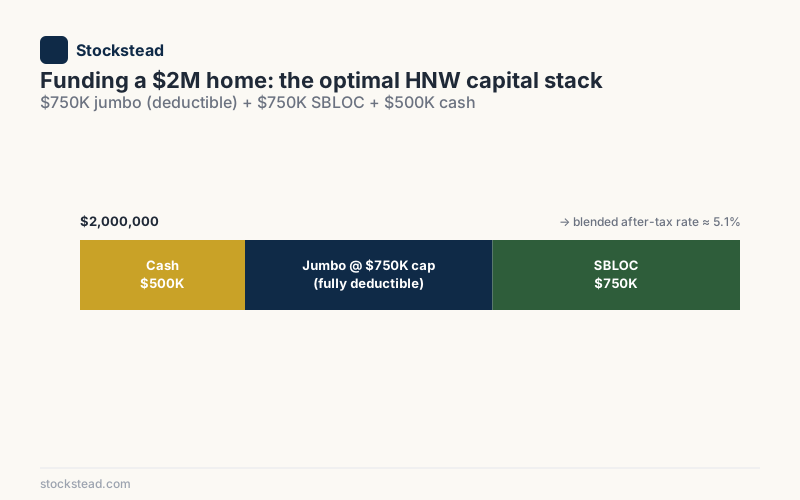
A purist version would draw the entire $2M from an SBLOC, but that's a 100% LTV draw and no lender will touch it — initial LTV caps at most institutions sit around 50%. So the realistic structure is a hybrid: $1M SBLOC against the $2M portfolio (50% initial LTV — high, but executable at a relationship banker on diversified collateral) plus a $1M jumbo mortgage.
SBLOC. $1,000,000 at 6.25%, interest-only. Annual interest: $62,500. Ten-year cumulative interest: $625,000. Not deductible (proceeds traced to home purchase, not investment under IRS Pub 550).
Jumbo mortgage. $1,000,000 at 6.75%, 30 years.
- Monthly P&I: $6,483
- Ten-year totals: ~$777,960 paid, of which ~$641,000 is interest and ~$137K is principal
- Balance at year 10: $863,040
- Deduction: a $1M balance fits cleanly inside the $750K cap on its early life and most of the interest is deductible. Average ~95% deductibility over 10 years.
- Deduction value: $641,000 × 95% × (37% federal + 9% state) ≈ $280,107
Portfolio compounding. Untouched. $2,000,000 growing at 7% real for 10 years: $3,934,000.
Ten-year position.
- Home equity: $2,000,000 − $863,040 (mortgage balance) = $1,136,960
- Portfolio: $3,934,000
- SBLOC owed: $1,000,000 (interest-only carry)
- Total net wealth: $1,136,960 + $3,934,000 − $1,000,000 = $4,070,960
Lifetime out-of-pocket cost. SBLOC interest + mortgage interest − mortgage deduction = $625,000 + $641,000 − $280,107 = $985,893.
The comparison, side by side
| Path | 10-yr cost | Ending net wealth | Tax bill | Notes |
|---|---|---|---|---|
| A: All cash | $2,261,000 | $2,000,000 | $328,000 | Worst on every dimension |
| B: Jumbo + small liquidation | $891,392 | $3,780,760 | $65,600 | Cheapest dollar cost |
| C: SBLOC + smaller jumbo, no liquidation | $985,893 | $4,070,960 | $0 | Highest ending wealth |
Three things jump out when you stack them this way.
The all-cash path is the clear loser by an enormous margin. $2.26M of effective cost on a $2M home — once you price in the tax bill and the compounding the buyer walked away from — is roughly 2.5 times the cost of either of the other paths. This is the path many "simple" buyers prefer instinctively, and it's the one that punishes them hardest.
Path B (jumbo) is the cheapest on nominal cost, but the gap to Path C is small. The mortgage path beats the SBLOC-hybrid by about $94K over ten years on out-of-pocket dollars. That's real money but it isn't the whole picture, because Path C ends with a substantially bigger portfolio base.
Path C wins decisively on ending wealth. Despite costing slightly more out-of-pocket, the SBLOC-hybrid leaves the buyer with $290K more total net wealth than the mortgage path at year 10. The intact $2M portfolio compounds harder than the SBLOC interest costs.
The relationship between cost and wealth here is the part most calculators don't make visible. Path B "wins" by one definition and "loses" by another. Which definition matters depends on what you're optimizing for.
A founder's note: this case study was the calculator
I'll be honest about what built this post: I was running these numbers for myself, in a Google Sheet, in late 2024, when I realized none of the existing mortgage tools had the columns I needed. I wasn't trying to start a company. I was trying to figure out whether an SBLOC actually made sense for the situation I was looking at — equity-heavy portfolio, NYC tax footprint, hold horizon long enough that the compounding curve mattered, and a stack of unrealized gains I didn't want to crystallize in a year my W-2 was already in the highest brackets I'd hit.
The thing that surprised me in my own modeling — and that I think is the takeaway most worth sharing — is that the path that looks cheapest (Path B) and the path that leaves you richest (Path C) are not the same path. The mortgage saves you ~$94K of out-of-pocket cost over a decade. The SBLOC-hybrid leaves you with $290K more wealth at the end of the same decade. Net of net, the SBLOC-hybrid is the wealthier outcome by about $200K, even after paying more in interest.
That fact only shows up if the model tracks both cost and ending net wealth, separately, with the full compounding math on the un-touched portfolio. Standard mortgage calculators don't track ending wealth. They track monthly payment. The frame is wrong for this buyer.
The other thing I learned, which doesn't show up cleanly in the tables: the SBLOC's advantage compounds over time. At year 10, Path C is ~$290K ahead of Path B on net wealth. At year 20, the gap widens to roughly $1.5M. At year 30, it's well over $3M. The longer the buyer's horizon, the more valuable the don't-realize-the-gain feature becomes — both because the underlying compounding gap widens and because the buyer can engineer the eventual realization (or non-realization) into a year of their choosing rather than the year of the closing.
I didn't end up running the numbers for "what if I bought in 2025 vs 2026 vs 2027" in this post. That's the next layer — timing risk on top of path choice — and the answer depends on assumptions I don't want to bake into a static case study. But it's worth knowing it's there, and worth modeling for your specific situation rather than relying on a 10-year-clean snapshot.
When this case study breaks
The 1:1 ratio is convenient but doesn't generalize cleanly. Three places where the conclusions change:
Bigger portfolio relative to home. $4M portfolio against a $2M home means the SBLOC can fund the full purchase at 50% LTV, no mortgage needed. That structure dominates everything else for any buyer who can carry the interest, because it preserves 100% of the portfolio compounding and avoids the dual-debt servicing problem.
Smaller portfolio relative to home. $500K portfolio against a $2M home means an SBLOC can only fund a small slice of the purchase, the rest has to be a mortgage, and the tax-avoidance value is modest because the small portfolio probably has a small embedded gain. The mortgage path wins by default.
Lower expected portfolio return. At 4% real, the SBLOC's interest cost exceeds the portfolio's growth and the leverage is a drag. Path B wins outright. The 7% return is doing more work in this analysis than buyers typically realize.
The single biggest assumption in any HNW financing decision is the expected portfolio return. If the buyer is confident the portfolio will outearn the SBLOC rate by 2%+ annually over the hold horizon, the SBLOC-hybrid is the wealth-maximizing structure. If the buyer is not confident, the mortgage is the safer bet.
Run your version
Stockstead runs exactly this analysis against your numbers — your portfolio size, your cost basis, your state, your bracket, the rates quoted to you, your expected return. The case study above is the canonical 1:1 shape; your shape probably isn't 1:1, and the answer might rank differently.
A wrong answer at this scale is a $1M+ mistake. A right answer compounds for thirty years.
Sources
- IRS Topic 409 — Capital Gains and Losses
- IRS — Net Investment Income Tax (NIIT)
- IRS Publication 936 — Home Mortgage Interest Deduction
- IRS Publication 550 — Investment Income and Expenses
- Robert Shiller — Long-run S&P 500 data
Educational, not financial advice. Tyler Singletary founded Stockstead while researching his own first home purchase. The case study above started as his own modeling exercise. He's spent 20+ years in software product roles — currently as Product Specialist for AI/ML Startups at AWS, previously CPO/COO at Tagboard, and an executive at Klout (exited to Lithium in 2014) — and has been compensated in RSUs, ISOs, and post-IPO equity at high-growth tech companies for two decades. He is not a licensed financial advisor or CPA. Run your numbers; talk to a fiduciary advisor and a tax professional before acting on any of these figures.
Frequently asked questions
- On a 1:1 portfolio-to-home ratio, which financing path wins?
On a $2M portfolio against a $2M home with 50% cost basis, 32.8% combined LTCG rate, an assumed 6.75% jumbo and 6.25% SBLOC, and 7% real returns over 10 years: paying cash costs $2.26M effective and ends with $2.0M of wealth, a jumbo plus partial liquidation costs $891K and ends with $3.78M, and an SBLOC-hybrid costs $986K and ends with $4.07M. The SBLOC-hybrid wins on ending wealth by $290K despite being roughly $94K more expensive on out-of-pocket carry. The path that looks cheapest is not the path that leaves you wealthiest.
- Why is paying cash for a $2M home so expensive in this case study?
Two compounding costs. Liquidating the full $2M portfolio realizes the entire $1M unrealized gain at a 32.8% combined rate, producing a $328K tax bill — and the $2M sale price net of tax is only $1.67M, so the buyer has to come up with another $328K from outside sources just to close. Then, the $2M portfolio that would have compounded at 7% real for 10 years would have grown to $3.93M. The cash buyer forfeits that $1.93M of compounding. Total effective cost: $328K tax + $1.93M forgone growth = $2.26M, on a $2M home.
- How does the SBLOC-hybrid path beat the jumbo path on net wealth?
By keeping the full $2M portfolio invested instead of liquidating $400K of it. In the jumbo path, $400K is sold (paying $65K tax) and the remaining $1.6M compounds at 7% real for 10 years to $3.15M. In the SBLOC-hybrid path, nothing is sold — the full $2M compounds for 10 years to $3.93M. The extra $780K of portfolio growth more than offsets the SBLOC's $625K of cumulative interest (since it is not deductible). The net wealth gap at year 10: $290K in favor of the SBLOC-hybrid.
- How does the wealth gap between paths change over a longer horizon?
It widens dramatically. At year 10, the SBLOC-hybrid is roughly $290K ahead of the jumbo path. At year 20, the gap grows to about $1.5M. At year 30, it is well over $3M. The longer the buyer's horizon, the more valuable the don't-realize-the-gain feature becomes — both because the underlying compounding gap on the intact portfolio widens and because the buyer can engineer the eventual realization or non-realization (death-step-up, low-income year, charitable donation) into a year of their choosing rather than the year of the closing.
- When does the SBLOC-hybrid advantage in the 1:1 case study fail?
Three conditions flip the ranking. Bigger portfolio relative to home — a $4M portfolio against a $2M home means the SBLOC can fund the full purchase at safe LTV and dominates everything. Smaller portfolio relative to home — a $500K portfolio against a $2M home means the SBLOC can only fund a small slice and the tax-avoidance value collapses; jumbo wins by default. Lower expected portfolio return — at 4% real instead of 7%, the SBLOC's interest exceeds the portfolio's compounding rate and leverage becomes a drag rather than a multiplier. The 7% return assumption is doing more work than buyers typically realize.
Ready to run the numbers on your situation?
Open the calculator →Related posts
High Net Worth Home Buyer Financing: The Complete Guide
Cash, jumbo mortgage, SBLOC, hybrid, and asset-depletion — the five paths to fund an HNW home purchase. After-tax math, decision framework, and links to deeper guides.
Jumbo Mortgages for HNW Buyers: When Banks Still Win
SBLOC is not always the answer. For many HNW home purchases, especially loans near the $750K deduction cap, a jumbo at the right bank is cheaper, safer, and cleaner.
SBLOC vs Mortgage vs Cash: The Complete HNW Guide
Four ways to fund a $300K down payment from a $2M portfolio, the 10-year math on each at current rates, and the failure mode standard mortgage calculators hide.