Capital Gains Tax on Home Down Payments Explained
By Tyler Singletary · · Updated · in Tax & deductions
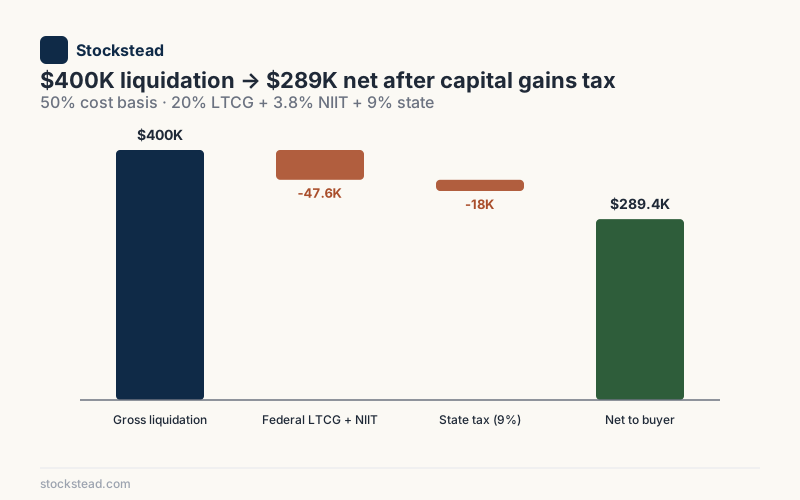
The number you pay in capital gains tax when you liquidate investments for a home down payment is not 15%. It is not 20%. For most HNW buyers liquidating from a high-cost-basis portfolio in 2026, it sits between 23.8% (Texas, Florida) and 37.1% (California) of the realized gain, with New York around 33.7% and most other high-tax states clustered between those two anchors.
This post walks the layers — federal long-term, NIIT, and state — and shows the combined number for the residency states that actually matter to HNW buyers. Where it gets interesting is the non-obvious parts: the NIIT threshold that hasn't moved since 2013, the cost-basis variable that swings the bill more than residency does, and the bracket-stacking that happens when an RSU vest and a portfolio liquidation hit the same tax year.
The four layers, in order
Federal long-term, NIIT, state, and (sometimes) local. They compose multiplicatively in some cases and additively in others, which is why the number that comes out of the wash is rarely the one buyers expect.
Layer 1: Federal long-term capital gains. 0%, 15%, or 20% based on taxable income. For 2026 (Rev. Proc. 2025-32), the 20% bracket starts at $545,500 single / $613,700 MFJ. For nearly every HNW buyer with W-2 income above $400K, the marginal long-term rate on a meaningful liquidation is 20%.
Layer 2: Net Investment Income Tax (NIIT). A flat 3.8% on top of the federal rate. Triggered when MAGI exceeds $200K single / $250K MFJ. Crucially, those thresholds are statutory — they have not been indexed since the tax took effect in 2013 — meaning more and more buyers cross them every year through inflation alone. Combined federal-plus-NIIT for the typical HNW filer: 23.8%.
Layer 3: State. Varies wildly. The states matter for HNW buyers because the dollars are large enough that the gap between low-tax and high-tax residency dwarfs the cost of moving, hypothetically, except moving has its own complications.
| State | Top LTCG rate (treated as) | Combined with 23.8% federal+NIIT |
|---|---|---|
| California | 13.3% (ordinary income) | 37.1% |
| New York | 10.9% | 33.7% (state residents above $25M income) |
| New York | 6.85% | 30.65% (most NY filers) |
| New Jersey | 10.75% | 33.55% |
| Massachusetts | 9% on > $1M gains | 30.0% |
| Illinois | 4.95% | 27.85% |
| Texas / Florida / Tennessee | 0% | 23.8% |
| Washington | 7% on > $250K LTCG | 29.6% (only on the marginal portion above $250K) |
Layer 4: Local. New York City adds 3.876% on top of state for residents earning above ~$50K MAGI, putting NYC's effective combined LTCG rate just under 38% for a 2026 buyer in the city — not far from California despite the much-publicized state-rate gap.
A buyer in NYC liquidating $300K of stock with a 50% basis ($150K gain) writes a tax check of roughly $57,000. A buyer in Austin doing the same thing writes a check for roughly $35,700. Same transaction, $21,300 difference, only because of geography.
The bigger lever: cost basis
Residency moves the rate. Cost basis moves the size of the gain that the rate is applied to. The latter swings the final tax bill more than the former, and most buyers don't have an accurate handle on it.
A $2M portfolio built over twenty years through patient buying and dividend reinvestment might have a cost basis of 70–80% of market value (only 20–30% unrealized gain). A $2M portfolio built mostly from RSU vests at grant-date prices that have since appreciated 4× might have a cost basis of 25%, meaning 75% of every dollar liquidated is realized gain. Same portfolio value. Wildly different tax bills.
A $300K liquidation, with combined rate of 30.65% (NY filer outside NYC):
- 80% basis: $60K gain × 30.65% = $18,400 in tax
- 50% basis: $150K gain × 30.65% = $45,975 in tax
- 25% basis: $225K gain × 30.65% = $68,963 in tax
- 10% basis (low-basis founder stock): $270K gain × 30.65% = $82,755 in tax
That's a 4.5× swing in tax bill, on the same dollar amount of liquidation, driven entirely by how the portfolio was built. The NYC-vs-Austin geographic swing was about $21K; the cost-basis swing on the same trade is over $64K.
If you don't know your cost basis cold, you don't know what your liquidation actually costs. Most brokerages report it on year-end statements. It's worth pulling.
What I didn't expect about my own bracket math
I'd been thinking about this as a static rate problem when I started researching for my own purchase: figure out the combined rate for my state, multiply by gain, get a number, decide. The version that actually showed up in my spreadsheet was much messier and much more expensive.
The thing I underestimated is bracket stacking in years when equity comp also lands. For a tech worker compensated in RSUs, the vest hits W-2 ordinary income. A meaningful vest in a calendar year — say, $200K of RSUs — pushes total taxable income up, which (a) puts more of any subsequent capital gain into the 20% federal LTCG bracket instead of the 15% bracket, (b) raises the amount of investment income exposed to NIIT, and (c) at the federal level interacts with the AMT exposure on any same-year ISO exercise. Liquidating $300K of long-held stock in that year is materially more expensive than liquidating the same $300K in a year with no vest.
The implication for my own model: don't think about "what's my LTCG rate" — think about "what's my combined effective rate in the specific tax year I'd liquidate." For me that meant the year I was eyeing for a purchase had me already at the highest combined rate I'd ever face, because of vest timing. Liquidating to fund the down payment in that year would have stacked an extra ~$20K of tax on top of the static-rate calculation. Which is, not coincidentally, roughly what the entire cost difference between SBLOC and liquidation comes out to in a single year of carry.
That's the moment the SBLOC question stopped being "is this cheaper?" and started being "is this avoidable?" The answer to "cheaper" is sometimes yes, sometimes no, depending on rates. The answer to "avoidable" is almost always yes — the gain doesn't have to be realized in 2026; it can be deferred, harvested in a deliberate low-income year, or never realized at all if the holder dies and the basis steps up.
That re-framing is what I think most HNW buyers miss when they read tax-rate posts in isolation. The question isn't "what rate do I pay." The question is "what rate will I pay in the specific year I'd otherwise force the realization."
Three planning levers most calculators ignore
If you're going to liquidate, the framework above is the static answer. But a buyer with optionality has at least three levers that change the bill.
Year selection. If you can spread a $1M liquidation across three tax years instead of one, you may keep more of it under the 20% federal LTCG bracket and below the highest NIIT exposure. This works most cleanly when the home purchase doesn't require all the cash at closing — for example, when an SBLOC fronts the down payment and the borrower paid back over a planned multi-year liquidation.
Lot selection. When you sell, you can typically specify which tax lots to sell — high-basis lots first to minimize realized gain, low-basis lots first if you're using a tax-loss-harvesting strategy that offsets them, or specific identification to optimize for the year. Default settings on most brokerages are FIFO, which is rarely tax-optimal.
Charitable offset. If you're already planning meaningful charitable giving, donating appreciated securities instead of cash means the charity gets the gross value, you avoid the gain on the donated lot, and you get a fair-market-value deduction. For HNW buyers in high-itemizing positions, this can shelter $50K–$200K of intended gain harvest. Not relevant for the down-payment dollars themselves, but relevant for the broader tax year.
When capital gains tax stops being the deciding factor
For everything I've said about how big this number is, there are profiles where it's small enough to ignore.
- High-cost-basis portfolios. If your basis is 80%+, the gain is small and the tax bill is in the noise. Liquidate.
- Recent contributions. If most of your portfolio is the last three years of paychecks, the embedded gain is modest. Liquidate.
- No-income-tax residents at the moderate end of the federal bracket. Florida filer in the 15% federal bracket with 3.8% NIIT and a 50% basis on a $300K liquidation pays about $28K — material but not huge.
- Loss harvesting available. If you have realized or unrealized losses to offset, the effective rate on the gain can be near-zero for the year.
In any of those scenarios, the tax-avoidance argument for an SBLOC weakens, and a clean liquidation becomes the simpler path. The framework is the same; only the inputs change.
Run your own combined rate
Stockstead's calculator computes the combined effective LTCG rate for your state, applies it to your cost basis, and runs the comparison against the SBLOC and traditional-mortgage paths. The static-rate answer is in the model. The bracket-stacking awareness — which year you're liquidating in and what other income hits that year — is on you, and it's worth modeling explicitly with your tax advisor before you sign.
The headline number is "23.8% to 37.1%, depending on state." The realistic number for any specific buyer in any specific year can be higher, sometimes meaningfully. Worth knowing before you write the check.
Sources
- IRS Rev. Proc. 2025-32 — 2026 inflation adjustments
- IRS Topic 409 — Capital Gains and Losses
- IRS — Net Investment Income Tax (NIIT)
- IRS Publication 550 — Investment Income and Expenses
Tax rates current as of 2026. Long-term capital gains brackets reflect IRS Rev. Proc. 2025-32 inflation adjustments. NIIT thresholds are statutory and unchanged since 2013. State rates (California, New York, Texas, etc.) are current as of January 2026; verify with your state's revenue department before relying on these figures. Educational, not financial or tax advice. Tyler Singletary founded Stockstead while researching his own first home purchase. He's spent 20+ years in software product roles — currently as Product Specialist for AI/ML Startups at AWS, previously CPO/COO at Tagboard, and an executive at Klout (exited to Lithium in 2014) — and has been compensated in RSUs, ISOs, and post-IPO equity at high-growth tech companies for two decades. He is not a licensed financial advisor or CPA. Tax rules are complex and your specific situation matters; consult a licensed professional before making any liquidation decisions.
Frequently asked questions
- What capital gains rate will I actually pay when liquidating stocks for a down payment?
Combined federal, NIIT, and state rates for HNW buyers in 2026 range from 23.8% in no-income-tax states (Texas, Florida, Tennessee) to 37.1% in California and roughly 38% in New York City. The federal long-term rate is 20% above $545,500 single or $613,700 MFJ in 2026. NIIT adds 3.8% above $200K/$250K MAGI thresholds — thresholds that have not been indexed since 2013, so more buyers cross them every year. State rates layer on top: California 13.3%, New York 6.85-10.9%, Massachusetts 9% above $1M gains. NYC adds 3.876% local on top of state.
- Why does the NIIT affect more HNW buyers each year?
Because the thresholds are statutory and have not been indexed for inflation since the tax took effect in 2013. The $200K single and $250K MFJ MAGI thresholds in 2013 represented genuinely high incomes; in 2026 dollars, they capture a meaningfully broader population. The 3.8% NIIT applies on top of federal long-term capital gains, taking the headline 20% bracket up to 23.8%. For HNW buyers liquidating stock for a down payment, NIIT exposure is essentially automatic — and gets bigger every year the threshold stays frozen while incomes drift up.
- Does cost basis matter more than state of residence for the tax bill?
Yes, often by 3-4×. A $300K liquidation in New York at a combined 30.65% rate produces a $18,400 tax bill if the cost basis is 80% (small embedded gain), or $82,755 if the basis is 10% (low-basis founder stock). That is a 4.5× swing on the same dollar amount of liquidation, driven entirely by how the portfolio was built. The same $300K trade moved from NYC to Austin saves about $21,000 — meaningful but smaller than the basis swing. If you do not know your cost basis cold, you do not know what a liquidation actually costs.
- How does an RSU vest in the same tax year affect my capital gains tax bill?
Substantially, through bracket stacking. RSU vests hit W-2 ordinary income. A meaningful vest — say $200K of RSUs — pushes total taxable income up, which then pushes more of any subsequent capital gain into the 20% federal LTCG bracket instead of 15%, raises the amount of investment income exposed to NIIT, and at the federal level interacts with AMT exposure on any same-year ISO exercise. Liquidating $300K of long-held stock in a high-vest year is materially more expensive than liquidating the same $300K in a year with no vest. The question is rarely 'what is my LTCG rate' — it is 'what is my combined effective rate in this specific tax year.'
- What planning levers can reduce the capital gains hit on a liquidation?
Three big ones. Year selection — spreading a $1M liquidation across three tax years instead of one can keep more of it under the 20% federal LTCG threshold and below peak NIIT exposure, particularly effective when an SBLOC fronts the down payment and the borrower repays on a planned multi-year liquidation schedule. Lot selection — most brokerages default to FIFO, but specific identification lets you sell high-basis lots first to minimize realized gain. Charitable offset — donating appreciated securities directly to a donor-advised fund instead of cash means you avoid the gain on the donated lot and get the fair-market-value deduction.
Ready to run the numbers on your situation?
Calculate the tax cost of selling your stock →Related posts
Tax-Loss Harvesting Before a Home Purchase: Playbook
If you're about to liquidate portfolio assets for a home down payment, a disciplined tax-loss harvesting pass can save six figures. Here's the timing and the playbook.
Selling Stock to Cover a Margin Call: Why the Math Sometimes Fails
Selling pledged stock to cure an SBLOC collateral call is not a simple paydown — the sale shrinks your collateral and the tax leaks out of the proceeds. Past a certain embedded gain, no sale of any size cures the call.
The $200K Mistake: Liquidating Stock for a Down Payment
See how capital gains taxes and opportunity cost can turn a $200K down payment into a $301K decision. Use our free calculator to compare options.