SBLOC Rates 2026: Schwab, Fidelity, IBKR, Morgan Stanley
By Tyler Singletary · · Updated · in How it works
Rates as of October 8, 2026 (SOFR 3.87%). SBLOC rates float with SOFR and each lender's schedule can change without notice — verify directly with the lender before sizing a draw. Source links for every schedule are at the bottom of this post.
Correction, October 11, 2026: An earlier version of this post described Fidelity's offering as its margin loan at roughly 5.50% on a $1M draw. Fidelity's published margin rate is much higher (10.825% base rate), and Fidelity does offer a separate securities-backed line of credit, which is what this comparison now prices.
If you are pricing out a securities-backed line of credit to fund a home purchase, the rate is the biggest variable you can shop. A 100 basis point difference on a $1 million line is $10,000 a year, every year, until you pay it down. (If you're still deciding whether an SBLOC is the right structure at all, our SBLOC vs mortgage vs cash guide walks through the full comparison first.)
This post compares four venues HNW investors commonly use for SBLOC-style borrowing: Charles Schwab's Pledged Asset Line, Fidelity's securities-backed line of credit, Interactive Brokers Pro margin, and Morgan Stanley's Liquidity Access Line.
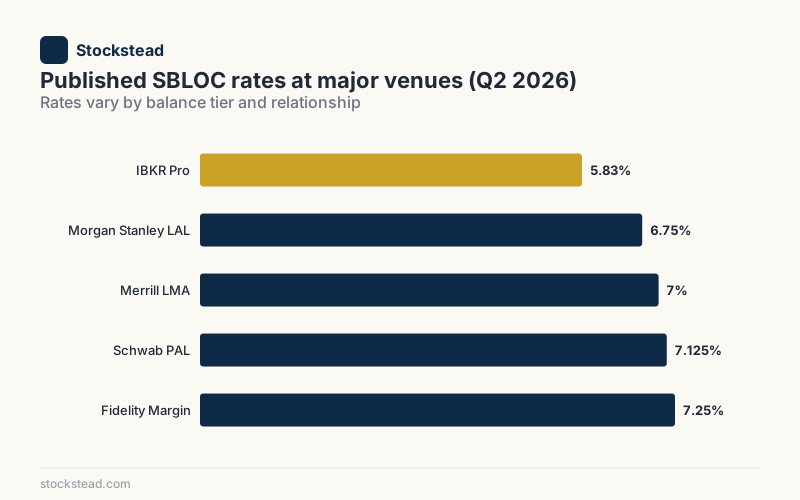
At a glance — published all-in rate on a $1M draw (SOFR 3.87%, as of October 8, 2026, cheapest first):
| Venue | All-in rate on a $1M draw | Annual interest | Margin-call enforcement |
|---|---|---|---|
| Interactive Brokers Pro margin | 4.93% | $49,300 | Reg T margin; algorithmic liquidation, often within minutes |
| Morgan Stanley Liquidity Access Line | 5.40% (fixed promo) | $54,000 | Non-purpose line; banker discretion on calls |
| Fidelity securities-backed line | 6.22% | $62,200 | Non-purpose line from third-party lenders; call with a cure window |
| Schwab Pledged Asset Line | 6.77% | $67,700 | Non-purpose loan; call with a cure window |
What changed in 2026
The Federal Reserve held rates through July, then raised the federal funds target by 25 basis points on September 16, 2026, to 3.75–4.00%. SOFR, the benchmark most SBLOCs float on, was 3.87% on October 8, 2026.
Mortgage rates moved further. The Freddie Mac 30-year fixed averaged 7.40% and the MBA jumbo 30-year 7.39% — both well above where they started the year. That has widened the gap between SBLOC and mortgage rates: at the $1M level, every published SBLOC rate in this comparison is now below the 30-year fixed.
That is a rate comparison, not a verdict. An SBLOC floats and can be called; a fixed mortgage can't do either. The next FOMC meetings are October 27–28 and December 8–9, 2026, and any move flows straight through to SBLOC rates.
A note on methodology
Each lender quotes its rate as a spread over a benchmark. Schwab and Fidelity use SOFR, published daily by the New York Fed. Interactive Brokers uses its own benchmark, which tracks the effective federal funds rate rather than SOFR. To get your actual cost on the day you borrow, add the lender's spread to that day's benchmark.
We use a $1 million draw as the comparison size. Smaller lines pay higher spreads at every lender. All figures are published list rates; relationship pricing can be meaningfully lower.
Charles Schwab Pledged Asset Line
Schwab's PAL is the closest thing to a "standard" SBLOC. It is structured as a non-purpose loan, meaning proceeds cannot be used to buy securities — but a home purchase, business expenses, and personal use are all eligible.
Published spread schedule over SOFR:
- $100K to $250K: SOFR + 4.40% (8.27%)
- $250K to $500K: SOFR + 3.90% (7.77%)
- $500K to $1M: SOFR + 3.40% (7.27%)
- $1M to $2.5M: SOFR + 2.90% (6.77%)
- $2.5M and up: SOFR + 2.40% (6.27%)
Two details matter. First, Schwab sets your tier by the loan value of the collateral you pledge, not by how much you draw — so a large pledged portfolio can earn a tighter spread on a smaller draw. Second, relationship pricing commonly takes 0.25–1.00% off the published schedule. At list price, a $1M line costs about 6.77%.
Strengths: purpose-built for non-securities borrowing, familiar for existing Schwab clients, and meaningful discounts for larger relationships.
Weaknesses: the highest list price of the four at the $1M tier, and the rate can change after origination.
Fidelity securities-backed line of credit
Fidelity offers a securities-backed line of credit through third-party lenders, separate from its brokerage margin loan. The minimum line is $100,000, and Fidelity says clients typically pledge at least $500,000.
Published spread schedule over SOFR:
- $100K to $500K: SOFR + 3.10% (6.97%)
- $500K to $1M: SOFR + 2.85% (6.72%)
- $1M to $3M: SOFR + 2.35% (6.22%)
- $3M and up: SOFR + 1.90% (5.77%)
For a $1M line that is about 6.22%. Don't confuse it with Fidelity's margin loan, whose base rate is 10.825% — margin is a far more expensive way to borrow against a Fidelity account at these sizes.
Strengths: a published, transparent schedule that undercuts Schwab's list price at every tier we compared.
Weaknesses: the line is held with a third-party lender rather than inside your Fidelity brokerage relationship, which adds a separate application and agreement.
Interactive Brokers Pro margin
IBKR has been the price leader on margin rates for a decade. Its rates are blended: each slice of your balance is charged its own tier's spread, so the effective rate on a large balance is a weighted average.
Published IBKR Pro schedule:
- Up to $100K: benchmark + 1.50% (5.38% on that slice of the balance)
- $100K to $1M: benchmark + 1.00% (4.88% on that slice of the balance)
- $1M to $50M: benchmark + 0.75% (4.63% on that slice of the balance)
- $50M and up: benchmark + 0.50% (4.38% on that slice of the balance)
Blended across tiers, a $1M balance costs about 4.93%.
The catch: this is a Reg T margin loan, not a purpose-built SBLOC. IBKR is a brokerage, not a wealth manager. There is no relationship banker, and maintenance enforcement is the most algorithmic in the industry — if your account breaches maintenance, IBKR can liquidate positions within minutes, not days.
Strengths: the lowest published carry without a private-bank relationship; a transparent schedule.
Weaknesses: aggressive automated liquidation, and less suitable for borrowers who want a human in the loop during a drawdown.
Morgan Stanley Liquidity Access Line
The Morgan Stanley LAL is the full-service option, offered to wealth-management clients. Its floating spread schedule is not published — pricing is negotiated within the relationship.
What Morgan Stanley does publish is a fixed-rate offer:
- 5.40% 1-year fixed promotional rate (offer ends November 6, 2026)
A fixed rate removes the floating-rate risk that defines every other line here, which is unusual for an SBLOC. It is a promotion with an end date, so check it is still available before relying on it.
Strengths: banker availability during market stress, the option of a fixed rate, and pricing that can be bundled with a broader wealth relationship.
Weaknesses: the floating rate isn't published, and access requires a Morgan Stanley wealth-management relationship.
Side-by-side cost on a $1M draw
The annual interest column in the table above is the cost of carrying a $1M balance for a year at today's published rates. Over five years, the gap between Interactive Brokers Pro margin and Schwab Pledged Asset Line at list price is roughly $92,000 in cumulative interest — before any relationship discount, and assuming SOFR stays where it is.
Why borrowers pay more than the lowest rate
Cheaper is not always better with leverage. Reasons HNW borrowers often accept a higher rate:
Margin-call handling. A purpose-built SBLOC with a cure window gives you time to post collateral or pay down the line. An algorithmic margin loan may liquidate positions before you can respond.
Banker relationships. A relationship banker may have discretion during a market dislocation that an automated system does not.
Rate certainty. A fixed-rate offer like Morgan Stanley's removes the risk that the next Fed hike raises your carrying cost.
Regulatory regime. A pledged asset line is a non-purpose loan, not a margin loan. The classification affects how the loan is enforced and how the interest may be treated for tax purposes — see our post on whether SBLOC interest is tax deductible.
How to weigh the options
The lowest rate belongs to the venue with the least forgiving enforcement. If you are comparing a low-cost margin loan against a pricier SBLOC, the questions are how much drawdown your portfolio could see while the line is outstanding, and what happens if the lender acts before you can. Our SBLOC margin call guide walks through that risk.
Published schedules are a starting point. Schwab and Morgan Stanley in particular price relationships individually, so a quote from your own banker may beat the list rates here.
See it modeled against your numbers
The rate is one input. Your tax bracket, cost basis, and expected portfolio return matter just as much. Stockstead's calculator lets you enter any rate — a published one from this page or a quote from your banker — and compare the after-tax cost of an SBLOC against paying cash or taking a mortgage.
Sources and further reading
- Charles Schwab — Pledged Asset Line rates
- Fidelity — Securities-backed line of credit
- Fidelity — Margin rates
- Interactive Brokers — Margin Rates
- Morgan Stanley — Liquidity Access Line fixed-rate offer
- Federal Reserve Bank of New York — SOFR Reference Rates
- Federal Reserve — FOMC statement, September 16, 2026
- Freddie Mac — Primary Mortgage Market Survey
- FINRA — Securities-Backed Lines of Credit (Investor Alert)
Rates as of October 8, 2026 from publicly posted schedules. Lender rate schedules change frequently; verify directly with the lender before sizing a draw. Educational, not financial advice. Tyler Singletary is the founder of Stockstead and is not a licensed financial advisor.
Frequently asked questions
- What is the lowest SBLOC rate in 2026?
As of October 8, 2026, the lowest published rate on a $1M draw is Interactive Brokers Pro margin at about 4.93%. Interactive Brokers is a Reg T margin loan rather than a purpose-built SBLOC, and it enforces maintenance algorithmically, so a sharp drawdown can trigger liquidation within minutes rather than days.
- Which broker has the cheapest SBLOC for a $1M draw?
On published rates as of October 8, 2026: Interactive Brokers Pro margin 4.93%, Morgan Stanley's 1-year fixed promotional LAL rate 5.40%, Fidelity's securities-backed line 6.22%, and Schwab's Pledged Asset Line 6.77% at list price. Schwab relationship discounts of 0.25–1.00% are common, and Morgan Stanley's floating schedule is not published.
- How is SBLOC interest calculated?
Most SBLOCs charge a spread over SOFR, the Secured Overnight Financing Rate published daily by the New York Fed. Schwab's Pledged Asset Line at the $1M tier is SOFR + 2.90%; with SOFR at 3.87% on October 8, 2026, that is 6.77% all-in. Spreads tighten as the line size grows, and the rate floats with SOFR, so it moves every time the Fed does.
- Is a Pledged Asset Line the same as an SBLOC?
Functionally, yes. Schwab's Pledged Asset Line is a securities-backed line of credit structured as a non-purpose loan: the proceeds can't buy securities but can fund a home. A margin loan, like Interactive Brokers Pro margin, is different: it operates under Regulation T inside the brokerage account, with different enforcement mechanics.
- Are SBLOC rates lower than mortgage rates right now?
As of October 8, 2026, yes at the $1M level. The Freddie Mac 30-year fixed averaged 7.40% and the MBA jumbo 30-year 7.39%, while every published $1M SBLOC rate in this comparison was lower. The trade-off: SBLOC rates float with SOFR and can rise after any Fed meeting, while a fixed mortgage locks the rate for 30 years.
Ready to run the numbers on your situation?
Open the calculator →Related posts
Schwab Pledged Asset Line for a Home Purchase: When It Wins, the Process, and the Rate Schedule
When a Schwab Pledged Asset Line beats a jumbo or IBKR margin for a home purchase: the application process, the two LTVs that govern safety, and a worked $1M example.
Pledged Asset Line vs SBLOC: Are They the Same Thing?
PAL and SBLOC get used interchangeably, but the underlying products have meaningful differences in structure, rate, and enforcement. Here's what actually separates them.
Interactive Brokers Margin vs SBLOC for a Home Purchase
IBKR Pro margin is the cheapest leverage available to most retail investors. Here's when to use it for a home purchase — and when its enforcement model makes a slower SBLOC the better choice.