Schwab Pledged Asset Line for a Home Purchase: When It Wins, the Process, and the Rate Schedule
By Tyler Singletary · · Updated · in How it works
If you bank with Charles Schwab and you are buying a home large enough to make a portfolio-backed credit line worth considering, the Schwab Pledged Asset Line (PAL) is probably the most natural fit on the market. It is not the cheapest. It is not the most negotiable. But it is the cleanest middle ground between the algorithmic enforcement of Interactive Brokers margin and the relationship-heavy private bank options like Morgan Stanley's Liquidity Access Line and Goldman Sachs Select.
This guide is the complete walkthrough of how Schwab PAL works for a home purchase: the published rate schedule, the concessions Private Client clients actually negotiate, the application timeline, the two LTVs that determine your safety, and the specific scenarios where Schwab PAL beats both IBKR Pro on operational fit and a jumbo mortgage on after-tax cost. For the broader landscape of HNW home financing options — cash, jumbo, hybrid, asset-depletion — see our complete guide to high net worth home buyer financing.
Market rates in this post are shown as of October 8, 2026. The worked example uses the illustrative rates it states. Schwab's published spread schedule changes — verify directly with a Schwab Bank lending specialist before sizing a draw. Source links for the official rate schedule and primary regulatory references are at the bottom of this post.
What the Schwab Pledged Asset Line Actually Is
A Schwab PAL is a non-purpose loan — a revolving credit line secured by your taxable investment account, structured outside of Federal Reserve Regulation T because the proceeds cannot be used to buy additional securities. Real estate, business expenses, and personal use (including a home purchase) are all eligible. The pledged account stays in your name, you continue to trade within Schwab's restrictions, and Schwab takes a contingent claim on the assets if you breach the maintenance ratio.
Mechanically, the structure is identical to the SBLOC structure offered at every major brokerage — see our complete walkthrough of how an SBLOC works for the universal mechanics. What is specific to Schwab:
- The pledged account must be a non-retirement Schwab brokerage account. Schwab IRAs are not eligible. Joint accounts are eligible. Trust accounts can be pledged if the trust instrument permits.
- Schwab assigns advance rates per asset class and publishes the schedule. The blended advance rate against your specific mix determines your maximum line size.
- Interest accrues daily on the outstanding balance, billed monthly. No required principal payment. No defined maturity. The line stays open indefinitely as long as you pay interest and the collateral holds.
- Schwab is one of the cleaner non-purpose structures in terms of operational integration — the PAL account is separate from the brokerage, and you can manage both inside the same Schwab dashboard.
For most HNW Schwab clients considering an SBLOC for a home purchase, the choice is rarely "Schwab PAL vs. some other broker's SBLOC at a wildly different rate." It is Schwab PAL vs. IBKR margin vs. Morgan Stanley LAL. As of October 8, 2026, published rates on a $1M draw were 6.77% for Schwab's PAL at list price, 4.93% for IBKR Pro margin, and 5.40% for Morgan Stanley's 1-year fixed promotional LAL rate (its floating schedule is not published). The spread between venues is real money, but the decision is also about enforcement model, banker discretion, and operational fit.
Rate Schedule and How Schwab Prices Tiers
Just comparing current SBLOC rates across brokers? This guide covers Schwab's PAL in the context of a home purchase. For the side-by-side rate breakdown across Schwab, Fidelity, IBKR, and Morgan Stanley — kept current for 2026 — see the dedicated 2026 SBLOC rates comparison.
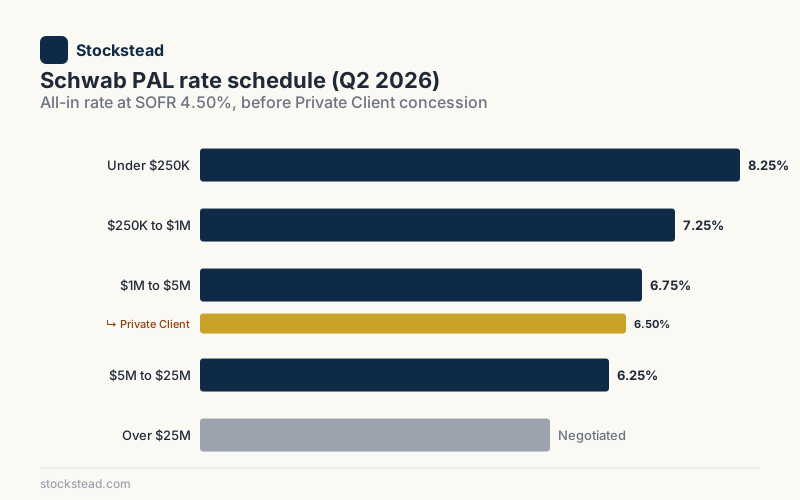
Schwab publishes a tiered spread schedule over SOFR (the Secured Overnight Financing Rate, published daily by the Federal Reserve Bank of New York). The tier is set by the loan value of the collateral you pledge, not the amount you draw. The published schedule before relationship discounts, as of October 8, 2026 (SOFR 3.87%):
| Loan value of collateral | Spread over SOFR | All-in rate |
|---|---|---|
| $100K to $250K | SOFR + 4.40% | SOFR + 4.40% |
| $250K to $500K | SOFR + 3.90% | SOFR + 3.90% |
| $500K to $1M | SOFR + 3.40% | SOFR + 3.40% |
| $1M to $2.5M | SOFR + 2.90% | 6.77% |
| $2.5M and up | SOFR + 2.40% | SOFR + 2.40% |
For a $1M draw, which needs at least $1M of collateral loan value, the published rate is 6.77% all-in. One band lower adds 50 basis points. The schedule rewards larger collateral materially: each step up a band cuts the spread by 50 basis points on the entire balance.
Relationship discounts. Schwab publishes a discount off the schedule based on qualifying Schwab assets (as of October 8, 2026: 0.25% at $250K to $1M, 0.50% at $1M to $5M, 0.75% at $5M to $10M, and 1.00% at $10M and up). On a $1M-tier line at SOFR + 2.90%, the 0.50% discount brings the spread to SOFR + 2.40%. This guide calls this the Private Client concession.
Ultra-high-net-worth relationships ($10M+ in assets, often with broader Schwab wealth management engagement) negotiate further. Spread concessions of 100-150 basis points off the published schedule are achievable for clients with the scale.
The practical takeaway: the published rate is the ceiling for HNW clients, not the floor. Always ask your Schwab banker for the all-in rate they can actually deliver before doing the cost comparison against IBKR margin or a jumbo mortgage. The full venue-by-venue comparison is in our 2026 SBLOC rates breakdown across Schwab, Fidelity, IBKR, and Morgan Stanley.
The Application Process (Start to First Draw)
For an existing Schwab brokerage client with a non-retirement account at adequate scale, the PAL application is reasonably fast.
Day 0 — Initiate the application. Online or through your Schwab banker. The application is short relative to a mortgage — Schwab can see your account composition and balance in real time, so they do not ask for asset documentation. They will ask for basic employment and use-of-proceeds information, plus your requested line size.
Days 1-3 — Eligibility review. Schwab Bank reviews the pledged account's composition. The blended advance rate is computed against the specific holdings. Concentrated single-stock positions over 25% of the account get reduced advance rates. Restricted or unvested securities (post-IPO lockup shares, RSUs that have not vested) typically get zero advance rate. The bank confirms the maximum line size your collateral supports.
Days 3-7 — Documentation. Schwab sends a pledge agreement and a credit line agreement to sign. Both are e-signable in most cases. The pledge agreement creates a security interest over the brokerage account; the credit line agreement defines the line size, the rate (referencing the schedule), the maintenance ratio, and Schwab's remedies on default.
Days 7-10 — Line opens. Schwab Bank funds the line and you receive your draw mechanism (typically a linked bank account where draws are wired). You can draw at will, up to the line cap.
Day of closing — Draw and wire. Wire the draw amount to the closing agent. Interest begins accruing on the drawn balance from the wire date.
The total timeline from initiating the application to having funds at closing is typically 5-15 business days. If you need to transfer in additional securities to support a larger line, ACATS adds 5-10 days.
By comparison: a jumbo mortgage from a private bank takes 30-60 days. The SBLOC's operational speed is a meaningful advantage for competitive home purchases, especially in markets where a cash close wins the negotiation.
Advance Rates and the Two LTVs That Govern Safety
Schwab assigns advance rates per asset class. The exact rates vary by account composition and are updated periodically. Representative values for a clean diversified portfolio as of early 2026:
| Asset class | Approximate advance rate |
|---|---|
| US Treasury ETFs and notes | 85-95% |
| Diversified equity ETFs (VTI, VOO, VXUS) | 65-75% |
| Large-cap individual stocks (S&P 500 names) | 50-70% |
| Mid-cap and small-cap individual stocks | 30-50% |
| Concentrated single-position holdings (>25% of account) | 25-50% |
| International or sector ETFs | 50-65% |
| Investment-grade municipal bonds | 75-85% |
| High-yield bonds and below-investment-grade | 30-50% |
| Restricted or post-IPO lockup shares | 0% |
The blended advance rate against your specific mix determines your maximum line size. A diversified $2M portfolio at Schwab might support a maximum line of $1.3-1.4M (a blended advance rate of 65-70%). A tech-concentrated $2M portfolio might only support $900K-1.1M (a blended rate of 45-55%).
Two LTVs govern your safety once the line is drawn. Initial LTV is what you draw on day one against the current portfolio value — Schwab caps it at the blended advance rate, but you do not have to draw that high. Maintenance LTV is the threshold at which a call is triggered — typically 70% on diversified collateral.
The relationship between them tells you how much market drop you can absorb. Crude formula: portfolio drop tolerance = 1 minus (initial LTV divided by maintenance LTV). Drawing $500K against a $2M portfolio (25% initial LTV) with a 70% maintenance threshold gives you tolerance for a 64% portfolio drop before a call. Drawing $1.3M against the same $2M portfolio (65% initial LTV) gives tolerance for only a 7% drop — barely a normal correction. For the math behind why initial LTV matters more than rate, see our stress test of SBLOC structures through the 2008 drawdown.
When Schwab PAL Wins (vs IBKR Pro and vs Morgan Stanley LAL)
The three real comparison points for an HNW Schwab client are IBKR Pro margin, Morgan Stanley LAL, and a jumbo mortgage at the right bank. Schwab PAL wins each on different facts.
vs IBKR Pro margin. As of October 8, 2026, IBKR Pro margin on a $1M balance was 4.93% against 6.77% for Schwab's PAL at list price. Over a five-year carry on $1M, the gap between Interactive Brokers Pro margin and Schwab Pledged Asset Line at those published rates is about $92,000 in cumulative interest — real money. But IBKR's enforcement is algorithmic: a maintenance breach triggers automated liquidation within minutes, no human review, no banker call, no extended cure window. For a buyer who travels internationally, who holds any concentrated stock position, who cannot monitor the account during trading hours, or who simply wants a human in the loop during a 2008-style event, the Schwab premium is operational insurance worth paying. Schwab's 3-5 business day cure window plus relationship banker discretion is the real product. See our IBKR margin vs SBLOC comparison for the full operational breakdown.
vs Morgan Stanley LAL. Morgan Stanley does not publish its floating LAL schedule; its published offer as of October 8, 2026 was a 1-year fixed promotional rate of 5.40% on new advances, for a limited time. Beyond promotions, Morgan Stanley operates on a relationship pricing model that can produce materially lower negotiated rates for clients with broader wealth management relationships, typically $5M+ in invested assets. Schwab Private Client gets you a similar concession, but Schwab's wealth management offering is less customized than Morgan Stanley's. For a buyer who wants Schwab's lower minimum thresholds for relationship pricing (Private Client kicks in at $1M assets, not $5M+), Schwab wins.
vs jumbo mortgage. The jumbo on a primary residence is fully deductible up to the $750K acquisition cap under IRC Section 163(h)(3). At a 37% federal bracket plus 9% state, an illustrative 6.75% jumbo has an after-tax effective rate around 3.65% (the jumbo 30-year average was 7.39% as of October 8, 2026) — substantially below any SBLOC's non-deductible rate. The jumbo wins on after-tax cost for the deductible portion of the mortgage. Where Schwab PAL beats jumbo: down payment financing (mortgage interest deduction does not apply to a portfolio-secured loan funding the down payment), purchases above the $750K acquisition cap, and any scenario where avoiding a capital gains realization on liquidation has higher after-tax value than the deduction. The math is in our SBLOC vs mortgage vs cash pillar.
A Worked Example: $1M Schwab PAL on a $3M Portfolio
Concrete numbers, using illustrative rates: SOFR at 4.50% and an earlier Schwab schedule ($1M-to-$5M tier at SOFR + 2.25%, less a 25 bp concession, for 6.50%). As of October 8, 2026, SOFR was 3.87% and Schwab's published $1M-tier rate was 6.77% before relationship discounts, so treat the dollar figures as a template, not a quote. Buyer is a 42-year-old tech executive with:
- $3,000,000 Schwab brokerage account (65% diversified ETFs, 25% large-cap individual stocks, 10% Treasury ETF)
- $2,500,000 home purchase, 20% down ($500K)
- $250,000 in cash savings
- Schwab Bank Private Client status (qualifies via the $3M brokerage relationship)
- NY tax footprint: 37% federal + 6.85% state = ~46% combined marginal rate on ordinary income
Line size and initial LTV. The blended advance rate on a 65/25/10 mix at Schwab is approximately 67% (65% equity ETF at 70% + 25% large-caps at 60% + 10% Treasuries at 90% = ~67% blended). Maximum line: $2.0M. Buyer requests a $1.0M line and draws $250K of it for the gap above the $250K cash savings, funding the full $500K down payment in cash at closing.
Rate. Private Client tier on $1M-$5M: assumed SOFR + 2.25%, with a 25 bp concession to SOFR + 2.00%. At SOFR 4.50%, that is 6.50% all-in.
Annual carry. $250K balance at 6.50% = $16,250 per year. Interest-only; the buyer services the carry from W-2 cash flow.
Initial LTV at draw. $250K balance against $3M portfolio = 8.3% LTV. With a 70% maintenance threshold, the portfolio would need to drop 88% before a call. This is structurally bulletproof — even a 2008-level 45% drawdown leaves the buyer at $250K / $1.65M = 15% LTV, still in the deeply-safe zone.
Ten-year cost. Assuming SOFR stays at 4.50% on average (it varies; this is illustrative), cumulative interest is roughly $162,500 over a decade. Not deductible. Compare to liquidating $250K at a 50% basis: $125K gain × ~28% combined LTCG rate = $35,000 in tax, plus the forgone compounding on $250K at 7% real for 10 years = approximately $215,000 of opportunity cost. Total cost of the liquidation path is roughly $250,000 — meaningfully higher than the SBLOC carry.
The SBLOC wins by ~$88K on this specific worked example. The wider the portfolio's expected return and the lower the cost basis, the wider the win.
When Schwab PAL Is the Wrong Tool
A few profiles where the structure does not fit and a different path is correct.
Insufficient diversification. If the Schwab account is heavily concentrated in one stock — typical for founders or long-tenured tech employees with vested employer equity — the blended advance rate drops to 35-50%, the available line shrinks materially, and the maintenance call risk during a single-stock drawdown is concentrated. A hedged SBLOC (collar structure) at a private bank, or selective diversification before opening the line, is usually a better fit. See our concentrated stock position playbook.
Pre-IPO or post-IPO lockup. Restricted shares get zero advance rate. If most of the Schwab account value is locked-up equity, Schwab PAL cannot meaningfully fund the purchase. Wait for the lockup to clear, or bridge with an alternative structure.
No external cash reserve. SBLOC interest is paid from cash flow. If servicing the carry requires drawing further on the line, the leverage compounds against the buyer and the structure accelerates toward a margin call. A cash reserve of 10-15% of the line balance, held outside the pledged account, is the operational floor.
Within 10 years of retirement. The SBLOC math depends on the portfolio compounding faster than the borrowing rate over the carry window. As retirement approaches, the portfolio typically shifts to income from growth, expected returns drop, and the SBLOC's compounding advantage erodes. A traditional jumbo or asset-depletion mortgage usually fits better. See when not to use an SBLOC for a home purchase for the full disqualifier list.
The Margin Call Reality at Schwab Specifically
Schwab's enforcement falls in the middle of the spectrum between IBKR's algorithmic style and Morgan Stanley's relationship style.
If your LTV crosses the 70% maintenance threshold, Schwab generates a call notification — typically via email and in your account portal — quantifying the cure amount and stating the deadline. The cure window at Schwab is typically 3-5 business days, sometimes extended on a first call for clients with a credible plan and a Private Client banker relationship. The cure options are the standard three: deposit cash into the pledged account (fastest), transfer in additional eligible securities from another brokerage (slower, requires ACATS), or sell positions to pay down the line (last resort because it crystallizes gains at the bottom).
If you miss the deadline, Schwab Bank sells securities at its discretion to pay down the line. You do not pick the lots. You do not pick the tax treatment. The lender is optimizing for restoring a safe LTV, not for your tax bill.
The full operational mechanics, including how Schwab compares to IBKR and Morgan Stanley on cure-window behavior, are in our SBLOC margin call guide. The single most consequential decision in opening a Schwab PAL is the initial LTV — drawing at 25-30% gives you cushion for any historical drawdown; drawing at 50%+ does not.
How to Negotiate the Best Rate
Schwab's published schedule is a starting point. A few concrete moves to lower your all-in rate.
-
Consolidate assets at Schwab before applying. A line size that bumps you into the next tier reduces the spread on the entire balance. If your collateral's loan value sits just under a band boundary, transferring assets in from a competitor (and unlocking the next band) is often worth more than any one-time bonus the competitor might offer.
-
Establish Schwab Bank Private Client status. Schwab's published relationship discount (0.25% to 1.00% depending on qualifying Schwab assets, as of October 8, 2026) applies once you qualify. The 0.50% level starts at $1M in qualifying assets — much lower than most private bank tiers.
-
Ask your banker directly for a relationship concession. Particularly if you have multiple Schwab products (brokerage, banking, a mortgage with Schwab Bank), the bundled relationship has value. The first quote is rarely the best quote. A banker authorized to negotiate can typically drop 10-25 bp on top of the standard Private Client concession.
-
Compare against competitor quotes before signing. A live quote from IBKR Pro, Morgan Stanley, or Fidelity gives your Schwab banker something to match. Schwab does not love losing HNW relationships to competitors over 25 basis points.
-
Time the application to your relationship review. Schwab Bank often refreshes its concession schedules quarterly. Applying right after a refresh, or right after a Private Client review meeting, tends to produce better terms than applying at the end of a quarter when the banker has less flexibility.
The combined effect of these moves is typically a 50-100 basis point reduction off the published schedule. On a $1M five-year carry, that is $25,000 to $50,000 in cumulative interest savings.
Sample Application Walkthrough
If you are ready to start the process, the order of operations:
- Confirm your pledged account is at Schwab and is non-retirement. If not, decide whether to transfer in or use a different lender.
- Compute the blended advance rate against your current holdings to estimate the maximum line size. Use the schedule above as a baseline; ask Schwab for the live rate.
- Decide on your initial draw size. Conservative posture is 25-30% of the portfolio.
- Establish or confirm Schwab Bank Private Client status. If you are at $900K-$1M in qualifying assets, the marginal cost of consolidating to clear the threshold is usually worthwhile.
- Initiate the PAL application online or through your Schwab Bank relationship manager.
- While the application is processing (5-7 days), confirm your home-purchase financing structure: mortgage size, down payment, draw amount, cash savings level.
- Sign the pledge and credit line agreements when delivered.
- Once the line is open, do not draw until closing day. Drawing early means accruing interest on funds sitting in your bank account.
- On closing day, draw the down payment amount and wire to the closing agent.
- Begin monthly interest payments out of cash flow. Monitor the account LTV during volatile periods.
See the Math for Your Specific Situation
Stockstead models a Schwab PAL against your actual numbers — your portfolio value, your cost basis, your tax bracket, your state, your expected return, the SBLOC rate you have been quoted — and shows the after-tax cost side-by-side with cash purchase, jumbo mortgage, and the SBLOC vs hybrid alternatives. Plug in the rate Schwab quotes you (6.77% at list on a $1M-tier line as of October 8, 2026) and see how the spread compounds over your actual hold horizon. For the portfolio-vs-home-equity decision specifically — comparing a Schwab PAL against a HELOC for the same down-payment funding need — the SBLOC vs HELOC after-tax calculator handles that path directly.
Compare Your Options with Stockstead →
The Schwab Pledged Asset Line is the right tool for an HNW Schwab client with a diversified portfolio, a conservative initial LTV, and a preference for human-in-the-loop enforcement. It is rarely the cheapest line on the market, and it is rarely the most negotiable. But it is one of the cleanest middle-ground options — and for most Schwab clients, that is the right tradeoff.
Sources and further reading
- Charles Schwab — Pledged Asset Line
- FINRA — Securities-Backed Lines of Credit (Investor Alert)
- SEC — Securities-Based Lending Investor Bulletin
- Federal Reserve Bank of New York — SOFR Reference Rates
- IRS Publication 936 — Home Mortgage Interest Deduction
- IRS Publication 550 — Investment Income and Expenses
Market rates shown as of October 8, 2026, based on publicly posted schedules; the worked example uses the illustrative rates it states. Schwab's rate schedule and Private Client concession structure change periodically; verify directly with a Schwab Bank lending specialist before sizing a draw. Educational, not financial advice. Tyler Singletary is the founder of Stockstead and is not a licensed financial advisor. Consult a fiduciary advisor and a tax professional before opening an SBLOC.
Frequently asked questions
- What is the Schwab PAL rate in 2026?
As of October 8, 2026, Schwab's published spread for the $1M to $2.5M tier (set by the loan value of the collateral you pledge) is SOFR + 2.90%, which is 6.77% all-in with SOFR at 3.87%. Schwab also publishes relationship discounts of 0.25% to 1.00% based on qualifying Schwab assets. Ultra-high-net-worth relationships can negotiate further. The published schedule is the ceiling, not the floor — always ask your banker for the all-in rate they can actually deliver before sizing the line.
- How long does it take to set up a Schwab Pledged Asset Line?
Typically 5-15 business days from application to first draw if the pledged account is already at Schwab. The flow: complete the PAL application, Schwab reviews collateral eligibility and applies advance rates, you sign the pledge agreement and credit line agreement, the line opens, you can draw. If you need to transfer in securities from another brokerage first, add 5-10 business days for the ACATS transfer. There is no appraisal, no title search, and no income documentation — the collateral is the pledged portfolio, which Schwab can value in real time.
- Is Schwab PAL interest tax-deductible for a home purchase?
Generally no. The Schwab PAL is secured by your investment portfolio, not by the home, so it does not qualify as home acquisition indebtedness under IRC Section 163(h)(3). Without a sophisticated tracing structure that converts the interest to deductible investment interest under IRC Section 163(d), Schwab PAL interest used for a personal residence purchase is non-deductible personal interest. This changes the after-tax comparison versus a jumbo mortgage materially — model the SBLOC as fully non-deductible by default.
- What is the maintenance LTV on a Schwab Pledged Asset Line?
Typically 70% on diversified collateral, though the exact threshold depends on the specific portfolio composition and is set in your loan agreement. The 70% maintenance level means if your loan balance ever reaches 70% of the pledged portfolio's market value, Schwab issues a maintenance call requiring you to cure within 3-5 business days. Initial LTV draw caps are lower (typically 50% on diversified portfolios). Drawing at 25-30% initial LTV gives you cushion to absorb a 50%+ portfolio drawdown before crossing maintenance — the conservative posture for a multi-year SBLOC carry.
- When does a Schwab Pledged Asset Line beat IBKR Pro margin?
When the cure window matters more than the rate. As of October 8, 2026, IBKR Pro margin on a $1M balance cost about 4.93% versus 6.77% for Schwab's PAL at list price, before any Schwab relationship discount. But IBKR's enforcement is algorithmic — a margin breach triggers automated liquidation within minutes, no human review. Schwab's 3-5 business day cure window plus relationship banker discretion is operational insurance worth real money for buyers who travel, who hold any concentrated position, who can't monitor the account during trading hours, or who are leveraged through any market event since 2008. The premium pays for the discretion.
Ready to run the numbers on your situation?
Open the calculator →Related posts
SBLOC vs Mortgage vs Cash: The Complete HNW Guide
Four ways to fund a $300K down payment from a $2M portfolio, the 10-year math on each at current rates, and the failure mode standard mortgage calculators hide.
Pledged Asset Line (PAL) Mortgage Calculator: Schwab Rates
PAL mortgage calculator: Schwab's tiered SOFR spread schedule, relationship pricing discounts, maintenance LTV math, and a worked $1M draw vs a generic SBLOC.
SBLOC vs HELOC for HNW Homeowners: An After-Tax Comparison
A Home Equity Line of Credit and a Securities-Backed Line of Credit sound similar but behave very differently — and for HNW homeowners, the after-tax math frequently reverses the headline rate gap. Here's the comparison, six variables, and three borrower profiles where the answer is obvious.