Interactive Brokers Margin vs SBLOC for a Home Purchase
By Tyler Singletary · · Updated · in How it works
If you ranked every venue an HNW investor can borrow against a portfolio strictly by interest rate, Interactive Brokers Pro margin would be at the top of the list almost every time. The published spread over its benchmark rate is among the tightest in the industry, the rate tiers reward larger lines aggressively, and there are no relationship requirements or minimum AUM thresholds.
So why don't more home buyers use it?
The answer is enforcement. IBKR's rate advantage exists in part because IBKR runs the most aggressive margin enforcement engine in the retail brokerage world. Used carelessly, the savings on the rate evaporate in a single bad week. Used carefully, IBKR margin is one of the most powerful tools available for a tax-aware home purchase.
This post walks through when IBKR margin makes sense for a home purchase, when a slower SBLOC is the better choice, and the operational rules HNW borrowers use to make IBKR work without getting hurt.
The Rate Picture, Concretely
For a $1M draw, published rates as of October 8, 2026 (SOFR 3.87%):
- IBKR Pro margin: 4.93% all-in (IBKR's benchmark plus a tiered spread, blended on $1M)
- Morgan Stanley LAL: 5.40% on a 1-year fixed promotional offer (the floating schedule is not published and is often negotiable)
- Fidelity securities-backed line of credit: 6.22% all-in. Fidelity's margin loan is a different product, priced off a 10.825% base rate.
- Schwab PAL: 6.77% all-in at list price, before relationship discounts
On a $1M balance carried for five years, the spread between Interactive Brokers Pro margin and Schwab Pledged Asset Line at those published rates is about $92,000 in cumulative interest. These are real, meaningful numbers when you are evaluating a multi-year financing strategy for a major purchase.
For larger balances, IBKR's spread steps down further. Some private banks can match this for top-tier clients, but the matching usually requires a much broader relationship.
What You Actually Get for the Lower Rate
IBKR Pro margin is regulated margin under Reg T. The mechanics:
- The loan lives inside your IBKR brokerage account, not in a separate loan account.
- Proceeds are technically restricted to non-securities purchases under the non-purpose loan rules, though the operational reality is that you wire the cash out of IBKR and use it however you want.
- Maintenance margin is calculated continuously, throughout the trading day, against the live mark-to-market value of your collateral.
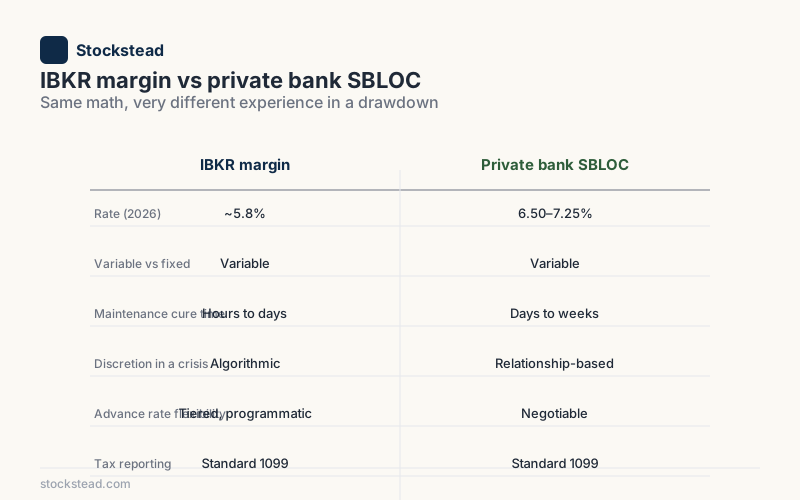
- A maintenance violation is enforced by the system within minutes — sometimes seconds — of being detected. There is no human review, no notification window, no banker call.
The third and fourth points are the source of both the rate advantage and the risk. Continuous mark-to-market plus algorithmic enforcement means IBKR's risk to losses on margin loans is much lower than at a private bank that gives borrowers 5–7 days to cure a call. The bank charges more because it is taking more enforcement risk on each loan.
The Operational Rules That Make IBKR Work
HNW borrowers who use IBKR margin successfully for home purchases tend to follow a small set of operational rules. None of them are subtle.
Set initial LTV at 25–30%, not 50%. This is non-negotiable. The thin cure window means the only acceptable defense against a margin call is a fat collateral cushion. At 25% initial LTV against an equity portfolio, you can absorb a 60–65% drawdown before triggering a call. That covers everything in the historical record.
Hold cash equivalents inside the IBKR account. A balance of T-bills or money-market funds inside the same IBKR account counts toward your maintenance calculation at very high advance rates (90%+). Holding 15–20% of the portfolio in T-bills inside IBKR is a much stronger position than holding the same cash at an external bank.
Use Portfolio Margin, not Reg T margin. IBKR's Portfolio Margin program prices risk on the full account exposure, not on a position-by-position basis. For a diversified portfolio, this typically results in higher available leverage at lower effective margin requirements. To qualify, you typically need $100K+ in account equity and a margin-experience checkbox.
Avoid concentrated single-stock positions in the pledged account. IBKR's Portfolio Margin algorithms penalize concentration heavily. A single position over 25% of the account materially reduces the available leverage and raises the effective maintenance threshold.
Do not rely on phone support to stop an enforcement event. IBKR's customer service is not authorized to halt an in-progress liquidation. By the time you reach a human, the trades have executed. The only effective intervention is a cash deposit or a securities transfer that hits the account before the algorithm acts.
When IBKR Is the Right Tool
IBKR margin is the right venue for a home purchase when the borrower fits a specific profile:
- Already operationally sophisticated with brokerage mechanics, margin math, and order execution.
- Maintains a diversified, liquid portfolio (no large concentrated positions).
- Drawing at a conservative LTV (under 35%).
- Holds 10–20% of the account in T-bills or money-market funds as an internal cushion.
- Has external cash reserves equal to 15%+ of the line balance.
- Comfortable monitoring the account during volatile periods.
- Cost-sensitive enough that the 100–200 bp annual savings outweigh the operational overhead.
For this borrower, IBKR delivers genuine alpha — at published rates as of October 8, 2026, $49,300 a year of interest per $1M at IBKR versus $67,700 at Schwab's PAL list price, with manageable risk if the operational rules are followed.
When a Slower SBLOC Is Better
The same set of facts can flip in the other direction. A slower SBLOC at Schwab, Morgan Stanley, or Merrill is the right tool when the borrower:
- Holds a concentrated stock position in the pledged account (employer stock, founder shares, inherited concentration).
- Is operationally busy and cannot monitor the account during market hours.
- Is uncomfortable with algorithmic enforcement and wants a banker in the loop.
- Is drawing at a higher initial LTV (40%+) and needs the cure window as a real defense.
- Values the relationship for other purposes — mortgage, wealth management, lending against other assets.
- Travels internationally or regularly into time zones where they cannot respond to a 4 a.m. enforcement event.
For this borrower, the extra 100–200 bp on the rate is the cost of operational insurance, and it is generally worth paying.
A Worked Comparison
Same scenario, two venues. This comparison uses illustrative rates of 5.00% at IBKR and 6.75% at Schwab; as of October 8, 2026, the published $1M rates were 4.93% and 6.77%. Borrower has a $2.5M diversified portfolio at IBKR and an existing Schwab PAL relationship. They want to draw $1M to fund the down payment on a $3.5M home, with the rest covered by a jumbo mortgage.
IBKR path. Initial LTV is 40%. Rate is 5.00% on the $1M draw, costing $50K/year in interest. Annual savings vs. Schwab: $17,500. The borrower commits to maintaining 15% cash inside IBKR ($375K) and holds another $150K external. At 40% initial LTV the call threshold is roughly a 50% portfolio drawdown.
Schwab path. Initial LTV is 40%. Rate is 6.75% on the $1M draw, costing $67,500/year. The borrower carries less internal cash because Schwab's enforcement is gentler. At 40% initial LTV the call threshold is the same — a 50% portfolio drawdown. But the cure window is 5 business days vs. minutes.
Five-year cumulative interest cost: IBKR $250K, Schwab $337,500. Spread: $87,500.
For an operationally engaged borrower with cash reserves, the IBKR path is meaningfully cheaper with no material increase in real risk. For an operationally busy borrower without cash reserves, the Schwab path is cheaper after risk-adjusting because the cure window is the real defense.
The Hybrid Strategy
Some borrowers split the difference: open both a Schwab PAL and an IBKR Pro margin line. Use the IBKR line for the initial draw at the cheap rate. Use the Schwab line as standby capacity that can be drawn rapidly to cure an IBKR margin call.
This is a genuinely sophisticated structure that delivers the IBKR rate with the Schwab cure flexibility. The trade-off is operational complexity and the dual maintenance requirements of two pledged portfolios. It tends to make sense above a $2M total exposure and rarely makes sense below.
What IBKR Will Not Do for You
A few things to be explicit about:
- IBKR will not help you negotiate with the IRS over deductibility. The 1099 will reflect interest paid; the rest is on you and your tax advisor.
- IBKR will not extend a cure window outside the algorithm's parameters. There is no human discretion at the moment of liquidation.
- IBKR will not bundle pricing across products. The margin rate is the margin rate; there is no relationship discount on top.
- IBKR will not call you proactively if your account is approaching maintenance. You are responsible for monitoring.
If any of those expectations matter to you, IBKR is the wrong venue and the rate savings are illusory.
Run the Numbers Against Your Situation
The headline rate at IBKR is the lowest in the market. Whether that translates into actual dollars saved depends on your draw size, your hold period, your cushion, and your tolerance for managing the operational requirements.
Stockstead lets you model an SBLOC at any rate you specify and compare the after-tax cost to cash and mortgage scenarios. Plug in the rates you are quoted (as of October 8, 2026, 4.93% for IBKR Pro on $1M and 6.77% for Schwab's PAL at list) and see how the spread compounds over your actual time horizon.
Compare Your Options with Stockstead →
The cheapest leverage is rarely the cheapest leverage after risk-adjusting. But sometimes it is. Know which one you are.
Frequently asked questions
- How much cheaper is IBKR Pro margin than a Schwab PAL?
As of October 8, 2026, a $1M IBKR Pro margin balance cost about 4.93% (blended across IBKR's tiers), while a Schwab PAL on a $1M-tier line cost 6.77% at list price. On $1M, that is $49,300 versus $67,700 of interest per year, and about $92,000 between Interactive Brokers Pro margin and Schwab Pledged Asset Line over five years. IBKR's spread steps down further on larger balances, while Schwab relationship discounts narrow the gap. These are real numbers that compound meaningfully over a multi-year financing strategy.
- Why doesn't every HNW buyer use IBKR Pro margin for a home purchase?
Because IBKR's rate advantage exists in part because IBKR runs the most aggressive margin enforcement engine in the retail brokerage world. When LTV crosses maintenance, liquidation happens within minutes — sometimes seconds — and there is no human review, no notification window, no banker call. Customer service is not authorized to halt an in-progress liquidation. For a borrower who travels, who cannot monitor the account during volatile periods, or who values a relationship banker in the loop during market stress, the 100-200 bp annual savings do not justify the operational risk.
- What initial LTV is safe at IBKR for a home purchase?
25-30%, against a diversified portfolio. At a 25% initial LTV the call threshold sits at roughly a 65% portfolio drawdown — large enough to absorb essentially any event in the historical record. Drawing at 35-40% is workable for operationally engaged borrowers who hold significant cash reserves and monitor the account actively. Drawing at 50%+ is dangerous at any venue but especially at IBKR, where the thin cure window means a normal correction can trigger algorithmic enforcement before the borrower has time to deposit cash.
- When should I choose Schwab PAL over IBKR Pro margin?
Five profiles where the slower SBLOC wins. Concentrated stock position in the pledged account — IBKR's Portfolio Margin algorithms penalize concentration heavily and the algorithmic enforcement is especially dangerous against single-stock volatility. Operationally busy borrowers who cannot monitor the account during market hours. Borrowers drawing at higher LTV (40%+) who need the 5-business-day cure window as a real defense. Buyers who value the relationship for other purposes — mortgage, wealth management, other lending. International travelers who cannot respond to a 4 a.m. enforcement event. The 100-200 bp extra is operational insurance.
- What is the hybrid IBKR plus Schwab strategy?
A genuinely sophisticated structure: open both an IBKR Pro margin line and a Schwab PAL against the same effective pool of wealth. Use the IBKR line for the initial draw at the cheaper rate. Hold the Schwab PAL as standby capacity that can be drawn rapidly to cure an IBKR margin call — Schwab's 5-business-day window combined with the ability to wire funds to IBKR provides the cure flexibility IBKR alone cannot. The trade-off is operational complexity and dual maintenance requirements on two pledged portfolios. It tends to make sense above $2M total exposure and rarely below.
Ready to run the numbers on your situation?
Open the calculator →Related posts
Schwab Pledged Asset Line for a Home Purchase: When It Wins, the Process, and the Rate Schedule
When a Schwab Pledged Asset Line beats a jumbo or IBKR margin for a home purchase: the application process, the two LTVs that govern safety, and a worked $1M example.
How to Buy a Home Without Selling Investments
Four ways to fund a home purchase while keeping your portfolio invested — SBLOC, margin loan, asset-depletion mortgage, and hybrid structures. Mechanics, trade-offs, and how to choose.
Using an SBLOC as a Bridge Loan: When It Actually Makes Sense
If you're buying before you sell, an SBLOC bridge is faster and cheaper than a traditional bridge loan. Here's the math, the timeline, and the risk to manage.