Pledged Asset Line vs SBLOC: Are They the Same Thing?
By Tyler Singletary · · Updated · in How it works
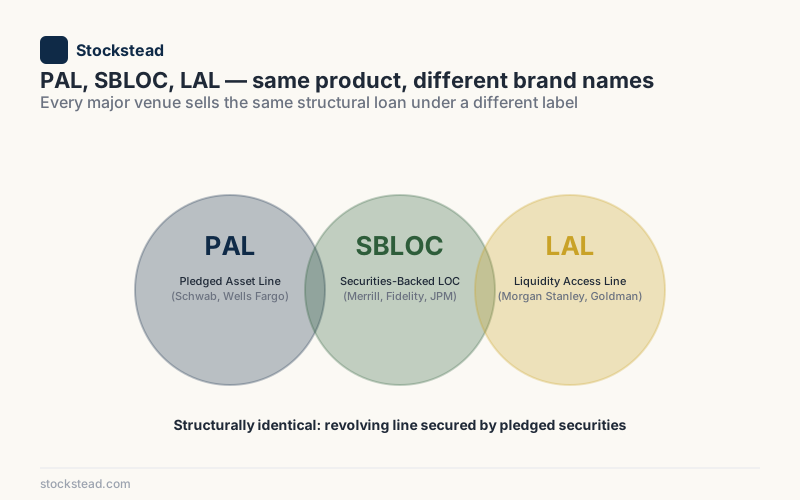
Walk into any private bank with $2M in marketable securities and you will be offered something that sounds like a Securities-Backed Line of Credit but may not technically be one. Morgan Stanley calls it a Liquidity Access Line. Merrill Lynch calls it a Loan Management Account. Goldman Sachs Private Wealth calls it a Select Line. Schwab calls it a Pledged Asset Line. JPMorgan calls it a Wealth Lending facility.
These are not all the same product. They share a core mechanic — borrow against a pledged portfolio — but they differ in legal structure, rate, enforcement, and tax treatment in ways that matter when you are planning a major purchase.
This post untangles the terminology and walks through what actually separates a Pledged Asset Line (PAL) from a generic SBLOC.
The Core Mechanic Is the Same
At a high level, every product in this family does the same thing: you pledge a taxable investment account, the lender extends a revolving line of credit sized as a percentage of that account's market value, you pay interest on the drawn balance, and the lender can demand repayment or liquidate the collateral if the portfolio value drops below a maintenance threshold.
That is where the similarities end. The structural differences fall into four categories: legal classification, rate architecture, enforcement behavior, and relationship expectation.
Legal Classification: Non-Purpose Loan vs Regulated Margin
The first real distinction is whether the loan is classified as a non-purpose loan or a regulated margin loan under Federal Reserve Regulation T.
A regulated margin loan lives inside a brokerage account. Its proceeds can be used to buy additional securities. It is subject to Reg T, which caps initial purchases and governs maintenance requirements. Interactive Brokers margin, Fidelity margin, and Schwab's brokerage margin all fall in this category.
A non-purpose loan lives in a separate loan account. Its proceeds cannot be used to buy securities. It is not subject to Reg T's specific rules. Schwab's PAL, Morgan Stanley's LAL, Merrill's LMA, and JPMorgan's Wealth Lending products are all non-purpose loans.
For a home purchase, the non-purpose classification is the right fit — you are not buying securities, so the securities-specific rules do not apply. But the classification also affects enforcement. Regulated margin lenders must comply with Reg T's maintenance math. Non-purpose lenders have more discretion in how they set and enforce maintenance ratios, which in practice means they are often more flexible in a crisis (and occasionally less).
Rate Architecture: Matrix Pricing vs Relationship Pricing
Generic SBLOCs from discount brokers use matrix pricing. The rate is a posted schedule: benchmark plus a spread based on line size or collateral value. Any relationship discount follows a published schedule too (Schwab's runs from 0.25% to 1.00% by qualifying assets). There is no negotiation and no relationship banker.
Private-bank PALs use relationship pricing. The published schedule is a starting point, but the actual rate reflects the total relationship — assets under management, other banking products, deposit balances, expected revenue over time. A $2M line that prices at SOFR + 2.25% on paper may close at SOFR + 1.50% after the banker applies a relationship concession.
This difference is why private-bank pricing is hard to compare on paper. Morgan Stanley does not publish its floating LAL schedule (its published offer as of October 8, 2026 was a 5.40% 1-year fixed promotional rate), and at any relationship lender the posted rate is not the rate HNW clients actually pay. If you are considering a PAL from a private bank, always ask the banker for the all-in rate they can actually deliver before comparing to a matrix-priced alternative.
Enforcement Behavior: Algorithmic vs Relationship
The enforcement style is where the products diverge most dramatically in practice.
Algorithmic enforcement. IBKR is the purest example. When LTV crosses maintenance, the system acts within minutes. There is no human review, no call window, no negotiation. The algorithm sells whatever is most liquid at market prices until the ratio is restored.
Rule-based enforcement. Schwab PAL and broker-arranged non-purpose lines, such as Fidelity's securities-backed line from third-party lenders, fall in the middle. The system generates a call notification and applies a standard cure window, typically a few business days and set in the loan agreement. Inside that window, a human may review escalations, but the default path is automated. Regulated margin loans at full-service brokers, Fidelity's included, sit closer to the algorithmic end: the margin agreement lets the firm sell without waiting for you to cure, even if it usually sends a call first.
Relationship enforcement. Morgan Stanley LAL, Merrill LMA, Goldman Select, and JPMorgan Wealth Lending all operate on a relationship-enforcement model. When LTV crosses maintenance, your banker gets notified. They call you. They may extend the cure window, suggest a partial transfer, or in extreme cases apply a temporary waiver if the market event is clearly transient. During 2020's March selloff, several private banks effectively paused margin call enforcement for 48–72 hours to allow the market to settle.
The relationship-enforcement model is not a free pass. If the market does not recover, the bank still enforces. But the extra cushion and the human-in-the-loop are material to anyone carrying leverage through a correction.
Rate Comparison at $1M Drawn
For a $1M draw, published rates as of October 8, 2026:
| Product | Type | Published rate | Cure Behavior |
|---|---|---|---|
| IBKR Pro Margin | Regulated margin | 4.93% (blended) | Minutes, algorithmic |
| Fidelity Margin | Regulated margin | 10.825% base rate | Call issued, but firm may sell without waiting |
| Fidelity securities-backed line | Non-purpose loan (third-party lenders) | 6.22% | Cure window set in the lender's agreement |
| Schwab PAL | Non-purpose loan | 6.77% at list | 3–5 days, rule-based |
| JPMorgan Wealth Lending | Non-purpose loan | Not published* | 5–7 days, relationship |
| Morgan Stanley LAL | Non-purpose loan | 5.40% 1-year fixed promo; floating not published* | 5–7 days, relationship |
| Merrill Lynch LMA | Non-purpose loan | SOFR-based, spread not published* | 5–7 days, relationship |
*Relationship-priced and subject to negotiation. Ask the banker for an all-in quote before comparing.
Tax Treatment Subtleties
All of these products accrue interest that, in principle, might be deductible depending on how the proceeds are used. The specific classification affects the paperwork and the arguments available to you.
Investment interest deduction. Interest is potentially deductible against investment income under IRC Section 163(d) if the loan proceeds are used to acquire or carry investment property. If you draw on the line and immediately invest the proceeds, the deduction is relatively clean.
Mortgage interest deduction. Under IRC Section 163(h), mortgage interest is deductible on acquisition indebtedness secured by the taxpayer's qualified residence. An SBLOC or PAL is secured by the portfolio, not the home. The interest does not generally qualify as mortgage interest regardless of what the proceeds were used for.
Non-deductible personal interest. If the proceeds are used for personal purposes (including a home purchase that does not qualify as acquisition indebtedness) and the loan is not tied to investment property, the interest is personal interest and is not deductible.
The bottom line: for a home purchase, the interest on a PAL or SBLOC is generally not deductible regardless of which product you choose. There are exceptions involving sophisticated tracing strategies, but they are narrow and should be executed with a tax advisor.
When to Choose Each
Choose IBKR margin if your primary criterion is cost, your portfolio is diversified, and you can operate with algorithmic enforcement. On a $1M draw as of October 8, 2026, IBKR Pro (4.93% blended) was 129 bp below Fidelity's line and 184 bp below Schwab's PAL list rate (134 bp after a 0.50% Schwab discount). That gap is real and compounds over a long hold. Morgan Stanley's 5.40% fixed promotional rate narrowed it to 47 bp, but only until the offer ends on November 6, 2026.
Choose Schwab PAL if you want a non-purpose structure, you are already a Schwab client at scale, and you value a clean separation between your brokerage and your borrowing. Good middle-ground option.
Choose a private-bank PAL (Morgan Stanley, Merrill, Goldman, JPMorgan) if your portfolio is concentrated, your situation is complex, or you want the enforcement flexibility a relationship banker provides. Negotiate. The published rate is not the real rate.
Choose Fidelity's securities-backed line if your portfolio already sits at Fidelity and you want a non-purpose line without moving assets. Fidelity arranges it through third-party lenders, priced at SOFR plus a spread that steps down with line size: SOFR + 3.10% from $100K, SOFR + 2.85% from $500K, SOFR + 2.35% from $1M, and SOFR + 1.90% from $3M (published schedule as of October 8, 2026). That was 6.22% on $1M as of October 8, 2026, below Schwab's PAL list rate but above IBKR. Because the lender is a third party, the call and cure terms come from that lender's agreement, so read them before you draw. Do not confuse it with Fidelity's margin loan, a regulated margin product priced off a 10.825% base rate, which makes it an expensive way to fund a home purchase.
The Practical Meta-Question
The choice between products is less about rate arbitrage and more about fit. A cost-sensitive borrower at 30% LTV on a diversified portfolio should use IBKR. A busy executive with a concentrated position who travels internationally and cannot respond to a call within 24 hours should pay up for a private-bank PAL. Both are correct choices for their respective borrower.
The worst outcome is choosing based on a misread of the product category. If you thought you were buying a non-purpose loan with a relationship banker and you instead opened a regulated margin account with an algorithmic enforcement engine, the rate savings will evaporate the first time you hit a drawdown.
Model the Rate, Not the Label
Stockstead lets you input any rate you want — 4.93% from IBKR Pro, 5.40% from Morgan Stanley's promotional fixed LAL, 6.77% from Schwab PAL at list (published rates as of October 8, 2026), or whatever your banker quotes — and compare the after-tax cost against cash and mortgage options. The label of the product matters for enforcement; the rate matters for cost.
Compare Your Options with Stockstead →
A PAL is an SBLOC is a margin loan. Except when it isn't. Know which one you are signing.
Frequently asked questions
- Is a Pledged Asset Line the same thing as an SBLOC?
In casual usage, yes — both are credit lines collateralized by a pledged investment portfolio, and the terms are often used interchangeably. In strict legal terms, a Pledged Asset Line is the specific Schwab product name for a non-purpose loan against a pledged brokerage account. Morgan Stanley calls its version a Liquidity Access Line, Merrill calls it a Loan Management Account, Goldman calls it a Select Line, and JPMorgan calls it Wealth Lending. All five share the core mechanic but differ meaningfully in enforcement, rate negotiation, and relationship expectations.
- What is the difference between a non-purpose loan and a regulated margin loan?
A regulated margin loan lives inside the brokerage account and is governed by Federal Reserve Regulation T, which caps initial purchases and explicitly assumes the proceeds will be used to buy more securities. Interactive Brokers margin and Fidelity margin are the canonical examples. A non-purpose loan lives in a separate loan account, sits outside Reg T, and its proceeds cannot be used to buy securities. Schwab PAL, Morgan Stanley LAL, Merrill LMA, and JPMorgan Wealth Lending are non-purpose loans. For a home purchase, the non-purpose classification is the correct fit because you are not buying securities.
- Why do private bank SBLOC rates look uncompetitive on paper?
Because the published rate is not the rate HNW clients actually pay. Private banks use relationship pricing — the posted schedule is a starting point, then the banker applies concessions based on assets under management, deposit balances, and total expected revenue. Morgan Stanley, for example, does not publish its floating LAL schedule at all, and the rate a $2M client closes at depends on the relationship. Always ask the banker for the all-in rate they can actually deliver before comparing to a matrix-priced alternative like IBKR or Schwab.
- How does enforcement differ between IBKR margin, Schwab PAL, and Morgan Stanley LAL?
Three distinct enforcement styles. IBKR is algorithmic: when LTV crosses maintenance, the system liquidates positions within minutes, no human review. Schwab PAL and broker-arranged non-purpose lines such as Fidelity's securities-backed line are rule-based: a call notification with a cure window of a few business days, set in the loan agreement, before sales begin. Regulated margin at any broker, Fidelity's included, lets the firm sell without waiting for you to cure. Morgan Stanley LAL, Merrill LMA, Goldman Select, and JPMorgan Wealth Lending are relationship-based: the banker calls you, may extend the cure window, and in clear cases of transient market stress may apply a temporary waiver — as several private banks effectively did during the March 2020 selloff.
- Is the interest on a PAL or SBLOC tax-deductible for a home purchase?
Generally no, regardless of which product you choose. Home mortgage interest under IRC Section 163(h)(3) requires the debt to be secured by the qualified residence — meaning a recorded mortgage or deed of trust on the home itself. An SBLOC, PAL, or any portfolio-secured line is secured by the brokerage account, not the property. The debt cannot qualify as acquisition indebtedness no matter what the proceeds funded. A sophisticated tracing structure can sometimes convert SBLOC interest into deductible investment interest, but only with careful execution and a tax advisor.
Ready to run the numbers on your situation?
Open the calculator →Related posts
SBLOC Rates 2026: Schwab, Fidelity, IBKR, Morgan Stanley
Published SBLOC rates at Schwab, Fidelity, IBKR, and Morgan Stanley as of October 8, 2026, with side-by-side cost on a $1M draw.
Schwab Pledged Asset Line for a Home Purchase: When It Wins, the Process, and the Rate Schedule
When a Schwab Pledged Asset Line beats a jumbo or IBKR margin for a home purchase: the application process, the two LTVs that govern safety, and a worked $1M example.
Pledged Asset Line (PAL) Mortgage Calculator: Schwab Rates
PAL mortgage calculator: Schwab's tiered SOFR spread schedule, relationship pricing discounts, maintenance LTV math, and a worked $1M draw vs a generic SBLOC.