SBLOC vs HELOC for HNW Homeowners: An After-Tax Comparison
By Tyler Singletary · · Updated · in Decision frameworks
If you already own your home and have built a taxable investment portfolio meaningful enough to borrow against, you have two non-mortgage credit tools on the table for funding a major purchase, a renovation, a business investment, or a second home. You can tap the equity in your home with a HELOC. You can tap the value of your portfolio with an SBLOC.
The two products rhyme but they are not interchangeable. The tax treatment is different. The rate structure is different. The collateral risk is different. The relationship with the lender is different. A decision that makes sense under one set of facts falls apart under another.
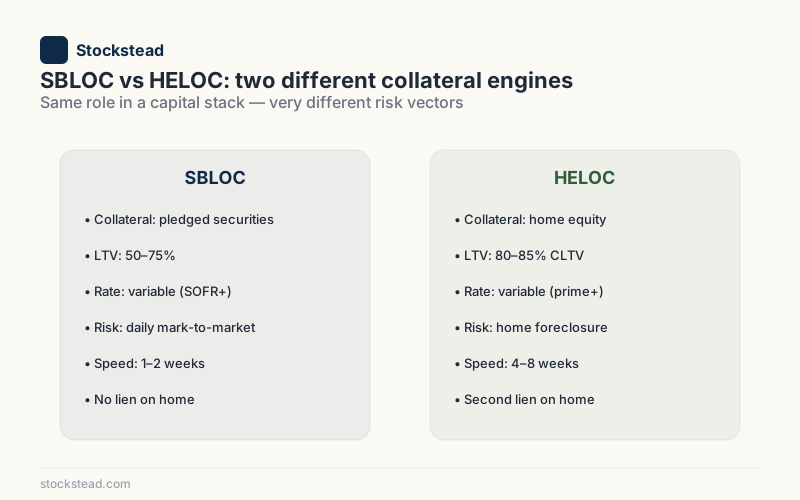
This post walks through the six variables that actually matter when choosing between a HELOC and an SBLOC, and the three HNW borrower profiles where the right answer is obvious.
TL;DR — the three obvious matches
Most HNW homeowners face one of three clean patterns:
- HELOC for qualified home improvement on the primary residence — the interest deduction up to the $750K cap reverses the headline rate gap and the HELOC frequently wins on an after-tax basis.
- SBLOC for funding a second-home down payment, a business investment, or any non-improvement use — HELOC interest becomes non-deductible for these uses, so the SBLOC's lower pretax rate is the lower after-tax rate.
- Both, stacked when you have multiple use cases that fit different tax treatments — open a HELOC for the renovation portion and draw an SBLOC for the business or second-home portion. The two facilities serve different purposes and produce a lower blended cost than either alone.
The rest of the post unpacks each variable, the three obvious scenarios in detail, and the harder edge cases.
The Two Products, in One Paragraph Each
A HELOC (Home Equity Line of Credit) is a revolving line of credit secured by your home. The lender places a second lien on the property, sized as a percentage of the home's appraised value minus your existing first mortgage. Rates are typically quoted as prime plus a margin (prime was 7.00% as of October 8, 2026). Draw period is usually 10 years, followed by a repayment period of 10–20 years. Interest is deductible only if the proceeds buy, build, or substantially improve the home that secures the line. The 2017 tax law set that rule, and the One Big Beautiful Bill Act made it permanent in July 2025.
An SBLOC (Securities-Backed Line of Credit) is a revolving line of credit secured by your taxable investment portfolio. The lender pledges the portfolio, sized as a percentage of the account's market value. Rates are SOFR (currently 3.87%) plus a spread that depends on venue, line size, and relationship. There is typically no fixed term — interest-only as long as you hold the line. Interest is generally not deductible unless the proceeds are traced to investment purposes. For the underlying mechanics — advance rates, the two LTVs that govern margin-call risk, and what a maintenance call looks like minute by minute — see how an SBLOC actually works.
The Six Variables That Actually Matter
1. Rate
Current rates as of October 8, 2026 (SBLOC figures are all-in on a $1M draw):
- HELOC (national average): 7.33%
- IBKR Pro margin: 4.93%
- Morgan Stanley LAL: 5.40% (promotional fixed rate; check when it resets)
- Fidelity SBLOC: 6.22%
- Schwab PAL (list): 6.77%
For the deeper venue-by-venue breakdown — Schwab, Fidelity, IBKR, and Morgan Stanley side by side, with the spreads, advance rates, and minimum line sizes that drive the actual rate you'll be quoted — see SBLOC rates compared across the major venues for 2026.
Pretax, the SBLOC usually wins on rate at this line size, but the size of the gap depends heavily on venue: compare the 7.33% HELOC average with the range from 4.93% to 6.77% above. Smaller lines price higher at most brokers, so a sub-$500K SBLOC can cost more than a HELOC. On a $500K balance carried for ten years, every 100 basis points of rate gap is roughly $50K of cumulative interest.
2. Deductibility
The tax treatment reverses the picture.
HELOC interest is deductible under IRC 163(h)(3) as home mortgage interest if the proceeds are used to buy, build, or substantially improve the home that secures the loan. For a homeowner using a HELOC to renovate their kitchen, the interest is deductible, subject to the overall $750,000 mortgage indebtedness cap, which now counts your first mortgage and the HELOC together and is permanent. Interest on home-equity debt used for anything else is permanently non-deductible. The deduction also only helps if you itemize: the 2026 standard deduction is $32,200 for joint filers, and the SALT cap is $40,400 (phasing down to $10,000 as MAGI rises above $505,000), so most HNW homeowners with a mortgage and state taxes already itemize.
SBLOC interest used for personal purposes is not deductible under IRC 163(h)(1). Full stop. Our post on SBLOC deductibility walks through the tracing structures under IRC 163(d) that can sometimes convert this to deductible investment interest.
Take rates as of October 8, 2026: at a 35% combined federal-plus-state effective tax rate, a fully deductible HELOC at 7.33% has an after-tax cost of roughly 4.76%. A Schwab PAL at its 6.77% list rate on $1M, non-deductible, costs the full 6.77%. The apparent rate gap reverses, and at these rates it reverses against IBKR too. The 35% figure also fits a top-bracket homeowner: under OBBBA's new IRC Section 68 limit, starting in 2026 a 37%-bracket filer loses 2/37 of the smaller of their itemized deductions or their taxable income above the 37% threshold ($768,700 joint, $640,600 single), so once income clears that threshold by at least the itemized total, each deducted dollar saves 35%, not 37%.
| Product (rates as of Oct 8, 2026) | Pretax Rate | After-Tax Rate (35% bracket) |
|---|---|---|
| HELOC (home improvement, fully deductible) | 7.33% | 4.76% |
| Schwab PAL, list, $1M (non-deductible) | 6.77% | 6.77% |
| IBKR Pro margin, $1M (non-deductible) | 4.93% | 4.93% |
| HELOC (other use, non-deductible) | 7.33% | 7.33% |
HELOC rate is the Bankrate national average; SBLOC rates are published all-in rates on a $1M draw. The table assumes the whole HELOC balance fits under the $750K cap. Rerun the after-tax column at your own quotes.
This is the single most consequential factor in the comparison, and most borrowers get it wrong in both directions.
3. Collateral Risk
A HELOC is secured by your home. The lender cannot foreclose unless you default. Home values don't mark-to-market daily. A HELOC does not have a margin-call mechanic.
An SBLOC is secured by a portfolio that does mark-to-market daily. A significant drawdown can trigger a margin call requiring immediate cure. The risk is real, it is not theoretical, and it has forced bad outcomes on sophisticated borrowers in every major drawdown.
The HELOC has less of a "bad day" risk. If your home's market value drops 20%, the HELOC does not care — you still owe the balance, and the lender generally cannot demand repayment absent an event of default.
The SBLOC's volatility-linked risk is the reason it tends to price below a HELOC. You are accepting a form of market-correlated risk in exchange for a lower interest rate.
4. Flexibility of Use
HELOC proceeds go where you want them to go — home improvements, business, vacation, anything. The tax deduction applies only when the use is qualified home improvement, but the use itself is unrestricted.
SBLOC proceeds are similarly flexible for most venues, but non-purpose loans explicitly bar using the proceeds to buy additional securities. For a home purchase, a remodel, a business, or personal expenses, this is a non-issue.
5. Draw and Repayment Mechanics
HELOCs typically have a defined draw period (often 10 years) followed by a repayment period (10–20 years). Once the draw period ends, you cannot take new draws, and the remaining balance converts to amortizing principal-and-interest payments.
SBLOCs typically have no defined draw or repayment period. As long as the collateral holds and you pay interest, the line remains open indefinitely. Some lenders will renew or review the facility annually, but the operational reality is that well-maintained SBLOCs stay open for years.
For a borrower who wants long-term flexibility without an amortization phase, the SBLOC structure is cleaner. For a borrower who wants the discipline of a forced paydown starting at a known date, the HELOC structure offers a useful forcing function.
6. Origination Friction
HELOCs require an appraisal, a title search, sometimes a home inspection, and a full loan underwriting process. Total time from application to funding is typically 30–60 days. Fees include appraisal ($400–700), title ($500–1,500), and origination (varies, sometimes waived).
SBLOCs require none of the home-related paperwork. The collateral is the portfolio, which the lender can see in real time at the brokerage. Time from application to funding is typically 5–15 business days. Fees are minimal or zero.
If you need capital quickly, the SBLOC's operational speed is a significant advantage.
The Three Obvious Answers
Obvious HELOC scenario. You are renovating your primary residence for $400K. You have a diversified portfolio but do not want to risk it against a margin call. The remodel qualifies for home mortgage interest deduction. If your first mortgage plus the HELOC stays within the $750K cap, the HELOC's after-tax cost sits well below its pretax rate (at the 7.33% average as of October 8, 2026, roughly 4.76% in a 35% bracket), which beats even the cheapest SBLOC before you risk-adjust. The HELOC is the right tool. If your first mortgage already uses most of the cap, see the worked example below.
Obvious SBLOC scenario. You are funding a new home down payment of $600K while you wait to sell your current home. The use is a home purchase, not home improvement on the existing home, so HELOC interest would not be deductible. You have a $3M diversified portfolio. As of October 8, 2026, IBKR Pro margin (about 4.96% blended on $600K) and Schwab PAL at its 6.77% list rate (the $1M to $2.5M tier, where a $3M diversified portfolio's loan value typically lands) both priced below a non-deductible HELOC at the 7.33% average. The SBLOC is the right tool as long as the SBLOC rate you are quoted sits below the HELOC rate you are offered.
Obvious do-both scenario. You are renovating (use A) and funding a business investment (use B) totaling $800K. Open a HELOC for the renovation portion (deductible), draw an SBLOC for the business portion (potentially deductible as business interest). The two facilities stack cleanly because they are secured by different assets and serve different purposes. Total borrowing cost is lower than either product alone could deliver.
The Non-Obvious Decisions
Where the choice gets harder:
You are funding a purchase that is not strictly qualified for the mortgage deduction. Say you are buying a vacation home that is your third property (not a qualified second residence), or you are gifting a down payment to an adult child. Neither a HELOC nor an SBLOC produces deductible interest, and the comparison becomes purely rate-based. SBLOC typically wins.
You live in a state with its own deductibility rules. California allows deduction on higher indebtedness than federal. New York has its own adjustments. The effective after-tax cost depends on both federal and state treatment. Run both numbers.
Your portfolio is concentrated. An SBLOC against a portfolio with a single position over 25% is likely to get underwritten at a reduced advance rate and with a tighter maintenance threshold. A HELOC is indifferent to portfolio composition. For a concentrated-stock investor, the HELOC may be a lower-operational-risk choice even at the higher rate.
You are approaching retirement or cash-flow change. A HELOC's repayment phase can hit exactly when income is dropping. An SBLOC's indefinite structure may be better for a borrower whose income profile changes mid-loan.
A Worked Example
Homeowner has a $1.5M primary residence, $600K mortgage balance, $2M taxable portfolio, 35% combined tax rate. They need $400K for use X.
This example uses rates as of October 8, 2026: the 7.33% Bankrate HELOC average, IBKR Pro margin at 5.00% blended on a $400K draw, and Schwab PAL at its 6.77% list rate (the $1M to $2.5M tier, set by the $2M portfolio's loan value). Rerun it at your own quotes.
Scenario A: Use is $400K kitchen and bath remodel.
- The cap matters here. The $600K first mortgage plus a $400K HELOC is $1.0M of home acquisition debt, and only $750K of it earns the deduction. Roughly $150K of the HELOC's balance (37.5%) fits under the cap.
- HELOC: 7.33% pretax, about 37.5% deductible. After-tax effective: about 6.37%.
- SBLOC at IBKR: 5.00% pretax, non-deductible. After-tax effective: 5.00%.
- SBLOC at Schwab: 6.77% pretax, non-deductible. After-tax effective: 6.77%.
- Winner: IBKR is cheaper by about 1.36 points ($5,500 a year on $400K), and the HELOC beats Schwab's list rate by about 0.40 points. The HELOC is operationally safer, so a conservative borrower may still pick it over IBKR.
- If the whole HELOC fit under the cap (a first mortgage of $350K or less), the answer flips: the HELOC's after-tax cost would be 4.76%, below IBKR's 5.00% by about 0.24 points and below Schwab by 2.01 points, and it would be both cheaper and safer. The break-even: the HELOC beats IBKR after tax only when at least about 90% of its balance is deductible.
Scenario B: Use is $400K down payment on a second home.
- HELOC: 7.33% pretax, deduction requires proceeds to be used to improve the home securing the HELOC — not buying another home. So non-deductible. After-tax effective: 7.33%.
- SBLOC at Schwab: 6.77% pretax, non-deductible. After-tax effective: 6.77%.
- Winner: SBLOC by 56 basis points at Schwab's list rate (233 at IBKR), same after tax. Clean choice, as long as your SBLOC quote stays below your HELOC quote.
Scenario C: Use is $400K to buy a business interest.
- HELOC: 7.33% pretax. Not deductible as home mortgage interest for this use. Under the interest-tracing rules, debt proceeds used in a business can produce deductible business interest whatever secures the loan, so ask your CPA whether that applies to a HELOC too. Without it, after-tax effective: 7.33%.
- SBLOC at Schwab: 6.77% pretax, potentially deductible as business interest if traced properly and absorbed against business income. Best-case after-tax effective: ~4.4%.
- Winner: SBLOC, significantly, if the tracing structure is executed cleanly. If both loans trace cleanly, the lower pretax rate still wins: about 4.40% after tax for Schwab versus 4.76% for the HELOC.
Run these numbers against your own use case and tax bracket: SBLOC vs HELOC after-tax calculator →
Decide on the Facts, Not the Vibe
Most borrowers have an instinct toward one product or the other based on their primary advisor — the mortgage broker pushes a HELOC, the wealth manager pushes an SBLOC. Neither is wrong, but neither is fully informed about the other's product.
The right answer almost always comes out of running the numbers on after-tax cost, risk-adjusting for margin call exposure, and accounting for the operational profile of your lender. Pretax rate alone is a misleading guide.
See the Numbers Side by Side
Stockstead models SBLOC scenarios with the correct tax treatment by default, and you can run the same math against a HELOC with deductibility toggled on or off depending on your use case. The comparison is clean, after-tax, and risk-adjusted for the pledged portfolio. For the broader funding question, see our SBLOC vs. mortgage vs. cash breakdown — HELOC and home-equity products sit one step downstream of that decision.
Compare Your Options with Stockstead →
HELOC and SBLOC are both useful tools. Which one is right for you depends entirely on which one actually saves you money after tax, not which one sounds better on paper.
Frequently asked questions
- Which is cheaper after tax: an SBLOC or a HELOC?
It depends on the use of proceeds and on how much of your home debt fits under the $750K cap. At rates as of October 8, 2026, a 7.33% HELOC used for qualified home improvement, fully deductible, drops to roughly 4.76% after tax at a 35% combined bracket. That beats every $1M SBLOC rate we track, from 4.93% at IBKR Pro to 6.77% at Schwab PAL list, because SBLOC interest used for a home improvement is non-deductible. The HELOC's edge disappears if your first mortgage already uses most of the $750K cap: it needs roughly 90% of its balance to be deductible to beat IBKR. Flip the use to a second-home down payment, business investment, or non-improvement personal expense, and HELOC interest becomes non-deductible, so the comparison falls back to pretax rates. The pretax rate alone is a misleading guide.
- Is HELOC interest tax-deductible if I use it for a down payment on another home?
No. HELOC interest qualifies for the home mortgage interest deduction under IRC Section 163(h)(3) only when the proceeds are used to buy, build, or substantially improve the home that secures the loan. A HELOC on your primary residence used to fund a down payment on a second property fails that test — it is not improving the home securing the loan. The interest becomes non-deductible personal interest, and the HELOC's after-tax cost stays at the full pretax rate. The 2017 tax law set this rule, and the One Big Beautiful Bill Act made it permanent in July 2025. For non-improvement uses, an SBLOC at a lower pretax rate is typically the better tool.
- What is the collateral risk difference between a HELOC and an SBLOC?
A HELOC is secured by your home, which does not mark-to-market daily. A 20% drop in your home's value does not trigger any action by the lender — you still owe the balance and pay the interest, but there is no margin call mechanism. An SBLOC is secured by a portfolio that does mark-to-market daily. A significant drawdown can trigger a margin call requiring immediate cure within 3-5 business days. The SBLOC's volatility-linked risk is the structural reason it prices below a HELOC — you accept market-correlated risk in exchange for the lower interest rate.
- How fast can I get a HELOC versus an SBLOC?
An SBLOC funds in 5-15 business days typically. The collateral is your investment portfolio, which the lender can see in real time at the brokerage, so there is no appraisal, no title search, no income documentation. Fees are minimal or zero. A HELOC funds in 30-60 days because it requires an appraisal (typically $400-700), title search ($500-1,500), and full loan underwriting. If you need capital quickly — a competitive bid situation, an unexpected investment opportunity, a short-fuse purchase — the SBLOC's operational speed is a meaningful advantage over a HELOC.
- When should I use both a HELOC and an SBLOC?
When you have multiple uses that fit different tax treatments. Example: you are renovating your primary residence for $400K (qualified home improvement) and funding a $400K business investment. A HELOC for the renovation captures the home mortgage interest deduction, lowering its after-tax cost below its pretax rate. An SBLOC for the business investment may qualify as business interest under proper tracing, producing an even lower after-tax rate. The two facilities stack cleanly because they are secured by different assets and serve different purposes. Total borrowing cost is lower than either product alone could deliver.
- Which is better, HELOC or Sbloc?
It depends entirely on the use of proceeds and your tax situation. For qualified primary-residence home improvement, a HELOC's mortgage-interest deduction under IRC 163(h)(3) frequently reverses its higher pretax rate, as long as your total mortgage debt stays within the $750K cap. At the 7.33% average as of October 8, 2026, a fully deductible HELOC falls to roughly 4.76% after tax in a 35% combined bracket, below even IBKR Pro's 4.93% on $1M. For a second-home down payment, a business investment, or any non-improvement personal expense, HELOC interest becomes non-deductible, and the SBLOC's lower pretax rate becomes the lower after-tax rate. Pretax rate alone is a misleading guide; the answer depends on your specific facts.
- What is the interest rate on a Sbloc?
SBLOC rates are quoted as SOFR (currently 3.87%) plus a spread that depends on venue, line size, and relationship. As of October 8, 2026, all-in pretax rates on a $1M draw were 4.93% at IBKR Pro, 5.40% at Morgan Stanley LAL (a promotional fixed rate), 6.22% at Fidelity, and 6.77% at Schwab PAL (list price). See SBLOC rates compared across the major venues for 2026 for the venue-by-venue breakdown, including spreads, advance rates, and minimum line sizes.
- Are sblocs a good idea?
An SBLOC can be a useful liquidity tool for a borrower who understands the trade-off: a lower interest rate and faster funding in exchange for accepting daily-mark-to-market collateral risk and the possibility of a margin call. They tend to fit when the use of proceeds is short-duration, the portfolio is diversified, and the borrower has a clear exit plan if markets correct. They tend to be a poor fit when the portfolio is concentrated, the borrower cannot tolerate volatility on the collateral, or the use of proceeds would have qualified for a tax-advantaged alternative — for example, a deductible HELOC for primary-residence home improvement. This is general education, not personalized financial advice. See /disclaimers.
- Can you use a Sbloc to buy a home?
Yes. An SBLOC is one of the cleaner ways to fund a home down payment if you want to avoid liquidating appreciated investments and triggering capital gains tax. The SBLOC sits as a lien on your investment portfolio, not on the home — so the home closes free and clear, you avoid the cap-gains hit on the liquidation that funding from a taxable account would otherwise trigger, and you can pay the SBLOC down over time from income or investment growth. See buying a home without selling investments for the full mechanics and SBLOC vs mortgage vs cash for how it stacks against the alternatives.
Ready to run the numbers on your situation?
Compare SBLOC vs HELOC after tax →Related posts
SBLOC vs Mortgage vs Cash: The Complete HNW Guide
Four ways to fund a $300K down payment from a $2M portfolio, the 10-year math on each at current rates, and the failure mode standard mortgage calculators hide.
SBLOC Mortgage Calculator: After-Tax vs Jumbo for HNW Buyers
SBLOC mortgage calculator for HNW buyers: after-tax math, the $750K deduction cap, a worked $2.4M portfolio-funded vs jumbo comparison, and rates as of October 8, 2026.
Schwab Pledged Asset Line for a Home Purchase: When It Wins, the Process, and the Rate Schedule
When a Schwab Pledged Asset Line beats a jumbo or IBKR margin for a home purchase: the application process, the two LTVs that govern safety, and a worked $1M example.