Pledged Asset Line (PAL) Mortgage Calculator: Schwab Rates
By Tyler Singletary · · Updated · in Decision frameworks
A general SBLOC calculator takes a single rate input and runs the math from there. That works for back-of-envelope sizing. It does not work for a Schwab Pledged Asset Line, where the rate depends on which tier your line size falls into, what relationship discount your Schwab assets qualify for, and what blended advance rate Schwab assigns to your specific portfolio composition. A PAL is structurally identical to a generic SBLOC but priced on a venue-specific schedule, and the pricing differences are large enough to change the financing decision.
This guide is the calculator companion to the Schwab PAL explainer. It walks through the inputs a PAL-specific calculator needs that a generic SBLOC tool does not, runs a worked draw with Schwab's relationship discount applied, and shows why the published rate is the ceiling for HNW clients rather than the floor. For the broader HNW calculator stack, see the pillar mortgage calculator for high net worth buyers.
Market rates in this post are shown as of October 8, 2026. The worked examples use the rates as of October 8, 2026 that they state. SOFR moves daily per the New York Fed. Schwab's spread schedule and relationship discount structure change periodically. Verify any rate directly with a Schwab Bank lending specialist before sizing a draw.
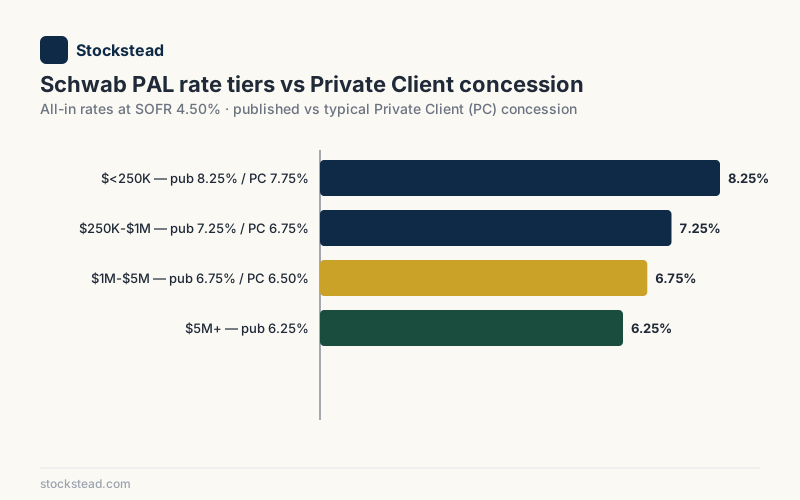
What a PAL Calculator Needs That a SBLOC Calculator Does Not
A Schwab PAL calculator needs three inputs a generic SBLOC tool collapses or omits: the tiered spread schedule, the relationship discount, and the per-asset-class advance rate. Per the Schwab Pledged Asset Line product page, the published spread as of October 8, 2026 ranges from SOFR + 2.40% on the largest tier to SOFR + 4.40% on the smallest. A single-rate calculator misses 200 bp of pricing reality.
The first input is the tiered spread. Schwab prices PAL spreads in five bands set by the loan value of the pledged collateral (published schedule as of October 8, 2026): $100K to $250K at SOFR + 4.40%, $250K to $500K at SOFR + 3.90%, $500K to $1M at SOFR + 3.40%, $1M to $2.5M at SOFR + 2.90%, and $2.5M and up at SOFR + 2.40%. A calculator that asks for "the SBLOC rate" as a single number forces the user to look up which tier applies before the math runs. The PAL-specific tool should take the collateral's loan value as the input and derive the spread.
The second input is the relationship discount. Schwab publishes a discount on top of the schedule: as of October 8, 2026, 0.25% to 1.00% depending on qualifying Schwab assets (0.50% at $1M to $5M). The threshold is materially lower than the $5M to $10M minimums at most private banks, which is part of why Schwab PAL pricing competes with relationship-priced products at Morgan Stanley and Goldman. A calculator that ignores the discount overstates the all-in rate by 25 to 100 bp for HNW Schwab clients who qualify.
The third input is the blended advance rate against the pledged portfolio. Schwab assigns advance rates per asset class: 85-95% on Treasuries, 65-75% on diversified equity ETFs, 50-70% on large-cap individual stocks, 30-50% on concentrated single positions, and 0% on restricted shares. The blended rate determines the maximum line size your collateral supports. A generic SBLOC calculator that assumes a flat 50% margin requirement misses the per-asset-class detail that drives Schwab's actual underwriting.
How Does Schwab's Tiered Rate Schedule Work?
Per the Schwab Pledged Asset Line product disclosures, the tiered schedule rewards larger collateral materially: the spread drops 50 basis points each time the collateral's loan value crosses into a higher tier, and the lower spread applies to the entire balance rather than the incremental amount. With SOFR at 3.87% per the New York Fed reference rates (October 8, 2026), the $1M tier works out to 6.77% all-in. For any other tier, add current SOFR to its spread.
| Loan value of collateral | Published spread (October 8, 2026) | All-in |
|---|---|---|
| $100K to $250K | SOFR + 4.40% | SOFR + 4.40% |
| $250K to $500K | SOFR + 3.90% | SOFR + 3.90% |
| $500K to $1M | SOFR + 3.40% | SOFR + 3.40% |
| $1M to $2.5M | SOFR + 2.90% | 6.77% |
| $2.5M and up | SOFR + 2.40% | SOFR + 2.40% |
All-in rates are before Schwab's relationship discount, and Schwab may change the spread after origination.
The tier-jump arithmetic is the most consequential output of a PAL calculator. Crossing from the $500K to $1M band (SOFR + 3.40%) into the $1M to $2.5M band (SOFR + 2.90%) saves 50 basis points on the entire balance, not just the incremental amount. On a five-year carry at $1M average outstanding, the tier jump is worth roughly $25,000 in cumulative interest. The calculator should flag any collateral loan value within $50K of a tier boundary so the user can evaluate whether bumping into the next band is worth the marginal capital commitment.
Why the relationship discount matters more than rate shopping
Schwab's relationship discount is set by qualifying Schwab assets, but it is rarely surfaced on a calculator that takes a single rate input. It applies to the entire balance. On a $1M draw held five years, a 0.25% discount saves about $12,500, a 0.50% discount about $25,000, and the full 1.00% about $50,000. The PAL calculator should ask which discount level the client qualifies for and apply it to the tier-derived spread before computing the all-in rate. As the jumbo comparison below shows, the discount can decide which way the financing choice goes.
What Inputs Does a Worked PAL Calculation Require?
A complete PAL calculator needs seven inputs to produce an all-in carry cost and a maintenance LTV projection. Per FINRA's Securities-Backed Lines of Credit Investor Alert, the maintenance LTV math is the most consequential input for SBLOC safety, more so than the rate. The seven inputs map directly to the worked example below.
The seven inputs the tool needs:
- Pledged portfolio market value (e.g., $3,000,000)
- Portfolio composition by asset class (for blended advance rate)
- Requested line size (drives the tier)
- Initial draw amount (drives initial LTV)
- Qualifying Schwab assets (drives the relationship discount)
- Current SOFR (rate basis, sourced from FRBNY daily)
- Maintenance LTV threshold (typically 70% on diversified collateral)
From those seven inputs the calculator derives the blended advance rate, the maximum supportable line size, the tier-based published spread, the discount-adjusted spread, the all-in rate, the annual carry on the drawn balance, the initial LTV, and the portfolio drawdown tolerance before a call.
Worked example: $1M PAL line with a relationship discount
This example uses Schwab's published schedule and SOFR as of October 8, 2026 (3.87%). Treat the dollar figures as a template, not a quote: SOFR moves daily and Schwab can change its spreads.
Assume a buyer with a $3,000,000 Schwab brokerage account, composed of 65% diversified ETFs, 25% large-cap stocks, and 10% Treasury ETFs. The buyer is funding a $2,500,000 home purchase with 20% down ($500K), has $250K in cash savings, and qualifies for Schwab's 0.50% relationship discount through the $3M relationship.
Blended advance rate. 65% at 70% + 25% at 60% + 10% at 90% = 45.5% + 15% + 9% = 69.5% blended.
Maximum line size. $3M times 69.5% equals roughly $2.09M of available line capacity. That is also the collateral's loan value, which is what sets Schwab's tier.
Requested line. $1.0M. The buyer draws $250K of it at closing to fund the gap above the $250K in cash savings, hitting the $500K down payment in full.
Tier and spread. A $2.09M loan value lands in the $1M to $2.5M band: SOFR + 2.90%, or 6.77% all-in at list. The 0.50% relationship discount brings it to SOFR + 2.40%, or 6.27%.
Annual carry. $250K balance times 6.27% = $15,675 of interest per year. At the 6.77% list rate the same draw would cost $16,925, so the discount saves $1,250 per year on this specific draw, or $6,250 over five years.
Initial LTV and drawdown tolerance. $250K against $3M is 8.3% initial LTV. Against a 70% maintenance threshold, tolerance is 1 minus (8.3% / 70%) = 88%. The portfolio could drop 88% before triggering a call. Even a 2008-level 45% drawdown leaves the LTV at 15%, deeply inside the safe zone.
How Does the PAL Calculator Differ From a Generic SBLOC Tool?
The most visible difference is the rate: a generic SBLOC calculator that asks for one rate input cannot model Schwab's tier-jump dynamics or the relationship discount. Per the SEC Securities-Based Lending Investor Bulletin, pricing across SBLOC venues varies by 100-200 basis points on the same nominal line size. A PAL-specific calculator captures Schwab's portion of that range; a generic tool flattens it to a single user-supplied rate.
Three concrete differences in calculator behavior:
Difference one: tier-aware rate derivation. The PAL calculator takes line size as the input and derives the spread from Schwab's published schedule, then applies the relationship discount if applicable. The generic SBLOC calculator takes the all-in rate as the input and trusts the user to look it up. For a buyer comparing Schwab against IBKR Pro or Morgan Stanley LAL, the PAL tool's tier logic surfaces the 50 bp step between the $500K-to-$1M and $1M-to-$2.5M bands that the generic tool would miss.
Difference two: per-asset-class advance rates. The PAL calculator takes portfolio composition by asset class and computes the blended advance rate against Schwab's published per-class schedule. The generic SBLOC calculator typically uses a flat 50% margin assumption, which understates capacity for diversified portfolios (Schwab supports 70%+ on most diversified mixes) and overstates capacity for concentrated portfolios (Schwab drops to 25-50% on concentrated single positions). The difference can change the maximum line size by 30-50%.
Difference three: maintenance LTV at Schwab's specific threshold. Schwab's standard maintenance LTV is 70% on diversified collateral, but the actual threshold appears in the loan agreement and can vary based on portfolio composition. The PAL calculator should default to 70% and allow the user to override based on their signed agreement. The generic SBLOC tool often hardcodes a single maintenance LTV that may not match the venue.
For the deeper structural comparison between the two, see the SBLOC mortgage calculator spoke and the venue-agnostic SBLOC vs HELOC after-tax tool.
When Does the PAL Output Argue Against the Conventional Jumbo?
Per IRS Publication 936, the home mortgage interest deduction caps acquisition indebtedness at $750,000 (a cap the One Big Beautiful Bill Act made permanent in July 2025), which means a jumbo above the cap has a non-deductible portion that compounds quickly. For a HNW buyer purchasing above the cap, the PAL's non-deductible rate can beat the jumbo's blended after-tax rate even though the jumbo deducts part of its interest. Whether it does depends on the PAL rate you are actually quoted.
The reconciliation math for a buyer at 37% federal in New York (taxable income well above the 37% threshold), using rates as of October 8, 2026: a 7.39% jumbo (the MBA 30-year jumbo average) and Schwab's 6.77% list rate on the $1M to $2.5M tier. This assumes the mortgage interest saves no state tax. If your state lets you deduct it, the jumbo's after-tax rate is lower and the PAL needs a deeper discount to win.
Under OBBBA's new IRC Section 68 limit, starting in 2026 a 37%-bracket filer loses 2/37 of the smaller of their itemized deductions or their taxable income above the 37% threshold ($768,700 joint, $640,600 single), so once income clears that threshold by at least the itemized total, each deducted dollar saves 35%, not 37%. A 7.39% jumbo on the first $750K of principal therefore has an after-tax effective rate of roughly 4.80%, because the deduction at 35% saves 2.59 points on the headline. The same 7.39% jumbo on the portion above $750K has an after-tax effective rate of 7.39%, because the deduction does not apply. A Schwab PAL is non-deductible across the entire balance, so its after-tax rate is its headline rate.
On a $2.4M jumbo, only $750K (31.25%) gets the deduction. The blended after-tax effective rate is roughly 6.58%, and that is the break-even PAL rate:
| PAL rate on $2.4M (Oct 8, 2026) | vs jumbo's 6.58% blended after tax |
|---|---|
| 6.77% list ($1M to $2.5M tier) | PAL loses by 19 bp |
| 6.52% with a 0.25% discount | PAL wins by 6 bp |
| 6.27% with a 0.50% discount, or list on the $2.5M-and-up tier | PAL wins by 31 bp |
| 5.77% with the full 1.00% discount | PAL wins by 81 bp |
So below about 6.6%, the PAL is the cheaper rate on this purchase; above it, the jumbo is. If the buyer's state also deducts the interest (a 44% combined rate: 35% federal plus about 9% state), the break-even drops to about 6.37%, and the PAL needs the 0.50% discount to win, by 10 bp. Beyond the rate, the PAL wins on three margins the headline rate misses: it avoids the cap-gains realization on any portion of the down payment that would otherwise require liquidating taxable holdings, it preserves the compounding on the pledged portfolio, and it stays in place beyond the conventional refi horizon without origination fees.
For the explicit hybrid comparison against the piggyback structure, see the piggyback vs SBLOC calculator. For the venue-specific essay on when Schwab PAL beats both IBKR margin and a jumbo on after-tax cost, see the companion post on the Schwab Pledged Asset Line for a home purchase.
For HNW buyers whose W-2 income alone does not clear the jumbo DTI cap but who would prefer to keep the portfolio liquid (not pledged) and pursue a conventional mortgage instead of a portfolio-financed line, the asset depletion mortgage calculator spoke covers the alternative path: a $4M eligible portfolio at a 70% haircut divided by 360 months adds roughly $7,778 of qualifying monthly income to a standard jumbo DTI numerator, often enough to clear the conventional underwriting standard without ever putting the brokerage account at risk of a maintenance call.
What Are the Most Common Calculator Mistakes?
The three most common mistakes in a HNW buyer's PAL calculation are using the published rate without asking for the relationship discount, ignoring the maintenance LTV math entirely, and assuming SBLOC interest is deductible. Each can swing the financing decision by tens of thousands of dollars over a multi-year carry. Per the FINRA Securities-Backed Lines of Credit alert, these are the precise errors regulators flag in investor complaints.
Mistake one: using the published rate without asking for the discount. Schwab's 0.25% to 1.00% relationship discount depends on qualifying assets, and it may not appear in the first quote. On a $1M draw over five years, the gap between the published rate and the discounted rate is $12,500 to $50,000 in cumulative interest. The calculator should apply the discount when the user indicates qualifying asset levels, and the user should confirm the discount appears on the live quote from the Schwab banker before signing.
Mistake two: ignoring maintenance LTV. A PAL calculator that outputs only the rate and the annual carry misses the most consequential safety metric. Initial LTV of 25-30% gives the buyer tolerance for a 2008-level drawdown without a call. Initial LTV of 60%+ gives tolerance for only a normal correction. The calculator must surface the drawdown tolerance prominently, and the buyer should size the draw based on that tolerance rather than maxing the available line.
Mistake three: assuming PAL interest is deductible. A PAL is secured by the portfolio, not the home, and therefore does not qualify as home acquisition indebtedness under IRC Section 163(h)(3). The interest is generally non-deductible personal interest. Sophisticated tracing structures can convert it to deductible investment interest under IRC Section 163(d) and Publication 550, but only on documented investment-purpose draws. The default calculator assumption should be fully non-deductible.
Frequently Asked Questions
What inputs does a Schwab PAL calculator need that a generic SBLOC calculator does not?
Three venue-specific inputs. First, Schwab's tiered spread schedule (published spreads of SOFR + 2.40% to SOFR + 4.40% as of October 8, 2026, tiered by the loan value of the pledged collateral), not a single rate. Second, Schwab's relationship discount (0.25% to 1.00% off the schedule, set by qualifying Schwab assets; 0.50% at $1M to $5M). Third, the blended advance rate against Schwab's per-asset-class schedule, which differs from the generic 50% margin assumption.
What is the Schwab PAL rate for a $1M draw in 2026?
As of October 8, 2026, Schwab's published spread for the $1M to $2.5M tier is SOFR + 2.90%, which is 6.77% all-in with SOFR at 3.87%. The tier is set by the loan value of the collateral you pledge, not the amount you draw. Schwab also publishes relationship discounts of 0.25% to 1.00% based on qualifying Schwab assets. Always confirm the live quote with a Schwab Bank lending specialist.
How does the maintenance LTV affect the PAL calculator output?
Maintenance LTV defines the threshold at which a margin call triggers, typically 70% on diversified collateral per Schwab's standard agreement. The calculator should derive the drawdown tolerance: tolerance equals 1 minus (initial LTV divided by maintenance LTV). A $250K draw against a $3M portfolio is 8.3% initial LTV, with tolerance for an 88% drop before a call.
Is PAL interest tax-deductible when used for a home purchase?
Generally no. A PAL is secured by the investment portfolio, not by the home, so it does not qualify as home acquisition indebtedness under IRC Section 163(h)(3) per IRS Publication 936. Without a sophisticated tracing structure that converts the interest to deductible investment interest under IRC Section 163(d), PAL interest funding a personal residence is non-deductible personal interest.
How does a PAL calculator differ from a SBLOC calculator at Fidelity or IBKR?
The math structure is identical (spread over SOFR, advance rate against pledged assets, maintenance LTV trigger), but the rate-schedule inputs are venue-specific. Schwab publishes a tiered schedule with relationship discounts. IBKR Pro prices margin off its own benchmark with tiered spreads; as of October 8, 2026, a $1M IBKR Pro balance cost about 4.93% blended, versus 6.77% for Schwab's PAL at list price. Morgan Stanley does not publish its floating LAL schedule and prices by relationship.
Run Your Own PAL Math
For the live side-by-side comparison of a Schwab PAL against a HELOC, a conventional jumbo, and an all-cash purchase, stockstead operates an interactive after-tax SBLOC vs HELOC calculator that takes the same inputs as the PAL framework above and outputs the cumulative cost spread over the chosen hold horizon. Plug in the rate Schwab quotes you (the published $1M-tier rate was 6.77% before relationship discounts as of October 8, 2026) and the calculator handles the comparison directly.
For the broader HNW calculator stack, the pillar mortgage calculator for high net worth buyers routes to each of the twelve calculator categories. For the structural comparison between SBLOC and PAL on the math side, see the SBLOC mortgage calculator spoke and the explainer on PAL vs SBLOC differences. For the hybrid piggyback comparison, see the piggyback vs SBLOC calculator.
Sources and further reading
- Charles Schwab — Pledged Asset Line
- Federal Reserve Bank of New York — SOFR Reference Rates
- FINRA — Securities-Backed Lines of Credit (Investor Alert)
- SEC — Securities-Based Lending Investor Bulletin
- IRS Publication 936 — Home Mortgage Interest Deduction
- IRS Publication 550 — Investment Income and Expenses
Market rates shown as of October 8, 2026, based on Schwab's posted schedule and FRBNY SOFR reference rates; the worked examples use the October 8, 2026 rates they state. Schwab's spread schedule and relationship discount structure change periodically; SOFR moves daily. Verify any rate or limit directly with a Schwab Bank lending specialist and primary sources before sizing a draw. Educational, not financial advice. Stockstead publishes educational content for HNW home buyers and is not a licensed financial advisor, tax advisor, or mortgage broker. For the full disclosure on what the site is and is not, see the disclaimers page.
Frequently asked questions
- What inputs does a Schwab PAL calculator need that a generic SBLOC calculator does not?
Three venue-specific inputs. First, Schwab's tiered spread schedule (published spreads of SOFR + 2.40% to SOFR + 4.40% as of October 8, 2026, tiered by the loan value of the pledged collateral), not a single rate. Second, Schwab's relationship discount (0.25% to 1.00% off the schedule, set by qualifying Schwab assets; 0.50% at $1M to $5M). Third, the blended advance rate against Schwab's per-asset-class schedule, which differs from the generic 50% margin assumption. A generic SBLOC calculator that takes one rate input understates the pricing range by 100-200 basis points across Schwab's tiers and ignores the relationship discount entirely.
- What is the Schwab PAL rate for a $1M draw in 2026?
As of October 8, 2026, Schwab's published spread for the $1M to $2.5M tier is SOFR + 2.90%, which is 6.77% all-in with SOFR at 3.87%. The tier is set by the loan value of the collateral you pledge, not the amount you draw. Schwab also publishes relationship discounts of 0.25% to 1.00% based on qualifying Schwab assets, so the published schedule is the ceiling for HNW clients, not the floor. Always confirm the live quote with a Schwab Bank lending specialist before sizing the draw.
- How does the maintenance LTV affect the PAL calculator output?
Maintenance LTV defines the threshold at which a margin call triggers, typically 70% on diversified collateral per Schwab's standard agreement. The calculator should derive the drawdown tolerance from initial LTV and maintenance LTV: tolerance equals 1 minus (initial LTV divided by maintenance LTV). A $250K draw against a $3M portfolio is 8.3% initial LTV, with tolerance for an 88% drop before a call. A $1.3M draw against the same portfolio is 43% LTV, with tolerance for only a 39% drop.
- Is PAL interest tax-deductible when used for a home purchase?
Generally no. A PAL is secured by the investment portfolio, not by the home, so it does not qualify as home acquisition indebtedness under IRC Section 163(h)(3) per IRS Publication 936. Without a sophisticated tracing structure that converts the interest to deductible investment interest under IRC Section 163(d) and Publication 550, PAL interest funding a personal residence purchase is non-deductible personal interest. Calculator outputs should model PAL interest as fully non-deductible by default for after-tax comparisons against a conventional jumbo.
- What is Schwab's relationship discount worth in dollar terms?
On a $1M draw held for five years, a 0.50% discount saves approximately $25,000 in cumulative interest, and the full 1.00% saves about $50,000. On a $2M draw at 0.50% over the same window, the savings climb to roughly $50,000. The discount starts at qualifying-asset levels well below the $5M+ thresholds at most private banks. On a $2.4M purchase in this post's October 8, 2026 example, the discount is also what moves the PAL from losing to a jumbo after tax to winning: by about 6 bp at 0.25% and 31 bp at 0.50%.
- How does a PAL calculator differ from a SBLOC calculator at Fidelity, IBKR, or Morgan Stanley?
The math structure is identical (spread over SOFR, advance rate against pledged assets, maintenance LTV trigger), but the rate-schedule inputs are venue-specific. Schwab publishes a tiered schedule with relationship discounts. IBKR Pro prices margin off its own benchmark with tiered spreads; as of October 8, 2026, a $1M IBKR Pro balance cost about 4.93% blended, versus 6.77% for Schwab's PAL at list price. Morgan Stanley does not publish its floating LAL schedule and prices by relationship. A general SBLOC calculator with one rate input cannot model these venue differences without the user manually computing the all-in rate first.
- Should I use a PAL calculator before or after running the jumbo mortgage math?
Run both in parallel, then reconcile. The conventional jumbo is fully deductible up to the $750K acquisition cap per IRC Section 163(h)(3), which makes the after-tax effective rate substantially lower than the headline. The PAL is non-deductible. The PAL can win on portions of the purchase above the $750K cap when its rate sits below the jumbo's blended after-tax rate, on down payment financing where the deduction does not apply, and on scenarios where avoiding a capital gains realization has higher after-tax value than the deduction. Both calculations are needed to size the spread.
Ready to run the numbers on your situation?
Open the calculator →Related posts
Schwab Pledged Asset Line for a Home Purchase: When It Wins, the Process, and the Rate Schedule
When a Schwab Pledged Asset Line beats a jumbo or IBKR margin for a home purchase: the application process, the two LTVs that govern safety, and a worked $1M example.
SBLOC vs Mortgage vs Cash: The Complete HNW Guide
Four ways to fund a $300K down payment from a $2M portfolio, the 10-year math on each at current rates, and the failure mode standard mortgage calculators hide.
How to Buy a Home Without Selling Investments
Four ways to fund a home purchase while keeping your portfolio invested — SBLOC, margin loan, asset-depletion mortgage, and hybrid structures. Mechanics, trade-offs, and how to choose.