Piggyback vs SBLOC Calculator: HNW Hybrid Down-Payment Math
By Tyler Singletary · · Updated · in Decision frameworks
The traditional 80/10/10 piggyback was popularized for one reason: avoiding private mortgage insurance on a conforming loan with less than 20% down. For HNW jumbo buyers, that reason does not apply. Jumbos do not carry PMI. So why is the piggyback structure still on the table for HNW buyers in 2026? Because the relevant variant has nothing to do with PMI. It is an 80% jumbo first mortgage plus a 20% SBLOC funded from a pledged taxable brokerage account, where the SBLOC replaces both the second mortgage and the cash down payment. The point is avoiding a capital gains realization on the portfolio assets that would otherwise need to be sold to fund the down payment.
This guide is the calculator-focused walkthrough of how the HNW piggyback hybrid compares to a conventional cash-down 80/20 and to a pure portfolio-funded purchase. For the broader four-calculator framework, see our mortgage calculator guide for high net worth buyers.
Market rates cited as current are as of October 8, 2026; the worked example's 6.85% jumbo, 6.75% SBLOC, and 8.5% HELOC are illustrative inputs. Tax data as of May 24, 2026. Freddie Mac PMMS jumbo rates and SOFR move daily. The $750K mortgage interest deduction cap under IRC Section 163(h)(3) and the federal LTCG schedule are current per IRS publications linked at the bottom. Verify any rate directly with your lender before sizing a structure.
Why HNW buyers reframe the piggyback as 80% jumbo plus 20% SBLOC
Per the Federal Housing Finance Agency, the 2026 baseline conforming loan limit is $832,750, and any loan above it is a jumbo that does not require PMI. So the original 80/10/10 motivation, avoiding the PMI surcharge on a 90% LTV conforming loan, is irrelevant to a buyer purchasing above the conforming line. The HNW reframe replaces the rationale entirely.
The new rationale is about funding the down payment without triggering capital gains. For a buyer with a $2M taxable brokerage account at a 50% cost basis, selling $400K to fund a down payment realizes a $200K long-term gain. At a 37% federal bracket plus 3.8% NIIT plus a 9% state rate, the combined long-term capital gains rate runs roughly 28% per IRS Topic 409 and state schedules. That is roughly $56K in cap-gains tax on a single liquidation, plus the forgone compounding on $400K of investment capital over the hold horizon.
The 80% jumbo plus 20% SBLOC structure sidesteps both costs. The jumbo funds 80% of the purchase against the home. The SBLOC funds the remaining 20% against the pledged portfolio, which stays whole and continues to compound. No assets are sold. No gain is realized. The buyer pays interest on the SBLOC instead of capital gains tax, and the math compares the cumulative interest cost over the hold horizon against the one-time tax bill plus opportunity cost of liquidation.
For the underlying mechanics of how a securities-backed line works, see our SBLOC mortgage calculator spoke and the deeper pledged asset line walkthrough.
What inputs does the HNW piggyback calculator actually need?
A piggyback hybrid calculator needs more inputs than a standard PITI calculator because it models two financing instruments simultaneously, plus the alternative liquidation path. Per FINRA's SBLOC investor alert, SBLOC rates are typically priced as a spread over SOFR, which the New York Fed publishes daily. Both rates need to be live inputs. The full input list:
Property and loan inputs
- Home purchase price. The total purchase amount.
- First mortgage size. Typically 80% of price for an 80/20 piggyback, though some HNW buyers use 75/25 or 70/30 splits to keep the first mortgage under the $750K cap on a smaller purchase.
- First mortgage rate. Current Freddie Mac PMMS jumbo 30-year average plus or minus the lender's specific pricing per the Primary Mortgage Market Survey.
- First mortgage term. Typically 30 years for HNW buyers prioritizing cash flow flexibility.
- SBLOC line size. Typically the remaining 20%, but the buyer may draw less if cash is available for part of the down payment.
- SBLOC all-in rate. SOFR (currently 3.87%) plus the broker's spread. As of October 8, 2026, $1M-draw rates at major brokerages ranged from 4.93% (Interactive Brokers Pro margin) to 6.77% (Schwab Pledged Asset Line, list). Smaller lines usually price higher.
Portfolio and tax inputs
- Pledged portfolio value. The market value of the taxable brokerage account being pledged for the SBLOC.
- Portfolio cost basis fraction. Critical for the liquidation comparison. A 50% basis fraction means selling $1 of position realizes $0.50 of gain.
- Federal marginal ordinary rate. Typically 35-37% for HNW buyers.
- Federal long-term capital gains rate. 20% for high earners, plus 3.8% NIIT under IRS Publication 550.
- State marginal rate. Varies. NY 6.85-10.9%, CA 9.3-13.3%, TX/FL 0%.
- Expected portfolio return. Used to compute opportunity cost of liquidation. Typically 6-7% real for diversified equity.
Time-horizon inputs
- Expected hold period. Most HNW buyers model 5-10 years. The breakeven between piggyback SBLOC and cash-down liquidation shifts with the hold.
- SBLOC payoff strategy. Three common patterns: interest-only carry (line stays open indefinitely), amortize from cash flow (pay down on a schedule), or pay off from gains at a refi or sale event.
The calculator combines these inputs to produce three cumulative cost numbers, one per financing path, that can be compared directly over the chosen horizon.
How does the math work on a $2M home with $1.6M jumbo plus $400K SBLOC?
Per IRS Publication 936, the mortgage interest deduction caps acquisition indebtedness at $750,000 for post-2017 mortgages, meaning only 47% of the $1.6M first mortgage in this example generates deductible interest. The worked numbers below assume a 7-year hold, 50% cost basis on the portfolio, 37% federal plus 3.8% NIIT plus 9% state on capital gains, and 6.5% expected real portfolio return. They also assume a 6.85% jumbo, a 6.75% SBLOC, and an 8.5% HELOC. As of October 8, 2026, the averages were 7.39% for the jumbo 30-year and 7.33% for a HELOC, and $1M-draw SBLOC quotes ran from 4.93% to 6.77%. The figures below have not been rerun at those rates.
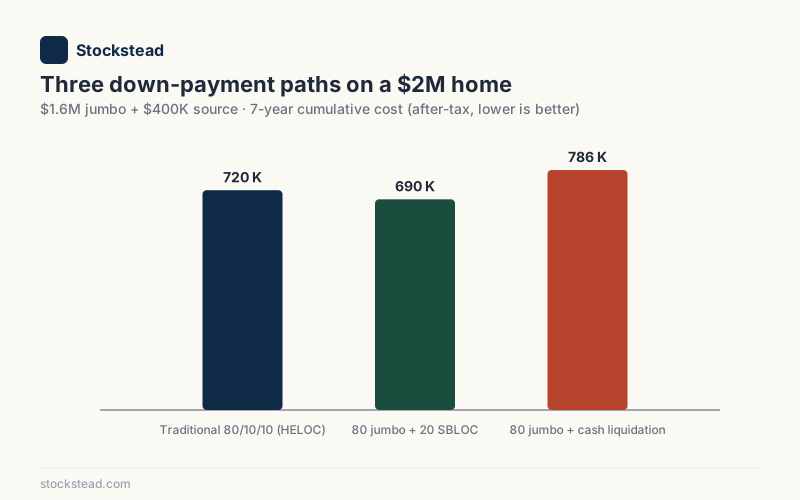
Path 1: 80/20 piggyback with SBLOC down
The buyer takes a $1,600,000 jumbo at an assumed 6.85% and draws $400,000 on an SBLOC at an assumed 6.75% all-in. Year-one interest on the jumbo is approximately $109,400, of which roughly $51,400 (the portion attributable to the first $750K of principal) is deductible. At a 46% combined marginal rate, the deduction is worth roughly $23,600 in year one. Year-one SBLOC interest is $27,000, fully non-deductible. For the upstream conversion from headline rate to effective rate under the $750K acquisition cap (worked through across marginal-rate combinations), see the after-tax mortgage calculator spoke.
Over a 7-year hold with the SBLOC carried interest-only and the jumbo amortizing on schedule, cumulative interest on the first mortgage runs roughly $700,000 (declining as principal pays down), with cumulative tax savings from the capped deduction of roughly $150,000. Cumulative SBLOC interest at a constant 6.75% on $400K is roughly $189,000. Net 7-year financing cost: approximately $739,000. The pledged portfolio stays whole and compounds at 6.5% on a base that grows from $2M to roughly $3.1M over the period.
Path 2: 80/20 conventional with cash from liquidation
The buyer takes the same $1,600,000 jumbo at 6.85% and funds the $400,000 down by selling $400K of taxable brokerage holdings. The cap-gains math: $200K realized gain at 28% combined rate equals $56,000 in tax. The buyer's portfolio drops from $2M to $1.544M ($2M minus the $400K sold minus the $56K tax paid from the sale proceeds, assuming tax is funded from the same liquidation).
Cumulative jumbo interest and deduction value match Path 1 at $700K and $150K respectively. There is no SBLOC interest. But the portfolio compounds on a smaller base. Over 7 years at 6.5%, $1.544M grows to roughly $2.40M, versus the $3.1M the unsold portfolio would reach in Path 1. The opportunity cost of the liquidation is roughly $700,000 in foregone portfolio growth, of which the buyer would eventually owe cap gains on realization, but on a deferred basis. Net 7-year financing cost including the cap-gains tax and opportunity cost: approximately $606,000, but with $700K less in the portfolio at the end of the period.
Path 3: Traditional 80/10/10 with HELOC second
The buyer takes a $1,600,000 jumbo at 6.85%, a $200,000 HELOC second at an assumed 8.5%, and puts $200,000 cash down by selling $200K of taxable brokerage holdings. Cap-gains tax on $100K of realized gain at 28% is $28,000. Year-one HELOC interest is $17,000. HELOC interest on funds used to acquire or substantially improve the same home can be deductible up to the combined $750K cap, but only the portion of total mortgage debt under the cap qualifies, and in this structure the first mortgage already exhausts the cap, so the HELOC interest is effectively non-deductible.
Cumulative 7-year cost: jumbo interest of $700K, HELOC interest of roughly $119K (assuming interest-only with rate roughly flat), tax savings of $150K from the jumbo, plus the $28K cap-gains tax. Net approximately $697,000. The portfolio drops from $2M to $1.772M at outset, then compounds to roughly $2.75M over 7 years, a middle ground between Paths 1 and 2.
Which path wins?
On pure 7-year cost-to-finance, Path 2 (conventional cash-down liquidation) looks cheapest at $606K. But it leaves the smallest portfolio at the end of the period. Path 1 (80/20 piggyback with SBLOC) costs $133K more in nominal interest, but the portfolio is $700K larger at year 7. The piggyback SBLOC wins on a wealth-maximizing basis by roughly $567K over 7 years on this specific worked example. Path 3 sits between the two on both dimensions. The wider the cost basis gap (lower basis fraction means bigger gain on sale) and the longer the hold, the wider the SBLOC win.
When does the traditional second mortgage piggyback still win over the SBLOC?
For an HNW buyer without a pledgeable taxable brokerage account of adequate scale, the traditional HELOC second is the operational alternative. Per FINRA's investor alert, an SBLOC requires diversified collateral typically at 2-3x the line size for safe initial LTV, meaning a $400K SBLOC realistically requires $1.2M-$2M of pledged portfolio. Below that scale, the SBLOC's maintenance call risk is structurally too high for a multi-year carry.
The HELOC second also wins when the buyer has strong reasons to keep the brokerage portfolio unencumbered: a concentrated single-stock position, a trust structure that prohibits pledging, an upcoming liquidity event where the portfolio needs to be free of liens, or a personal preference against the maintenance-call dynamics. The HELOC carries no maintenance-LTV risk on the brokerage account. Its risk lives in the home equity, which the buyer is presumably comfortable with by having taken the first mortgage.
The HELOC piggyback also offers a deductibility path that the SBLOC does not, though it is narrow. HELOC interest on funds used to buy or substantially improve the same home can be deductible up to the combined $750K cap. For most HNW jumbo buyers, the first mortgage alone exceeds the cap, so the HELOC second adds no incremental deduction. But for buyers whose first mortgage is under $750K (smaller homes, larger down payments), the HELOC interest can qualify. The SBLOC interest cannot.
For the underlying explainer on the HELOC vs SBLOC tradeoff, see our SBLOC vs HELOC for HNW homeowners post and the complete SBLOC mechanics walkthrough.
How does this compare to a pure 100% portfolio-funded purchase?
A pure portfolio-funded purchase replaces the entire mortgage with SBLOC draws against the pledged account. For a $2M home, that is a $2M SBLOC draw with no first mortgage. The buyer surrenders the deduction on the first $750K of acquisition indebtedness entirely, paying SBLOC interest on the full purchase amount as non-deductible carry. In exchange, there is no mortgage origination, no reserve requirement, no appraisal, no underwriting, and closing happens in 5-15 business days rather than 30-60.
For most HNW buyers, the math favors the 80/20 piggyback over the pure portfolio-funded purchase because the deduction on the first mortgage is real money. At a 46% combined marginal rate, the year-one deduction on $51K of capped jumbo interest is worth $23K, and over a 7-year hold the cumulative tax shield runs $150K+. The piggyback captures that shield while still avoiding the cap-gains realization on the down payment. The pure portfolio-funded purchase only wins when the buyer values the operational speed of an all-SBLOC close (rare competitive purchase scenarios) more than the cumulative deduction value, or when the buyer plans to refinance into a conventional jumbo shortly after closing.
For HNW buyers above the super jumbo threshold (above roughly $1.25M-$2M in loan size), the comparison shifts again because the first mortgage's deductible portion shrinks as a fraction of the total. See the jumbo mortgage calculator spoke for the underlying jumbo math and the pillar's discussion of when super jumbo pricing erodes the piggyback advantage.
What are the operational risks of the piggyback SBLOC structure?
Per the SEC's Securities-Based Lending Investor Bulletin, the central operational risk of any SBLOC structure is the maintenance call. On a piggyback SBLOC drawn against a pledged portfolio, the math is the same as on any other SBLOC: if the portfolio's market value drops to the point where the loan balance equals the maintenance LTV threshold (typically 70%), the lender issues a call requiring cure within 3-5 business days.
For the $400K SBLOC on a $2M pledged portfolio in the worked example above, initial LTV is 20%. A 71% portfolio drawdown is required to breach the 70% maintenance line. That is structurally bulletproof against any historical drawdown short of an end-of-financial-system event. The risk profile is different for smaller pledged portfolios. A $400K SBLOC against an $800K pledged portfolio is a 50% initial LTV, and a normal 30% correction puts the buyer at 71% LTV and into call territory.
The second operational risk is the variable rate. The SBLOC rate floats with SOFR. If SOFR rises 200 basis points over the hold horizon, the cumulative SBLOC interest in the worked example above rises by roughly $56K. The first mortgage in the piggyback is fixed, so only the 20% SBLOC piece carries the rate risk. For buyers who want to lock the entire structure, a fixed-rate second mortgage (HELOC or stand-alone seconds) replaces the variable-rate exposure with a higher fixed rate. For buyers comfortable with variable-rate exposure on a 20% slice of the total, the SBLOC is the cheaper structure most of the time.
The third risk is concentration in the pledged account. If the brokerage portfolio is heavily concentrated in employer equity or a single sector, the blended advance rate drops and the line size shrinks. For founders or long-tenured tech employees with concentrated positions, the piggyback SBLOC may not deliver enough line capacity, and the HELOC second or a partial liquidation becomes the operative alternative. See the related discussion on funding the down payment from a mixed cash, stocks, and SBLOC stack.
Calculator output: what numbers actually matter?
The piggyback hybrid calculator should produce four output numbers per financing path: year-one annual carrying cost, cumulative interest paid over the hold horizon, cumulative tax effect (deduction value minus any cap-gains tax paid), and ending portfolio value. Comparing all four across the three paths (piggyback SBLOC, conventional cash-down, HELOC second) gives the buyer the wealth-maximizing answer rather than the cheapest-cost answer.
On the worked $2M example with a 7-year hold, the rank-order on wealth maximization is typically: piggyback SBLOC first, HELOC second, conventional cash-down last. The gap between first and last is roughly $500-700K on a $2M home, driven almost entirely by the cap-gains tax avoided and the portfolio compounding on a larger base. The gap narrows on shorter holds and on portfolios with higher cost basis fractions (where less gain is realized on liquidation).
For the full strategic comparison logic across all four HNW calculator categories, the pillar guide on HNW mortgage calculators walks through how the piggyback hybrid fits alongside the after-tax mortgage tool, the asset depletion qualifier, and the cash-vs-mortgage strategic comparison.
When to consult a professional
A piggyback calculator can produce wealth-maximizing comparisons to two decimal places, but it cannot tell a buyer whether their specific brokerage account is eligible for pledging at the chosen broker, whether their trust structure permits creating a security interest over the portfolio, whether the SBLOC interest can be traced to deductible investment interest under their specific tax facts, or whether the lender will actually approve the requested line size against their specific holdings.
For a piggyback structure on a multi-million-dollar purchase, three professionals should review the calculator output. A jumbo loan officer or private bank relationship manager confirms the first mortgage rate and reserve requirements. A securities-based lending specialist at the chosen broker confirms the SBLOC line size, the blended advance rate against the specific portfolio, and the maintenance LTV threshold. A CPA with HNW practice depth confirms the deduction math, the cap-gains treatment of any partial liquidation, and the interaction with state tax and NIIT.
For the full disclosure on what stockstead.com publishes and does not, see the disclaimers page.
Sources and further reading
- IRS Publication 936 — Home Mortgage Interest Deduction
- IRS Topic No. 409 — Capital Gains and Losses
- IRS Publication 550 — Investment Income and Expenses
- FINRA — Securities-Backed Lines of Credit (Investor Alert)
- SEC — Securities-Based Lending Investor Bulletin
- Federal Housing Finance Agency — Conforming Loan Limits
- Federal Reserve Bank of New York — SOFR Reference Rates
- Freddie Mac — Primary Mortgage Market Survey
Market rates cited as current are as of October 8, 2026; worked-example rates are illustrative inputs. Limits and tax thresholds as of May 24, 2026. Jumbo and SBLOC rates move daily; tax thresholds change with new legislation. Verify directly with primary sources before structuring a piggyback. Educational, not financial advice. Stockstead publishes educational content for HNW home buyers and is not a licensed financial advisor, tax advisor, or mortgage broker. Consult a fiduciary advisor, a CPA, and a licensed loan officer before committing to any financing structure.
Frequently asked questions
- What is a piggyback 80/10/10 mortgage in the HNW context?
The traditional 80/10/10 is an 80% first mortgage, a 10% second mortgage (often a HELOC), and 10% cash down, structured to avoid PMI on conforming loans. For HNW jumbo buyers, PMI is irrelevant because jumbos do not carry it. The relevant HNW reframe is an 80% jumbo plus a 20% SBLOC funded from a pledged taxable brokerage account, with the SBLOC replacing both the second mortgage and the cash down. The point is no longer PMI avoidance. It is avoiding a capital gains realization on the assets that would otherwise need to be liquidated to fund the down payment, while keeping the portfolio intact and compounding.
- Why use an SBLOC instead of a traditional second mortgage for the 20% piggyback piece?
Three reasons. First, no appraisal, no title search, and no closing on a separate junior lien — the SBLOC funds in 5-15 business days against the pledged brokerage account per FINRA's investor alert. Second, on larger lines the rate is often lower than a stand-alone second mortgage or a 90-100% LTV HELOC, because the collateral is liquid securities rather than a junior real estate lien. Smaller lines price higher at most brokers, so compare quotes: as of October 8, 2026, the average HELOC rate was 7.33%, and $1M-draw SBLOC quotes ran from 4.93% (IBKR Pro) to 6.77% (Schwab PAL list). Third, the SBLOC is interest-only with no defined maturity, so the buyer is not amortizing a second mortgage on top of the first. The tradeoff is the SBLOC interest is generally non-deductible as home acquisition indebtedness.
- Is the SBLOC portion of an 80/20 piggyback tax-deductible?
Generally no. Per IRS Publication 936, home acquisition indebtedness must be secured by the home itself. An SBLOC is secured by the pledged brokerage account, not the home, so the interest does not qualify under IRC Section 163(h)(3) as deductible mortgage interest. A sophisticated tracing structure under IRC Section 163(d) can sometimes convert the SBLOC interest to deductible investment interest if the proceeds are used to buy investment property, but that does not apply to a primary residence purchase. Model the SBLOC piece as fully non-deductible.
- Does the 80% jumbo first mortgage still get the full mortgage interest deduction in an HNW piggyback?
Up to the $750,000 acquisition-indebtedness cap under IRC Section 163(h)(3), yes. For a $2M home with an $1.6M jumbo first, only the interest on the first $750K of principal is deductible, roughly 47% of year-one interest. The SBLOC piggyback structure does not change the cap on the first mortgage. It changes what funds the remaining 20% of the purchase price.
- What is the maintenance LTV risk on the SBLOC piggyback piece?
The SBLOC has a maintenance LTV threshold, typically 70% on diversified collateral per major broker schedules, at which point the lender issues a maintenance call. The buyer must cure within 3-5 business days by depositing cash, transferring in securities, or selling positions. Drawing $400K against a $2M pledged portfolio is a 20% initial LTV, which leaves room for a 71% portfolio drawdown before hitting the 70% maintenance level. Drawing $400K against a $600K portfolio is a 67% initial LTV and is one normal correction away from a forced sale.
- When does the traditional 80/10/10 with a HELOC second still make sense for an HNW buyer?
When the buyer does not have a sufficient pledgeable taxable brokerage account, when the home equity is needed for deductibility reasons (HELOC interest on home equity used to buy or substantially improve the same home can be deductible under specific facts), or when the buyer is uncomfortable with the maintenance-call dynamics of a portfolio-secured line. The HELOC second is a slower close (30-45 days) and can price above or below the SBLOC depending on venue and line size (as of October 8, 2026, the HELOC average was 7.33%), but it shares the deduction characteristics of the first mortgage up to the combined $750K cap and does not put the brokerage portfolio at risk.
- How does the piggyback SBLOC compare to a pure 100% portfolio-funded purchase?
The 80/20 piggyback splits the financing across two structures: a deductible jumbo on the first $1.6M and a non-deductible SBLOC on the remaining $400K. A pure portfolio-funded purchase replaces the jumbo entirely with a larger SBLOC, surrendering the deduction on the first $750K but eliminating the mortgage origination process and any reserve requirements. For most HNW buyers, the piggyback wins because it preserves the deduction on the first mortgage while still avoiding the cap-gains realization on the down payment. See the comparison logic in our pillar guide.
Ready to run the numbers on your situation?
Open the calculator →Related posts
The Down Payment Dial: How to Split Funding Across Cash, Stocks, and SBLOC
Most mortgage calculators force you into a single funding source. The reality for HNW buyers is a dial — what percentage from cash, what percentage from liquidating stocks, what percentage from an SBLOC. Each setting changes both your nominal cost and your ending net wealth, and the optimal mix isn't where you'd expect.
SBLOC Mortgage Calculator: After-Tax vs Jumbo for HNW Buyers
SBLOC mortgage calculator for HNW buyers: after-tax math, the $750K deduction cap, a worked $2.4M portfolio-funded vs jumbo comparison, and rates as of October 8, 2026.
Property Tax Mortgage Calculator: HNW High-Tax State Math
Property tax mortgage calculator for HNW buyers in CA, NY, NJ, MA, FL: $3M worked examples and how the 2026 SALT cap phase-down hits after-tax cost.