Asset Depletion Mortgage Calculator: Qualify on Portfolio
By Tyler Singletary · · Updated · in How it works
Most jumbo buyers without a six-figure W-2 paycheck assume they cannot qualify for a conventional mortgage. The assumption is wrong. Asset depletion (also called asset dissipation) is the underwriting mechanism that converts a portfolio balance into imputed monthly income for DTI purposes, and it is how founders pre-exit, retired executives, family-office principals, and recent liquidity-event sellers actually clear the qualifying ratios on a $2M-$5M jumbo. The math is straightforward. The lender-specific variants are not. A dedicated calculator beats a generic PITI tool here because the inputs that drive the answer, eligible-asset haircut, retirement-account divisor, account-type weighting, are not in any standard mortgage calculator.
This guide walks through how an asset depletion mortgage calculator actually works in 2026: the standard formula, the lender-specific haircuts, the FICO and reserve requirements, two worked examples, and the rate premium versus a vanilla jumbo. For the broader four-calculator framework, see the mortgage calculator for high net worth buyers pillar.
Market rates on this page are as of October 8, 2026; program parameters reflect May 2026; worked examples use a 7.64% rate dated October 2026. Asset depletion is a non-QM jumbo product; rates, haircuts, and divisors vary by lender and update without notice. Verify with a jumbo loan officer before sizing a loan. Primary regulatory and rate sources are linked at the bottom.
What is an asset depletion mortgage?
Per Fannie Mae's Selling Guide B3-3.1-09 and The Mortgage Reports' asset depletion overview, an asset depletion mortgage qualifies the borrower by converting eligible liquid assets into a stream of imputed monthly income, typically by dividing a haircut portfolio balance by the loan term in months. Minimum eligible assets generally start at $500K, with most HNW programs requiring $1M or more. The loan itself is a standard amortizing mortgage with a lien on the home, not on the portfolio.
The product solves a specific underwriting problem. A conventional jumbo wants two years of stable, documentable income, ideally W-2 or 1099 with consistent magnitude. A founder who has been paying themselves a modest salary while building equity in a private company does not produce that documentation, even with $5M in a brokerage account. A retired executive living off portfolio income and capital gains does not produce it either. Asset depletion is the underwriting bridge: the lender treats the portfolio as if the borrower will draw it down over the loan term, computes a monthly draw, and adds that synthetic income to whatever documented income exists.
The structure differs from asset based lending or a securities-backed line of credit. Asset depletion produces a conventional mortgage; the portfolio is never pledged or encumbered. The borrower retains full control of the account, continues to trade, and is free to liquidate or redeploy positions during the loan term. The lender simply uses the balance as a qualifying metric at origination.
How the asset depletion calculator math actually works
The standard formula has three inputs: the eligible-asset balance, the account-type haircut, and the divisor. Per industry guidance summarized by Quicken Loans' asset depletion guide, the dominant convention is 70% haircut on taxable brokerage, 60-70% haircut on retirement accounts, and a divisor equal to the loan term in months. A 30-year amortization divides by 360. A 15-year divides by 180.
The standard 70% / 360 formula
For a fully taxable brokerage portfolio:
Imputed monthly income = (Eligible assets × 0.70) / 360
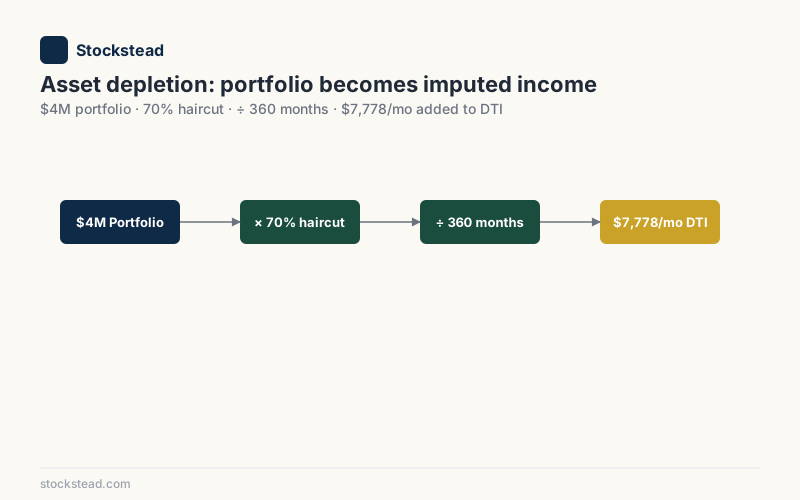
A $4,000,000 taxable brokerage account at 70% haircut produces $2,800,000 of qualifying assets. Divided by 360 months, that is $7,778 of imputed monthly income. Add this to any documented W-2 or 1099 income; the lender uses the combined figure as the DTI numerator base.
A $1,500,000 taxable brokerage account on the same formula produces $1,050,000 qualifying / 360 = $2,917 of imputed monthly income. A $10,000,000 portfolio produces $19,444. The relationship is linear, which is what makes asset depletion attractive for ultra-HNW buyers: the imputed income scales directly with portfolio size, with no cap.
Retirement account treatment
Retirement accounts get treated differently depending on age. For borrowers age 59.5 or older, IRA and 401(k) balances typically get a 70% haircut, the same as taxable brokerage, because withdrawals are penalty-free. For borrowers under 59.5, the haircut tightens to 60-65% on most programs because the lender models a 10% early-withdrawal penalty plus deferred-income-tax friction. A 50-year-old with a $2,000,000 401(k) and a $1,500,000 taxable brokerage account on a 30-year loan would compute:
Taxable: $1,500,000 × 0.70 / 360 = $2,917
Retirement: $2,000,000 × 0.60 / 360 = $3,333
Total imputed: $6,250 per month
The same balances at age 60 would produce $2,917 + $3,889 = $6,806. The 9% lift reflects unlocked retirement-account access.
Lender-specific divisor variants
Not every lender uses the loan term as the divisor. Three common variants:
- Loan-term divisor (most common). Divide by 360 for a 30-year, 180 for a 15-year. Produces the highest imputed income.
- Borrower-age-to-85 divisor (conservative). Divide by (85 - borrower's age) × 12. For a 60-year-old, that is 25 × 12 = 300 months. Produces a slightly higher monthly figure than the 360 divisor for older borrowers.
- Fixed 240-month divisor (some non-QM programs). Divide by 240 regardless of loan term. Produces a higher monthly figure than 360, which can be the difference for borderline DTI cases.
The borrower-age variant matters most for older HNW buyers. A 70-year-old with a $3M portfolio using the 360 divisor gets $5,833 of imputed income; the same buyer using the (85-70) × 12 = 180 divisor gets $11,667. Twice the qualifying income on the same portfolio because the lender assumes a shorter depletion horizon.
The lender selection question matters more than most calculator inputs. Always ask the jumbo desk what divisor they use before running the numbers.
What lenders haircut and why
Per Fannie Mae's Selling Guide B3-3.1-09, the haircut exists to absorb three risks: market volatility on the portfolio, tax friction on liquidation, and transaction costs. Each asset class gets a different haircut based on those risks. Below is a representative table for a non-QM HNW asset depletion program in 2026.
| Asset class | Typical haircut (eligible portion) |
|---|---|
| US Treasury notes and bills | 90-100% |
| Investment-grade municipal bonds | 80-90% |
| Diversified equity ETFs (VTI, VOO, VXUS) | 70-75% |
| Large-cap individual stocks (S&P 500 names) | 60-70% |
| Mid-cap and small-cap individual stocks | 40-60% |
| Concentrated single-position holdings (>25% of account) | 40-60% |
| International or sector ETFs | 60-70% |
| Retirement accounts (age 59.5+) | 70% |
| Retirement accounts (under 59.5) | 60-65% |
| Restricted or post-IPO lockup shares | 0% |
| Unvested RSUs | 0% |
| Real estate (not the subject property) | 0% (excluded from liquid) |
A diversified $3M portfolio at the blended rate above might qualify with a 70% haircut. A $3M portfolio concentrated 80% in a single tech stock might only qualify at 50%, producing materially less imputed income. The composition of the account, not just the balance, drives the qualifying number.
Some lenders apply a further reduction for "seasoning," requiring assets to be held in the borrower's name for 60-90 days minimum before they count. This catches recent transfers, including post-exit liquidity events where the cash hit the account three weeks before application. The fix is timing: complete any asset transfers at least 90 days before submitting the mortgage application.
Who actually uses asset depletion mortgages?
Per The Mortgage Reports, asset depletion is concentrated in four borrower profiles, each with a structural reason traditional W-2 underwriting fails. The shared trait is meaningful balance-sheet wealth with thin documented income. Industry estimates suggest fewer than 5% of jumbo originations use asset depletion, but the share rises sharply at the $2M+ loan tier where W-2-only qualifying becomes binding for many wealthy applicants.
Founders pre-exit
A founder of a venture-backed company often pays themselves a below-market salary (a "founder salary" of $150K-$250K is typical even at unicorn-valuation startups) while holding paper wealth in equity that does not count for DTI until exit. A founder with $250K of W-2 income and $4M of liquid investments outside the company qualifies on roughly $20,833 monthly base + $7,778 imputed = $28,611 combined. At a 43% DTI cap and a 7.64% rate (October 2026), that supports a loan of roughly $1.4M with 20% down once property tax and insurance are counted, about $400,000 more than the roughly $1.03M the W-2 alone supports. It does not reach a $3M jumbo, whose PITI of about $25,300 a month would put DTI near 89%.
Retired executives
A 62-year-old retired tech executive with a $6M portfolio and $80K of social security and pension income has documented monthly income of $6,667. Asset depletion converts the $6M portfolio at 70% / 360 into $11,667 of additional imputed income. Combined $18,333 monthly supports a loan of roughly $900,000 at a 43% DTI cap and a 7.64% rate (October 2026), or about $1.06M at a 50% cap, with 20% down. That is jumbo territory in most counties, but well short of $3M. The retired executive can buy a new primary residence (downsize, relocation, second-home conversion) without liquidating positions to satisfy a W-2-style underwriter.
Family-office principals
Principals of single-family offices draw irregular distributions, manage holdings through LLCs and trusts, and rarely produce two years of consistent personal W-2 income. Asset depletion lets the underwriter qualify against the verifiable liquid balance sheet instead of fighting through K-1s, partnership distributions, and entity flow-through.
Recent liquidity-event sellers
A founder or executive who recently sold a company and received $15M of cash has substantial balance-sheet wealth but no recent documented income, the proceeds hit a brokerage account, the company shuts down, and W-2 stops. Asset depletion qualifies them on the cash. The seasoning requirement (60-90 days) means timing the application correctly matters; submitting the day after the cash lands does not work at most lenders.
Two worked examples
Concrete numbers. Both examples run the DTI check at one rate: 7.64% on a 30-year fixed asset depletion jumbo, which is the 7.39% MBA jumbo average for the week of Oct 2, 2026 plus a 25 bp non-QM premium (the low end of the typical 25-100 bp range). A quote toward the top of that range would push both DTIs higher.
Example one: pre-exit founder
Buyer: 38-year-old founder, $200K W-2, $3.5M taxable brokerage (diversified), $750K in a Roth IRA (under 59.5). Target purchase: $2.4M primary residence, 25% down ($600K from cash and partial brokerage liquidation), $1.8M loan.
Imputed income calculation:
- Taxable: $3,500,000 × 0.70 / 360 = $6,806 per month
- Retirement (under 59.5): $750,000 × 0.60 / 360 = $1,250 per month
- W-2: $200,000 / 12 = $16,667 per month
- Combined qualifying income: $24,723 per month
DTI check at 7.64%:
- PITI on $1.8M at 7.64%, 30-year, 1.2% effective property tax, $4,000 annual insurance: approximately $15,492 monthly ($12,759 principal and interest)
- Existing debts (auto, no other mortgage): $800 monthly
- Total debt: $16,292 monthly
- DTI: $16,292 / $24,723 = 65.9%
This fails the typical 43% DTI cap, and it also fails the 50% ceiling that the most flexible non-QM programs allow when reserves are strong. At 25% down, this buyer does not qualify. A 240-month divisor, where offered, only brings DTI to 56.7%. What would make it pass a 50% cap:
- A much larger down payment. Holding the $2.4M price, the loan has to fall to about $1.245M, roughly 48% down, if the extra cash comes from outside the qualifying accounts. If it comes out of the brokerage, imputed income falls too, and the loan has to drop to about $1.157M (about 52% down).
- More documented income. About $32,600 of qualifying monthly income clears 50% on the original $1.8M loan, roughly $7,900 a month more than this buyer shows.
- A bigger portfolio. Holding everything else, the taxable account would need to be about $7.5M instead of $3.5M.
Clearing a 43% cap is harder still: the loan would need to fall to about $1.0M with outside cash. The W-2 alone ($16,667) against $16,292 of PITI plus debt would be 98% DTI, which no lender approves. Asset depletion helps a lot here, from 98% to 66%, but on its own it does not make this deal work.
Example two: post-exit principal
Buyer: 52-year-old recent liquidity-event seller, no current W-2 (company sold 14 months ago), $8M taxable brokerage, $1.5M in a traditional IRA (under 59.5). Target purchase: $3.5M primary residence, 30% down ($1.05M from cash), $2.45M loan.
Imputed income calculation:
- Taxable: $8,000,000 × 0.70 / 360 = $15,556 per month
- Retirement (under 59.5): $1,500,000 × 0.60 / 360 = $2,500 per month
- W-2: $0
- Combined qualifying income: $18,056 per month
DTI check at 7.64%:
- PITI on $2.45M at 7.64%, 30-year, 1.0% effective property tax, $6,000 annual insurance: approximately $20,783 monthly
- Existing debts: $1,200 monthly
- Total debt: $21,983 monthly
- DTI: $21,983 / $18,056 = 121.8%
This fails badly. The structural issue: the $8M portfolio is large but the 360-month divisor flattens it across the full loan amortization. Two fixes available. Use a borrower-age-to-85 divisor: (85-52) × 12 = 396 months produces lower imputed income, worse. Use a 240-month divisor where available: $8M × 0.70 / 240 = $23,333 plus $1.5M × 0.60 / 240 = $3,750, combined $27,083 imputed. New DTI: $21,983 / $27,083 = 81.2%. Still fails.
The honest answer for this borrower: asset depletion on a conventional mortgage does not clear DTI at this loan size against this portfolio. The fix is a different structure. A 50% down payment ($1.75M) drops the loan to $1.75M, PITI to roughly $15,821, total debt to $17,021, and DTI to 94.3% on the 360-divisor imputed income (62.8% on a 240 divisor), still far too high. On the 360 divisor, this income supports a loan of only about $444,000 at a 43% cap. A portfolio-funded approach using a Pledged Asset Line or SBLOC mortgage structure often fits this profile better; the lender's qualifying math collapses to "do you have enough collateral," not "do you have enough imputed income."
The lesson from example two: asset depletion has a ceiling. With no other income, a 70% haircut, and a 360-month divisor, a $1.5M loan at 7.64% (25% down, 1.2% property tax, $6,000 insurance) needs a portfolio of roughly 9x the loan to clear a 50% DTI cap and about 10.5x to clear 43%. Below that coverage, asset depletion has to be paired with documented income or the math breaks. The right call is to run the calculator early, see the constraint, and pivot to a portfolio-secured structure if asset depletion math does not clear.
Rates, FICO, and program parameters in 2026
Per Quicken Loans and The Mortgage Reports' coverage of non-QM jumbo programs, asset depletion mortgages were quoted in a 6.25% to 8.50% band on 30-year fixed in May 2026, depending on FICO, LTV, and reserve posture, when the standard 30-year sat in the mid-6% range. As of October 8, 2026, the Freddie Mac PMMS 30-year average was 7.40% and the 30-year jumbo average 7.39%. Asset depletion programs price 25-100 basis points above standard jumbo, reflecting non-QM secondary-market liquidity and the borrower profile.
Typical 2026 program parameters
- FICO minimum: 680 floor, 720+ unlocks the best pricing
- Maximum LTV: 75-80%, with some programs allowing 85% on smaller loans
- DTI ceiling: 43% standard, 45-50% on the most flexible non-QM programs
- Minimum eligible assets: $500K floor, $1M typical, $2M+ for the best pricing tier
- Reserve requirements: 12-24 months of PITI in liquid reserves on top of qualifying assets
- Asset seasoning: 60-90 days for taxable accounts at most lenders
- Maximum loan size: typically capped at $3M-$5M on standard programs, higher on portfolio-direct private-bank channels
The rate premium versus a vanilla jumbo is real but not punitive. For a $1.8M loan at 7.39% (the October 2026 jumbo average) versus 7.64% (asset depletion non-QM at a 25 bp premium), the monthly payment difference is about $308, or roughly $111K over a 30-year term assuming no refi. A premium toward the top of the 25-100 bp range costs proportionally more. For a buyer who could not otherwise qualify, the premium is the price of access.
When the rate premium reverses
A few situations where asset depletion pricing is competitive or even favorable. First, ultra-HNW borrowers with $10M+ in pledged-eligible assets often qualify for private-bank asset depletion programs at conventional jumbo pricing, the bank takes the relationship value into account. Second, super jumbo asset depletion loans above $3M often price competitively because the borrower profile (large balance sheet, low LTV) is exactly what portfolio lenders want. Third, hybrid asset depletion plus restricted-stock collateral structures sometimes price below standard jumbo if the lender wants the broader relationship.
When asset depletion is the wrong tool
Three profiles where asset depletion is technically available but a different structure fits better.
The portfolio is too small relative to the loan. Without other income, asset depletion needs roughly 9-10x portfolio coverage of the loan amount at October 2026 rates; with a salary in the mix, much less. A $1M portfolio supporting a $1.5M loan produces $1,944 of imputed monthly income against roughly $13,100 of PITI, nowhere near enough on its own. The fix is either a larger down payment, a smaller loan, or a different qualifying path.
The borrower has strong W-2 income. A buyer with $500K of documented W-2 income usually does not need asset depletion to qualify, even on a $2M jumbo. Adding asset depletion to the application sometimes triggers a non-QM rate premium that the borrower did not need to pay. Run a standard jumbo mortgage calculator on the W-2-only numbers first; if DTI clears under 43% without invoking imputed income, the vanilla jumbo is the cheaper path.
The deal would close better through a portfolio-secured structure. For buyers with substantial pledge-eligible taxable assets and high tax brackets, a pledged asset line or SBLOC often beats asset depletion on after-tax effective cost, particularly above the $750K acquisition cap per IRS Publication 936. The portfolio-secured path does not require DTI qualifying at all in the conventional sense; it requires collateral coverage. For comparison logic on the financing structures, see the HNW home buyer financing guide.
The borrower wants the broadest possible refi optionality. Asset depletion non-QM products often have shorter refi windows and tighter rate-and-term refi guidelines than vanilla jumbos. A borrower planning to refi within 2-3 years should confirm the program's prepayment and refi terms before committing.
How to actually run the calculator
Five steps to a defensible asset depletion qualifying estimate.
-
Inventory eligible assets. Pull current balances on every taxable brokerage account, money market, retirement account, and any other liquid investment. Exclude home equity, private company equity, restricted shares, unvested RSUs, and assets in trusts you do not directly control. The lender will exclude them too.
-
Apply asset-type haircuts. Use 70% on diversified taxable brokerage. Use 60-65% on retirement accounts if under 59.5, 70% if older. Apply concentration discounts for any single position above 25% of an account. Use 85-95% on Treasury holdings and investment-grade bonds.
-
Divide by the loan term in months. 360 for a 30-year, 180 for a 15-year. If you are over 60, ask the lender whether they offer a (85-age) × 12 divisor or a fixed 240-month divisor. Younger borrowers should stick with the 360-divisor as the baseline.
-
Add documented income. W-2, K-1 average, RSU vest average, partnership distributions, pension, social security. The imputed asset depletion income is additive to these, not a replacement.
-
Compute DTI against PITI plus existing debt. Standard target: 43% or below. Stretch ceiling: 50% on flexible non-QM programs with strong reserves. If the answer is above 50%, asset depletion alone will not work; consider a larger down payment, smaller loan, or a portfolio-secured structure.
A dedicated asset depletion calculator standardizes this against a particular lender's program. The arithmetic is simple; the program parameters are what vary.
When to consult a professional
The calculator gives a defensible qualifying estimate, but the actual answer comes from the jumbo desk. Lender-specific haircuts, divisors, seasoning rules, and DTI ceilings vary materially. Two lenders looking at the same portfolio and the same loan can produce qualifying answers that differ by 20-30% on imputed income, and one can approve while the other declines.
For loans above $1M, the calculator output is the input to a conversation with a non-QM jumbo loan officer or private-bank relationship manager who can confirm what their specific program accepts, at what rate, and against what reserve requirement. A CPA confirms the after-tax cost of the loan against the buyer's marginal rate (the $750K acquisition cap under IRC Section 163(h)(3) still applies). A fiduciary financial advisor confirms whether asset depletion fits the broader balance-sheet plan, particularly for borrowers within ten years of retirement, where the portfolio's compounding role becomes more sensitive to mortgage carry.
Stockstead publishes educational content and runs calculators that model the math. Stockstead does not provide investment, tax, or legal advice. For the full disclosure, see the disclaimers page.
Sources and further reading
- Fannie Mae — Selling Guide B3-3.1-09: Other Sources of Income
- Federal Housing Finance Agency — Conforming Loan Limits
- IRS Publication 936 — Home Mortgage Interest Deduction
- Consumer Financial Protection Bureau — Ability-to-Repay and Qualified Mortgage Standards
- Quicken Loans — Asset-Depletion Mortgage Guide
- The Mortgage Reports — Asset Depletion Mortgage Guide
- Federal Reserve Bank of New York — SOFR Reference Rates
- Freddie Mac — Primary Mortgage Market Survey
Market rates as of October 8, 2026; haircuts, program parameters, and worked-example rates reflect May 2026. Asset depletion is a non-QM jumbo product; pricing, divisors, and underwriting variants change without notice and differ by lender. Verify with a jumbo loan officer before sizing a loan. Educational, not financial advice. Stockstead publishes educational content for HNW home buyers and is not a licensed financial advisor, tax advisor, or mortgage broker. Consult a fiduciary advisor, a CPA, and a licensed loan officer before committing to any financing structure.
Frequently asked questions
- What is an asset depletion mortgage and who qualifies?
An asset depletion mortgage (also called asset dissipation) converts an eligible portfolio balance into imputed monthly income for DTI qualification. Lenders apply a haircut (typically 70% on taxable brokerage, 60-70% on retirement accounts) and divide by the loan term in months. Buyers without traditional W-2 income, founders pre-exit, retired executives, family-office principals, recent liquidity-event sellers, are the typical candidates. Per The Mortgage Reports, minimum eligible assets usually run $500K to $1M, with 680-720+ FICO and DTI of 43% or lower.
- How do I calculate imputed income from my portfolio?
Take eligible liquid assets, apply each account-type haircut (70% on taxable brokerage is standard, 60-70% on pre-retirement-age retirement accounts), then divide the haircut balance by the loan term in months (360 for a 30-year, 180 for a 15-year). A $4M taxable brokerage portfolio at 70% haircut, divided by 360 months, produces $7,778 of imputed monthly income. Different jumbo desks apply different divisors and haircuts, so a dedicated calculator standardizes the comparison.
- What is the difference between asset depletion and asset based lending?
Asset depletion is a qualifying methodology: the lender treats your portfolio as a stream of imputed income to clear DTI on a standard amortizing mortgage. Asset based lending is a structural alternative: the loan is collateralized by the portfolio itself, similar to an SBLOC or pledged asset line. Asset depletion produces a conventional mortgage with a lien on the home. Asset based lending produces a portfolio-secured credit facility with a lien on the brokerage account. Different products, often conflated.
- What FICO and asset minimums apply to asset depletion loans?
Per The Mortgage Reports and Defy Mortgage, typical asset depletion programs require 680-720+ FICO, minimum eligible assets of $500K-$1M, maximum 75-80% LTV, and a back-end DTI of 43% or lower including the imputed income. Programs vary materially: some require 12-24 months of PITI in liquid reserves on top of the assets used for qualifying calculation, and a few require seasoning (assets held in the borrower's name for 60-90 days minimum).
- What rates apply to asset depletion mortgages in 2026?
Asset depletion programs are typically jumbo non-QM products priced 25-100 basis points above standard jumbo. As of October 8, 2026, the Freddie Mac PMMS 30-year average was 7.40% and the MBA 30-year jumbo average 7.39%. In May 2026, when the jumbo average was in the mid-6% range, asset depletion 30-year fixed quotes ranged from 6.25% to 8.50% depending on FICO, LTV, asset coverage ratio, and whether reserves are inside or outside the qualifying calculation; get live quotes, since that band moves with the jumbo market. Higher FICO and lower LTV pull pricing toward the bottom of the range.
- Can I combine asset depletion with W-2 income?
Yes, and most HNW buyers do. The imputed monthly income from asset depletion is additive to documented W-2, K-1, RSU vests, and rental income. A buyer with $20K of monthly documented income plus $7,778 of imputed asset depletion income qualifies on a combined $27,778 monthly base for DTI purposes. The lender still verifies the W-2 income through standard documentation and treats the asset depletion piece as a supplement, not a replacement.
- What disqualifies a portfolio from asset depletion qualifying?
Three common disqualifiers. First, retirement assets where the borrower is under 59.5 typically get a deeper haircut (50-60% instead of 70%) because withdrawal penalties apply. Second, restricted or unvested securities (post-IPO lockup shares, unvested RSUs) usually get zero credit. Third, assets in trusts or entities the borrower does not directly control often require additional documentation; some lenders exclude them entirely. Concentrated single-stock positions above 25-30% of the account often receive a reduced haircut.
Ready to run the numbers on your situation?
Open the calculator →Related posts
SBLOC Mortgage Calculator: After-Tax vs Jumbo for HNW Buyers
SBLOC mortgage calculator for HNW buyers: after-tax math, the $750K deduction cap, a worked $2.4M portfolio-funded vs jumbo comparison, and rates as of October 8, 2026.
How to Buy a Home Without Selling Investments
Four ways to fund a home purchase while keeping your portfolio invested — SBLOC, margin loan, asset-depletion mortgage, and hybrid structures. Mechanics, trade-offs, and how to choose.
Super Jumbo Mortgage Calculator: Loans Above $1.25M
Super jumbo mortgage calculator: private-bank pricing above $1.25M, 12-24 month reserve requirements, tighter DTI, and worked $2.4M math against the $750K cap.