Property Tax Mortgage Calculator: HNW High-Tax State Math
By Tyler Singletary · · Updated · in Tax & deductions
Most mortgage calculators ask for a property tax rate and stop. They take whatever percentage you type in, multiply, add it to PITI, and produce a monthly payment. For an HNW buyer in California, New York, New Jersey, Massachusetts, or Florida, that single field hides three layers of math the generic tool never models: the state's specific assessment regime, the interaction with the SALT cap, which since 2025 depends on the buyer's income, and the deductibility math against the buyer's marginal federal bracket. The headline property tax number can be off by a factor of two against what a high earner actually writes a check for. The after-tax cost can be off by even more. This guide walks through the state-by-state math, then runs a $3M worked example across San Francisco, Manhattan, and Hoboken to show how the spread compounds. For the broader calculator stack, see the mortgage calculator for high net worth buyers pillar.
Property tax data current as of May 24, 2026; federal tax law current as of October 11, 2026. State and local property tax rates change annually with municipal budgets, and assessment ratios change with revaluation cycles. The SALT cap reflects the One Big Beautiful Bill Act: $40,400 for 2026, phased down above $505,000 of MAGI to a $10,000 floor, reverting to $10,000 in 2030. Verify directly with primary sources before sizing a purchase.
Why generic mortgage calculators miss the state-by-state property tax math
A typical online mortgage calculator estimates property tax at a flat 1.0% to 1.25% of home value. Per the Tax Foundation's 2026 state property tax rankings, the actual effective rate ranges from 0.27% in Hawaii to 2.23% in New Jersey. That seven-fold spread alone makes a national-average input dangerous, but the deeper failure is what the calculator does next. It typically adds the property tax line to a SALT deduction at the buyer's marginal rate as if the full amount were federally deductible. Since 2018 that has not been true for almost any top-bracket buyer in a high-tax state, and the 2025 tax law changed the answer for everyone below the top.
The SALT cap under IRC Section 164(b)(6) bundles state income tax, state and local property tax, and other state and local taxes into a single annual deduction ceiling. Under the One Big Beautiful Bill Act, that ceiling is $40,400 for 2026, but it shrinks by 30 cents for every dollar of modified AGI above $505,000 until it reaches a $10,000 floor at about $606,333. A California buyer earning $1M is far past the floor. Their state income tax, roughly $90,000 at California's graduated joint rates, exhausts the $10,000 cap many times over before the first dollar of property tax is counted. The marginal federal benefit of paying property tax for that buyer is zero, and a generic calculator that quietly applies a 37% federal deduction to a $30,000 property tax line is overstating after-tax savings by approximately $11,100 per year.
The phase-down band matters for the tech and RSU audience. Between $505,000 and about $606,333 of MAGI, each extra dollar of income removes 30 cents of SALT deduction, which adds about 9.6 points to the effective federal marginal rate in the 32% bracket and about 10.5 points in the 35% bracket. A large vest can push a household from the full $40,400 to the $10,000 floor in one year, and back again the next.
Three structural patterns drive the gap.
Pattern one: assessment ratio versus market value. California assesses at purchase price plus 2% per year, New York City uses a fractional assessment system that runs well below market value, New Jersey assesses near market value with periodic revaluations, and Florida resets at purchase and then caps growth at 3% per year for homestead. A "property tax rate" pasted into a generic calculator without knowing what it applies against produces nonsense.
Pattern two: county and municipal layering. State headline rates rarely match what the buyer pays. New Jersey's 2.23% statewide effective rate masks Bergen and Essex County rates above 2.5%. New York's headline rate is misleading because NYC adds a residency layer, and Westchester and Nassau Counties run effective rates near 2.0%. A calculator that uses a state-level rate misses the county-level reality.
Pattern three: SALT-cap interaction. This is the part every generic calculator skips. For top-bracket buyers in California, New York, New Jersey, Massachusetts, Connecticut, Oregon, and Hawaii, MAGI above about $606,333 puts the cap at its $10,000 floor, state income tax already fills it, and the federal deduction value of property tax is effectively zero. The after-tax cost of property tax equals the pre-tax cost, and the "tax benefit" line on the generic calculator is fiction. Below $505,000 of MAGI the answer is different: the $40,400 cap often leaves room for part of the property tax bill.
California property tax: Proposition 13 protects the seller, not the buyer
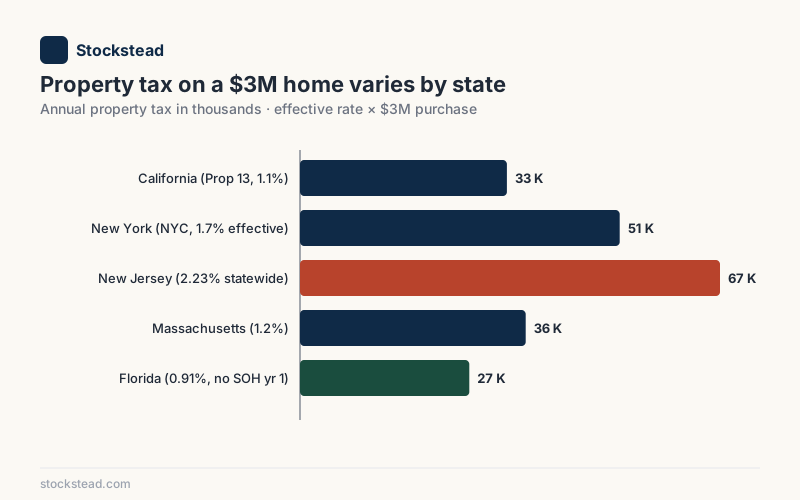
Per the California State Board of Equalization, Proposition 13 limits annual assessed-value growth to 2% per year, but a sale triggers reassessment to the new market value. A $3M California purchase resets the assessed value to $3M in year one, so the buyer pays the full 1% statewide base rate plus local bond and special assessments, which together produce effective rates of roughly 1.10% to 1.30% in most coastal metros. On a $3M home, that is $33,000 to $39,000 in year-one property tax, against $0 of federal deduction for a buyer at the $10,000 SALT floor, where California state income tax exhausts the cap.
How Prop 13 actually works at purchase
The mechanic is widely misunderstood. Prop 13 was enacted in 1978 to protect existing owners from runaway assessed-value increases during property booms. It caps the year-over-year growth in assessed value at 2%, regardless of how fast market value rises. A 1990 purchase at $500K, never reassessed, might carry an assessed value below $900K today. The owner pays roughly $9,000 in property tax. The new buyer who acquires that same home at $3M reassesses to $3M and pays roughly $33,000 to $39,000 in property tax. Same house. The seller's Prop 13 benefit does not transfer.
This produces the well-known California pattern of next-door neighbors paying property tax that differs by a factor of three or four. For the new HNW buyer, the operative number is the purchase price multiplied by the local effective rate. Prop 13 starts protecting the buyer only after year one, and only at 2% annual growth, which over a 10-year hold compounds to roughly 22% on the assessed value, far below typical California market appreciation.
San Francisco, Los Angeles, San Diego: actual rates
The 1% statewide base rate is universal. Local additions vary. San Francisco's effective rate in 2026 runs approximately 1.18% on assessed value (the 1% base plus voter-approved bonds and special assessments). Los Angeles County runs 1.16% to 1.25% depending on the city. San Diego County runs 1.10% to 1.18%. Silicon Valley municipalities like Palo Alto and Atherton run near 1.20% to 1.28%. A $3M home in any of these markets generates $33,000 to $38,400 in annual property tax in year one.
The after-tax math: a 37% federal plus 13.3% state California buyer has MAGI far above $606,333, so the SALT cap is $10,000, and state income tax fills it many times over. Zero room remains for property tax deduction. The pre-tax and after-tax cost of property tax are the same. The mortgage interest deduction operates separately under IRC Section 163(h)(3), capped at $750K of acquisition indebtedness, but the property tax line carries no federal benefit. The deeper after-tax math is in the after-tax mortgage calculator spoke.
New York property tax: county and NYC residency layers
Per the New York State Department of Taxation and Finance, New York's effective property tax rates vary enormously by county, ranging from roughly 1.0% in some upstate areas to 2.0%+ in Westchester and parts of Long Island. For HNW buyers, three submarkets matter: New York City (where fractional assessment produces lower effective rates but layered residency tax), Westchester County, and Nassau and Suffolk Counties on Long Island. Each requires its own calculator input.
New York City coops and condos
NYC uses a fractional assessment system that taxes coops and condos as Class 2 property. The headline class rate is around 12.5% in 2026, but it applies to an "actual assessed value" set at 45% of a "market value" that the Department of Finance derives from income-method comparables, not the buyer's purchase price. The result: effective rates on a $3M Manhattan condo typically run 0.85% to 1.20% of actual market value, well below the headline. A $3M Upper East Side condo might generate $25,500 to $36,000 in annual property tax depending on the building's assessment history.
Single-family townhouses are Class 1 and use a different formula with an even lower effective rate cap, often around 0.70% to 0.95% of market value. The catch: a buyer purchasing a $3M condo cannot easily predict the assessment until they see the building's most recent tax bill, because the income-method valuation can lag market value by several years.
The NYC residency layer compounds the SALT problem. A Manhattan resident pays NY state income tax at rates up to 10.9% plus NYC tax at up to 3.876%, as much as 14.776% combined. At $400K of joint taxable income, the marginal rates are 6.85% state and 3.876% city. State income tax alone on $400K of taxable income is approximately $27,400; NYC tax adds another $15,500, for about $42,900. Even at that income, where the full $40,400 cap applies, state and city income tax fill it before any property tax counts. Above about $606,333 of MAGI the cap drops to $10,000 and is consumed several times over. Either way, the federal deduction value of NYC property tax is zero.
Westchester and Long Island
Westchester County runs effective rates between 1.8% and 2.5% depending on the town. Scarsdale, Bronxville, and Rye are typically above 2.0% on market value. A $3M Scarsdale home generates $60,000 to $75,000 in annual property tax. Nassau County runs 1.9% to 2.4% on similar luxury price points. These rates are roughly double what a generic calculator typically estimates, and the SALT cap interaction is identical to the NYC pattern.
New Jersey property tax: the national high-water mark
Per the Tax Foundation's 2026 effective rates by state, New Jersey's statewide effective rate is approximately 2.23%, the highest in the United States. Bergen, Essex, Hudson, Morris, and Union Counties carry the largest HNW concentrations and typically exceed the state average. A $3M Hoboken, Englewood, Short Hills, or Montclair home generates $67,000 to $75,000 in annual property tax. For a top-bracket buyer at the $10,000 SALT floor, New Jersey's income tax (top rate 10.75%) fills the cap on its own, leaving zero federal deduction room for property tax.
Why New Jersey rates are structurally high
New Jersey funds public schools primarily through local property tax, with limited state aid relative to other Northeast states. The per-student spending in NJ school districts is among the nation's highest, and the tax base sits on residential real estate. The result is effective rates that run 2.0% to 2.5% across most of the densely populated northern counties, with occasional outliers above 2.7% in older suburban towns with high municipal costs.
For HNW buyers, the math is straightforward and painful. A $4M Short Hills home at the typical 2.3% effective rate generates $92,000 per year in property tax. Over a ten-year hold without revaluation, that compounds to nearly $1M in cumulative property tax against zero federal deduction. For a buyer at the $10,000 SALT floor, the pre-tax and after-tax cost are identical because the cap leaves no room.
The Hoboken and Jersey City case
Hudson County is the new HNW migration destination for finance professionals priced out of Manhattan. Hoboken's effective rate runs roughly 1.65% to 1.85% on market value, lower than Bergen County but still well above the national average. A $3M Hoboken condo generates approximately $49,500 to $55,500 in annual property tax. The savings versus Manhattan are real on the income-tax side (no NYC residency tax) but partially offset on the property-tax side. The detailed total cost comparison is in the true cost of homeownership calculator spoke.
Massachusetts property tax: Proposition 2 1/2 and the Greater Boston baseline
Per the Massachusetts Department of Revenue, Proposition 2 1/2 limits the total municipal property tax levy to 2.5% of total assessed value and caps annual levy growth at 2.5% per year, with override and debt exclusion exceptions. The cap protects long-term owners from runaway levy increases but does not lower the baseline rate. Greater Boston communities like Brookline, Newton, Weston, Wellesley, and Cambridge run effective rates of roughly 0.90% to 1.50% on market value, generating $27,000 to $45,000 in annual property tax on a $3M home.
The Massachusetts state income tax is a flat 5% on most income with a 4% surtax above $1M of taxable income (the Fair Share Amendment, effective 2023). An HNW buyer above $1M of income pays 9% on the surtax-eligible portion and sits at the $10,000 SALT floor, so the pattern repeats: zero federal deduction for the property tax line.
Massachusetts is also where the 2025 law shows up most clearly below the top. State income tax on $500K of income is approximately $25,000. At $500,000 of MAGI, the household is just under the $505,000 phase-down start and gets the full $40,400 cap, leaving $15,400 of room for property tax. At a 32% federal bracket, that is about $4,900 a year of federal savings that did not exist under the old $10,000 cap. Push MAGI to $550,000 and the cap falls to $26,900, leaving only $1,900 of room.
Brookline, Newton, Weston, Wellesley rates
Brookline runs roughly 1.0% to 1.1% effective. Newton runs 1.05% to 1.20%. Weston is on the lower end at 1.05% to 1.15% (high values offset by relatively lower rates). Wellesley runs 1.05% to 1.20%. Cambridge has unusually low effective rates around 0.55% to 0.70% on residential property because of the large commercial tax base. A $3M Cambridge home pays roughly $16,500 to $21,000, materially less than the Greater Boston suburban average.
For HNW buyers at the SALT floor comparing Cambridge to Newton or Wellesley, the property tax differential can be $15,000 to $25,000 per year, none of which is federally deductible. Over a 10-year hold, that is $150,000 to $250,000 of after-tax differential before any other carrying-cost comparison.
Florida property tax: homestead exemption and the Save Our Homes cap
Per the Florida Department of Revenue, the Florida homestead exemption removes up to $50,000 of assessed value for primary residences ($25,000 base plus an additional $25,000 for the school-tax portion). On a $3M home, that exemption saves approximately $1,000 per year against the typical effective rate. The bigger protection is the Save Our Homes cap, which limits annual assessed-value growth on homesteaded property to 3% per year, but only after the first homestead year. New buyers reset to market value at purchase, so year-one property tax applies to the full purchase price.
Miami-Dade, Palm Beach, Naples rates
Miami-Dade County's effective rate runs approximately 0.95% to 1.05% on market value for new buyers. Palm Beach County runs 0.95% to 1.10% in Palm Beach proper and roughly 0.80% to 0.95% in West Palm Beach. Collier County (Naples) runs 0.70% to 0.85%. A $5M Palm Beach home generates roughly $47,500 to $55,000 in annual property tax in year one. A $5M Naples home generates approximately $35,000 to $42,500.
The major Florida advantage is zero state income tax, so the whole SALT cap is available for property tax. For a top-bracket buyer relocating from California or New York, MAGI above about $606,333 keeps the cap at $10,000: the first $10,000 of Florida property tax is federally deductible for a buyer who itemizes, producing approximately $3,500 in annual federal tax savings in the 37% bracket, and the deduction goes to zero above that. The figure is $3,500 rather than $3,700 because, for filers in the 37% bracket (joint taxable income above $768,700, or $640,600 single), the One Big Beautiful Bill Act's new IRC Section 68 limit cuts itemized deductions by 2/37 starting in 2026, so each deductible dollar is worth 35% federally, not 37%. For a buyer with MAGI under $505,000, such as a retiree living on portfolio withdrawals, the full $40,400 cap applies. A $3M home's roughly $27,300 of year-one property tax (0.91% effective) then fits under the cap entirely, worth about $8,700 a year at a 32% bracket if the buyer itemizes. For most HNW Florida buyers above $1M home value, the cap is still binding, but the relative benefit versus a high-income-tax state is substantial.
Worked example: $3M home in San Francisco vs Manhattan vs Hoboken
The decision-relevant comparison for an HNW buyer choosing between primary residences in different states is the all-in after-tax annual carry. The mortgage interest math is roughly comparable across the three (same loan size, same headline rate, same $750K acquisition cap). The property tax math is not. The state income tax math is not. The SALT cap interaction is binding in all three cases, because at $1.5M of income the cap is at its $10,000 floor.
Assume: $3M purchase price, $2.4M jumbo mortgage at 7.39% (the MBA 30-year jumbo average for the week of Oct 2, 2026), buyer with $1.5M of taxable income, 37% federal marginal, no investment income offset. Year-one numbers. The property tax comparison does not depend on the mortgage rate.
San Francisco, CA. Property tax at 1.18% effective = $35,400 per year. California state income tax on $1.5M is approximately $152,000 at joint rates (graduated brackets plus the 1% surcharge above $1M). SALT cap fully consumed by state income tax alone. Federal deduction value of property tax: $0. Pre-tax = after-tax property tax cost: $35,400. Mortgage interest on $2.4M at 7.39% in year one: approximately $176,600, of which about $55,400 (interest on the first $750K of principal) is deductible in the 37% bracket, at 35 cents per dollar after the Section 68 limit. Annual federal savings: approximately $19,400 if the buyer already itemizes (for example, through charitable giving), or approximately $11,000 if the $10,000 of SALT is the only other itemized deduction, because the first $24,000 or so of interest just replaces the $32,200 joint standard deduction.
Manhattan, NY. Property tax on a $3M Manhattan condo with typical assessment: approximately $30,000 per year (1.0% effective). NY state income tax on $1.5M is approximately $103,000, plus NYC tax of approximately $58,000, total state and local income tax approximately $161,000. SALT cap fully consumed. Federal deduction value of property tax: $0. Same mortgage interest math as San Francisco. After-tax annual property tax cost: $30,000.
Hoboken, NJ. Property tax at 1.75% effective = $52,500 per year. NJ state income tax on $1.5M is approximately $161,000 (top bracket 10.75%). SALT cap fully consumed. Federal deduction value of property tax: $0. After-tax annual property tax cost: $52,500.
The spread between the three is $22,500 per year between San Francisco and Hoboken, and $22,500 per year between Manhattan and Hoboken. Over a ten-year hold, that compounds to approximately $225,000 of pre-tax differential, all of which is after-tax differential because none of the property tax is federally deductible. The generic mortgage calculator that applies a national-average 1.1% property tax assumption and a full SALT deduction overstates the after-tax position in every one of these markets.
The comparison expands further once state income tax and the cost of relocating between states is layered in. For the buyer specifically considering a portfolio-funded purchase that avoids realizing capital gains on a forced relocation sale, see the SBLOC mortgage calculator spoke for the after-tax carry math on the portfolio path.
How to use a property tax mortgage calculator correctly
Three inputs that need to be right before any output is meaningful.
One: use the county effective rate, not the state average. State averages mask 50% to 100% variation across counties in California, New York, and New Jersey. Look up the specific county or municipality. The local assessor's website typically publishes the current millage rate; the Tax Foundation's annual data lists county-level effective rates for the largest metros.
Two: assess against the actual basis the state uses. California assesses at purchase price for new buyers. NYC uses fractional assessment that runs well below market value. New Jersey assesses near market with periodic revaluations. Florida assesses at purchase price for the first year, then caps growth at 3% for homestead. A national calculator that applies "rate times market value" produces the wrong number in three of those four cases.
Three: set the SALT cap from MAGI, then subtract state income tax. For 2026, the cap is $40,400 up to $505,000 of MAGI, minus 30% of MAGI above that, with a $10,000 floor reached at about $606,333. Subtract state and local income tax; whatever room is left is the deductible share of property tax. For a top-bracket resident of California, New York, New Jersey, Massachusetts, Connecticut, Oregon, or Hawaii, that room is zero, so the after-tax property tax cost equals the pre-tax cost. For a household under $505,000 of MAGI, it can be $10,000 or more. Any calculator that does not take MAGI as an input is unfit for HNW use.
For the full true-cost framework that ties property tax to insurance, HOA, maintenance reserve, and capital improvements over a typical hold, see the true cost of homeownership calculator spoke.
When to consult a professional
A calculator can produce a property tax number to the dollar, but it cannot tell a buyer whether a specific California municipality has pending bond measures that will raise the effective rate, whether a New Jersey town is mid-revaluation with assessed values about to reset, whether a New York City coop board has appealed a recent valuation that is still pending, or whether a Florida homestead application has been correctly filed within the first-year window. These are facts a local tax counsel or a CPA with state-specific practice depth carries; the calculator does not.
For purchases above $1M in any of these high-tax states, the calculator output is a starting estimate. The validated number comes from the county assessor's office, the title company's tax certificate, and a CPA who has run the after-tax math against the buyer's specific return profile. Stockstead publishes educational content and runs calculators that model the comparisons. Stockstead does not provide tax, legal, or investment advice. For the full disclosure, see the disclaimers page.
Sources and further reading
- Tax Foundation — Property Taxes by State
- California State Board of Equalization — Proposition 13
- New York State Department of Taxation and Finance — Property Tax
- New Jersey Division of Taxation — Property Tax
- Massachusetts Department of Revenue — Proposition 2 1/2
- Florida Department of Revenue — Save Our Homes
- IRS Publication 936 — Home Mortgage Interest Deduction
- Congressional Research Service — The SALT Cap
Property tax data current as of May 24, 2026; federal tax law current as of October 11, 2026. State and local property tax rates change annually with municipal budgets, and assessment ratios change with revaluation cycles. The SALT cap is $40,400 for 2026, phases down above $505,000 of MAGI to $10,000, and reverts to $10,000 in 2030. Verify directly with primary sources before sizing a purchase. Educational, not financial advice. Stockstead publishes educational content for HNW home buyers and is not a licensed financial advisor, tax advisor, or mortgage broker. Consult a fiduciary advisor, a CPA, and a licensed loan officer before committing to a purchase in any of these markets.
Frequently asked questions
- How does the SALT cap affect a mortgage calculator's accuracy in California?
For a California buyer with modified AGI above about $606,333, the SALT cap is at its $10,000 floor, and state income tax alone fills it, leaving zero deductible room for property tax. On a $3M San Francisco home with a Prop 13 reassessment to roughly 1.18% effective, the buyer owes about $35,400 per year in property tax with $0 of federal deduction. A generic calculator that quietly applies the full SALT deduction overstates the after-tax benefit by approximately $13,000 per year at a 37% marginal federal rate.
- Does Proposition 13 protect a new California buyer from high property tax?
No, it protects the prior owner. Per the California State Board of Equalization, Prop 13 caps annual assessed-value increases at 2%, but a sale triggers a reassessment to current market value. A $3M purchase resets the assessed value to $3M, so the new buyer pays roughly 1.0% to 1.25% of the full purchase price in year one (county rates vary). The 2% cap then applies going forward. Prop 13 does not help the buyer at acquisition; it helps the owner over the hold.
- Why is New Jersey property tax so high for HNW buyers?
Per the Tax Foundation, New Jersey has the highest effective property tax rate in the country at roughly 2.23% of market value statewide, with Bergen, Essex, and Hudson counties commonly above 2.5% on luxury homes. A $3M Hoboken or Englewood home generates $67,000 to $75,000 in annual property tax. For a top-bracket buyer, New Jersey's 10.75% top marginal income tax fills the $10,000 SALT floor before property tax is counted, so the federal deduction is effectively zero.
- Does Florida's homestead exemption help a new HNW buyer at purchase?
Only partially in year one. Per the Florida Department of Revenue, the homestead exemption removes up to $50,000 of assessed value, which on a $3M home saves about $1,000 annually. The bigger protection is the Save Our Homes cap, which limits assessed-value growth to 3% per year, but only after the first homestead year. New buyers reset to market value at purchase. The headline rate of about 0.91% effective is real, but it applies to the full price for at least the first year.
- What property tax rate should I plug into a mortgage calculator for Manhattan?
New York City uses a fractional assessment system that produces effective rates well below the headline class rate. For a coop or condo above $3M in Manhattan, the effective rate typically runs 0.85% to 1.20% of market value after the assessment ratio applies, per the New York City Department of Finance. That is lower than the New York State average but layered on top of the 14.776% top combined NYC plus NYS income tax, so for a buyer at the $10,000 SALT floor the cap math still wipes out the federal deduction.
- Does a Massachusetts Proposition 2 1/2 cap protect HNW buyers?
It caps the municipal tax levy growth at 2.5% per year and limits total tax to 2.5% of assessed value, per the Massachusetts Department of Revenue. That is helpful for long-term owners but does not lower the baseline. Greater Boston towns like Brookline, Newton, and Weston run effective rates around 1.1% to 1.5%. On a $3M home, that is $33,000 to $45,000 in annual property tax, all above the SALT cap for a buyer in the 9% Massachusetts surtax bracket, whose $1M-plus income puts the cap at its $10,000 floor. Below $505,000 of MAGI the cap is $40,400, and part of that property tax becomes deductible.
- What is the SALT cap in 2026, and does it still apply to HNW buyers?
The $10,000 SALT cap from the 2017 Tax Cuts and Jobs Act did not expire. The One Big Beautiful Bill Act, signed July 4, 2025, raised it to $40,000 for 2025 and $40,400 for 2026, rising 1% a year, and it reverts to $10,000 for everyone in 2030. The higher cap phases down by 30% of modified AGI above $505,000 and bottoms out at $10,000 at about $606,333 of MAGI. So a household earning $250K to $505K now has room to deduct part of its property tax, while a top-bracket HNW buyer is effectively still at $10,000, and state income tax usually fills that alone. A calculator built on a SALT assumption needs the buyer's MAGI, not just the state.
Ready to run the numbers on your situation?
Open the calculator →Related posts
Mortgage Calculator for High Net Worth: Complete 2026 Guide
HNW mortgage calculator guide: jumbo PITI above $832,750, asset depletion income, after-tax rates under the $750K cap, and SBLOC vs. mortgage comparisons.
15 vs 30 Year Mortgage Calculator: HNW Tax-Bracket Math
HNW 15 vs 30-year mortgage math: above the $750K deduction cap, the 30-year only wins if freed cash flow earns more after tax than its non-deductible rate.
The $750K Mortgage Interest Deduction Cap for HNW
The $750K mortgage interest cap, now permanent, is why a $2M jumbo costs more than buyers expect. How to model it, SALT phase-down included.