Jumbo Mortgage Calculator: 2026 Limits, PITI, and HNW Math
By Tyler Singletary · · Updated · in How it works
For a high net worth buyer purchasing above $832,750 in 2026, a jumbo mortgage calculator is the first tool in the decision stack, and a generic conforming calculator will quietly mis-size the loan. Loan-size thresholds, reserve requirements, DTI ceilings, and rate pricing all shift at the jumbo line. This guide walks through the inputs of a proper jumbo PITI calculator, the 2026 limit math, the qualifying differences that change the loan size HNW buyers can actually clear, and a worked example on a $1.5M home with a $1.2M jumbo at 7.39%. For the broader framework on which calculators an HNW buyer should run alongside this one, see the mortgage calculator for high net worth buyers pillar.
Market rates on this page are as of October 8, 2026; loan limits are the 2026 FHFA figures. The worked example uses a 7.39% rate, the MBA 30-year jumbo average for the week of Oct 2, 2026. Conforming loan limits are set annually by FHFA in November. Jumbo rates move daily alongside the Freddie Mac PMMS average. Verify both with primary sources before sizing a loan.
What makes a jumbo mortgage calculator different
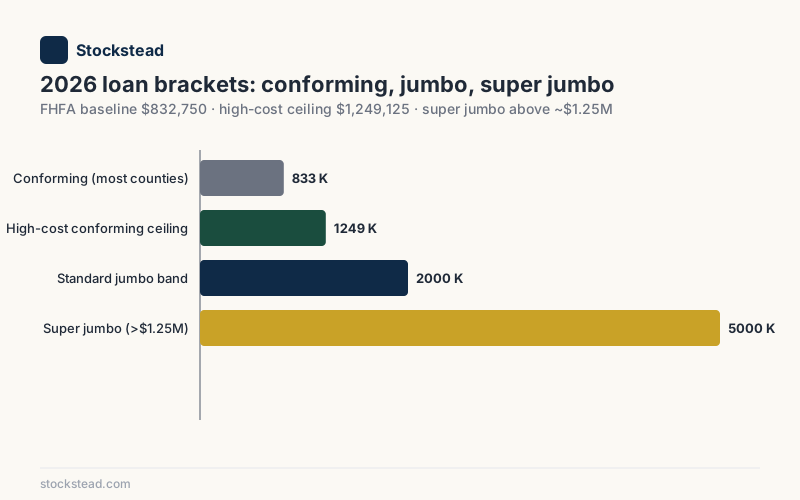
A jumbo mortgage calculator differs from a conforming calculator on three inputs and one output. Per the Federal Housing Finance Agency, the 2026 baseline conforming limit for a one-unit property is $832,750, with a high-cost ceiling of $1,249,125 in designated counties. Any loan above the applicable county limit is a jumbo and prices outside agency standards.
The first structural difference is the loan-size field. A conforming calculator caps the input at the FHFA baseline (or its high-cost variant) and throws an error above. A jumbo calculator accepts any balance and routes the rate lookup to the lender's portfolio schedule instead of the agency rate sheet. The threshold is binary: in a non-high-cost county, a loan of $832,750 is conforming; one dollar more is jumbo and the pricing model changes.
The second difference is reserves. Conforming loans following Fannie Mae guidelines typically require 2 months of PITI in post-close liquid reserves. Jumbo desks require 6 to 18 months on most loans, scaling with loan size and LTV. A $1.2M jumbo at 80% LTV with a roughly $10,200 monthly PITI (at 7.39%, with the taxes and insurance from the worked example below) commands about $61,000 to $122,000 of reserves the calculator should surface as a separate line, not bury inside the down payment field.
The third difference is DTI. Conforming back-end DTI caps under CFPB Qualified Mortgage standards reach 43% for safe-harbor QM loans. Most jumbo portfolio desks cap back-end DTI at 38-43%, slightly tighter than conforming. The output that changes: maximum loan size based on income. A jumbo calculator that uses 45% DTI will tell a buyer they qualify for a loan size most jumbo desks will not actually fund.
The 2026 jumbo loan limits in detail
Per the FHFA's November 2025 announcement, the 2026 baseline conforming limit for a one-unit property in most US counties is $832,750, with a high-cost ceiling at $1,249,125 (150% of baseline) in designated areas. Multi-unit properties carry higher limits: $1,066,250 for two-unit, $1,288,800 for three-unit, and $1,601,750 for four-unit at baseline.
The high-cost counties include most of the Bay Area, Los Angeles County, all five NYC boroughs, parts of Connecticut and New Jersey, Hawaii, the District of Columbia, and select metros in Massachusetts, Washington, and Colorado. Fannie Mae publishes the full county lookup table; a jumbo calculator that asks for state and county can apply the correct threshold automatically.
The practical implication for HNW buyers: a $1.0M loan in San Francisco County is conforming (under the $1,249,125 high-cost ceiling) and prices at agency rates with 2 months of reserves. The same $1.0M loan in a non-high-cost county is jumbo and prices at portfolio rates with 6-12 months of reserves. The county determines the calculator path, not the loan size alone.
How jumbo PITI math works
Jumbo PITI follows the standard four-component breakdown: principal, interest, property tax, and homeowners insurance. The amortization formula is identical to a conforming loan. What differs is the inputs and a frequently-omitted fifth component (HOA) that a proper jumbo calculator should surface for the condo and HOA-heavy markets where HNW buyers concentrate.
Principal and interest
The PI calculation on a 30-year fixed jumbo at a 7.39% rate (the MBA jumbo average for the week of Oct 2, 2026) against a $1.2M balance is roughly $8,300 per month, using the standard amortization formula M = P × [r(1+r)^n] / [(1+r)^n - 1] where r is the monthly rate and n is 360. At 7.14%, monthly PI drops to about $8,097; at 7.64%, it climbs to about $8,506. Each 25 bp move on a $1.2M jumbo shifts monthly PI by roughly $200, or about $74,000 over the full 30-year term.
The Freddie Mac PMMS publishes a weekly conforming average; the MBA publishes a weekly 30-year jumbo average. As of October 8, 2026, the 30-year conforming average was 7.40% and the 30-year jumbo average 7.39%; individual jumbo quotes typically land within 25-50 bp on either side depending on lender appetite. A jumbo calculator should default to the current average and let the user override based on their actual lender quote.
Taxes, insurance, and HOA
Property tax depends entirely on the county and the home value. A $1.5M home in Travis County, Texas faces effective rates near 1.8% ($27,000 annually). The same home in Marin County, California is capped at 1% under Prop 13 on assessed value, producing roughly $15,000 in year one. A jumbo PITI calculator that asks for ZIP or county can apply the correct rate; a calculator that uses a single national average will mis-size the monthly payment by 30-50% in high-tax HNW states.
Insurance ranges $1,500 to $8,000 annually on a $1.5M home depending on market. Catastrophe-exposed markets (coastal Florida, California wildfire zones, Texas hail belt) have seen premiums rise 30-100% since 2020 according to multiple state insurance department reports. HOA on luxury condos in major metros runs $1,200 to $10,000 per month and should be a line item in the calculator, not a footnote.
HNW qualifying math: DTI and reserves
Across the major jumbo desks Stockstead tracks, back-end DTI caps cluster in two bands: 38-40% for portfolio jumbos at most non-private-bank lenders, and 43-45% for private bank jumbos with broader relationship pricing. The 5-point spread translates to roughly $200,000-$400,000 of additional loan size at the same income, which is why the calculator's DTI input is the most consequential variable after the loan amount itself.
The HNW income mix complicates the DTI numerator. Most jumbo desks accept a 24-month trailing average of RSU vests if the vesting schedule continues, a 24-month average of K-1 distributions if the entity has positive retained earnings, and partnership distributions if the K-1 shows consistent payouts. Each lender applies haircuts differently. Some count 100% of trailing RSU vest income; others discount it 25% for ongoing vesting risk. A jumbo calculator that asks for "monthly income" and accepts a single number collapses this complexity into an output the loan officer will revise downward at intake.
Reserves on jumbos run materially higher than conforming. Typical schedule:
| Loan size | LTV | Typical reserve requirement |
|---|---|---|
| $832,750 to $1.5M | up to 80% | 6 to 12 months PITI |
| $1.5M to $3M | up to 75% | 12 to 18 months PITI |
| Above $3M | up to 70% | 18 to 24 months PITI |
| Any jumbo over 80% LTV | 80%+ | Add 3 to 6 months |
A $2M jumbo at 75% LTV and 7.39% carries about $13,834 of monthly P&I, or roughly $17,100 of PITI with 1.25% property tax and $6,000 of insurance, so it typically requires about $205,000 to $308,000 of post-close reserves. The reserves can be liquid cash, brokerage holdings at 100%, or retirement accounts at 60-70% haircut. The calculator should surface required reserves alongside the down payment so the buyer's total liquidity check is complete before quoting a payment.
For HNW buyers without traditional W-2 income clearing DTI, layering in asset-depletion income is the standard workaround. See the asset depletion mortgage calculator spoke for the imputed-income math that lets a portfolio balance count toward qualification.
A worked example: $1.5M home, $1.2M jumbo at 7.39%
The most common HNW jumbo profile Stockstead sees runs roughly: $1.5M-$2M purchase, 20-25% down funded from a mix of cash and taxable brokerage, W-2 base salary plus RSU vests, primary residence in a metro area, and a back-end DTI right at the 40% jumbo cap. The math below works that case.
Inputs.
- Home price: $1,500,000
- Down payment: $300,000 (20%)
- Jumbo loan: $1,200,000
- Term: 30-year fixed
- Rate: 7.39% (the MBA 30-year jumbo average for the week of Oct 2, 2026)
- Property tax: 1.25% effective ($18,750 annually)
- Insurance: $3,600 annually
- HOA: $0 (single-family)
Monthly PITI.
- Principal and interest: $8,300
- Property tax escrow: $1,563
- Insurance escrow: $300
- Total PITI: $10,163 per month
Reserves required. At 80% LTV in the $832,750-$1.5M band, expect 6-12 months PITI. Midpoint at 9 months: $91,466 in post-close reserves. Combined with the $300K down payment, the buyer needs roughly $391,500 of liquidity at closing.
DTI qualification. At a 40% back-end DTI cap, the buyer needs gross monthly income of at least $25,407 to qualify ($10,163 PITI divided by 40%, assuming no other monthly debt). Annualized: about $305,000. If the buyer carries $1,500 of other monthly debt (auto, student loans, minimum credit card), the income requirement climbs to roughly $29,157 per month, or about $350,000 annually.
Year-one interest and deduction math. Year-one interest on the $1.2M jumbo at 7.39% is approximately $88,300. Per IRS Publication 936, only the interest on the first $750K of acquisition indebtedness is deductible. Deductible portion: about 62.8% of interest as the balance amortizes, or roughly $55,400. At roughly $305,000 to $350,000 of income, a married couple filing jointly is in the 24% federal bracket, so the tax benefit is approximately $13,300. Effective rate after deduction across the full balance: roughly 6.25%, not the 5.62% a generic calculator would imply by applying the deduction to the entire interest payment. If the buyer's state also allows the deduction at a 9% rate, the benefit rises to about $18,300 and the effective rate falls to about 5.83%. A top-bracket buyer would not get the full 37% either: OBBBA's new IRC §68 limit disallows 2/37 of the lesser of itemized deductions or taxable income above $768,700 (joint), so each deducted dollar is worth at most 35%, for an effective rate of about 5.74% on this loan.
Two tax-law notes sit behind that math. The $750,000 acquisition-debt cap is now permanent under the One Big Beautiful Bill Act. And the deduction only helps if you itemize. The 2026 joint standard deduction is $32,200, and the SALT cap is $40,400 but phases down by 30% of MAGI above $505,000 to a $10,000 floor. At this example's income, below the phase-down, state and property taxes alone usually fill the full cap and clear the standard deduction, so the mortgage interest is deducted in full. Higher earners whose SALT deduction has fallen to the floor need the mortgage interest to carry the itemized total past the standard deduction.
Where the jumbo calculator hands off to other tools
The jumbo PITI tool answers "what will this payment cost and can I qualify." It does not answer the four follow-on questions HNW buyers face once the base case is sized.
For HNW buyers, the jumbo calculator is best treated as a sanity check on the conventional path, not a final answer. The buyer who runs only the jumbo PITI tool optimizes for monthly payment and misses the three other dimensions where the financing decision actually lives: after-tax cost, portfolio opportunity cost, and structural alternatives. Each requires a separate tool.
For loans above the $1.25M-$2M super jumbo threshold, the pricing tier shifts again, reserves climb to 12-24 months, and underwriting narrows to private-bank channels. The super jumbo mortgage calculator spoke handles those tier-specific changes.
For HNW buyers whose W-2 income alone does not clear the 38-40% jumbo DTI cap, asset depletion lets a portfolio balance convert to imputed monthly income. A $4M eligible portfolio at a 70% haircut, divided by 360 months, adds roughly $7,778 of qualifying income to the DTI numerator. At a 40% DTI cap and a 7.39% rate (October 2026), that delta supports about $450,000 of additional loan on principal and interest alone, and somewhat less once property tax and insurance on the larger home are counted. It closes a moderate shortfall, not a large one.
For ARM versus fixed comparisons on the same jumbo balance, the ARM vs fixed jumbo mortgage calculator runs the break-even hold and reset-risk math. With the national 5/1 ARM average at 6.43% against a 7.39% 30-year jumbo average as of October 8, 2026, the structural choice can save more than negotiating the fixed rate down by 25 bp.
For the headline-to-after-tax effective-rate conversion under the $750K acquisition cap, the deductibility math is worked end-to-end in the after-tax spoke for HNW buyers. Year-one interest on a $1.2M jumbo at 7.39% is roughly $88,300, of which only the portion attributable to the first $750K of principal qualifies for the IRC Section 163(h)(3) deduction. Running the after-tax conversion against the buyer's specific federal and state marginal rates is what turns the headline jumbo rate into a wealth-comparable cost.
For buyers funding the down payment from pledged portfolio assets rather than cash, two structural alternatives sit next to the conventional jumbo. The piggyback 80/10/10 vs SBLOC calculator compares the conventional 20%-down jumbo against a hybrid where an SBLOC funds the down payment from a taxable brokerage without triggering capital gains. For HNW buyers with $1M-plus in taxable brokerage who want to model funding the entire purchase from pledged assets rather than via a jumbo, the SBLOC mortgage calculator spoke runs the pure portfolio-financed path against the jumbo baseline.
When to consult a professional
A jumbo PITI calculator produces a precise monthly number from a precise set of inputs. It does not know whether your specific RSU vesting schedule will count toward DTI at a particular jumbo desk, whether your two-year K-1 average qualifies under a specific lender's portfolio guidelines, whether your trust structure permits the down payment funding source you plan to use, or whether the property's HOA, flood zone, or insurance market will pass underwriting.
For any jumbo loan above $1M, the calculator output is the starting point of a conversation with a jumbo loan officer or a private bank relationship manager, plus a CPA who can confirm the after-tax math against your specific return. Stockstead publishes educational content and runs the calculators; the site does not provide financing, tax, or legal advice. See the full disclaimers page for the complete disclosure.
Sources and further reading
- Federal Housing Finance Agency — 2026 Conforming Loan Limits
- Fannie Mae — 2026 Loan Limits
- Freddie Mac — Primary Mortgage Market Survey
- Consumer Financial Protection Bureau — Qualified Mortgage Rule
- IRS Publication 936 — Home Mortgage Interest Deduction
- Federal Reserve Bank of New York — SOFR Reference Rates
Market rates as of October 8, 2026; worked-example rates are dated October 2026 inputs; loan limits are the 2026 FHFA figures. Conforming loan limits update annually each November. Mortgage rates move daily. Verify directly with primary sources before sizing a loan. For the decision-framework view of when a jumbo wins versus an all-cash purchase or a portfolio-secured alternative, see the companion essay on jumbo mortgages for HNW buyers and when the bank wins. Educational, not financial advice. Stockstead is not a licensed financial advisor, tax advisor, or mortgage broker. Consult a fiduciary advisor, a CPA, and a licensed loan officer before committing to any financing structure.
Frequently asked questions
- What is the 2026 jumbo loan threshold?
The 2026 baseline conforming loan limit for a one-unit property is $832,750 in most US counties, per the Federal Housing Finance Agency's November 2025 announcement. In designated high-cost areas (parts of California, New York, Hawaii, DC, and select metros), the ceiling rises to $1,249,125, which is 150% of the baseline. Any loan above the applicable county limit is a jumbo, underwritten outside Fannie Mae and Freddie Mac standards.
- How does a jumbo mortgage calculator differ from a conforming calculator?
Three structural differences. First, the loan-size field accepts balances above $832,750 without throwing a limit error. Second, reserve requirements jump from 2 months of PITI on a conforming loan to 6-18 months on a jumbo, which the calculator should surface as a separate liquidity input. Third, jumbo rates price within roughly 25-50 basis points of the conforming average per Freddie Mac PMMS data, with portfolio lenders pricing more aggressively than securitized desks. Most generic calculators skip the reserve and pricing nuances entirely.
- What rate should I assume in a jumbo PITI calculator in 2026?
As of October 8, 2026, the Freddie Mac PMMS 30-year fixed average was 7.40% and the MBA 30-year jumbo average was 7.39%. Jumbo rates typically fall within 25-50 basis points of the conforming average depending on lender appetite and the buyer's relationship pricing. For a baseline calculation, assume the current PMMS rate as your starting jumbo rate, then adjust 25 bp up or down based on loan size, LTV, and your private bank tier. Verify the live rate directly with Freddie Mac before final sizing.
- How do jumbo lenders calculate DTI differently than conforming lenders?
Jumbo DTI math is stricter on the ratio and looser on the income mix. Conforming lenders following Fannie or Freddie guidelines typically allow back-end DTI up to 45-50%, while most jumbo desks cap back-end DTI at 38-43% per portfolio guidelines. The looser piece: jumbo underwriters routinely accept non-W-2 income (K-1 distributions, RSU vest averaging, partnership income, asset depletion) that the standard agency template often discounts or rejects. The calculator needs both inputs to model qualification accurately.
- How much in reserves does a jumbo loan require?
Most jumbo lenders require 6 to 18 months of PITI in liquid post-close reserves, compared to roughly 2 months for a conforming loan. The exact requirement scales with loan size and LTV: a $1.2M jumbo at 80% LTV typically requires 6-12 months, while a $3M loan at 70% LTV can require 18-24 months. Liquid means cash, brokerage, and (with haircuts) retirement accounts. The jumbo PITI calculator should surface required reserves as a separate line item, not roll it into the down payment field.
- Are jumbo mortgage interest payments tax deductible?
Only up to the acquisition-indebtedness cap. Per IRS Publication 936, for mortgages originated after December 15, 2017, the home mortgage interest deduction caps deductible acquisition debt at $750,000 ($375,000 MFS). Interest on the portion of a jumbo above $750K is non-deductible. On a $1.5M jumbo, roughly half of year-one interest qualifies for the deduction. A jumbo PITI calculator that does not surface this cap overstates the after-tax benefit by 50% or more for HNW buyers.
- When should I use a jumbo calculator versus a super jumbo calculator?
Use a standard jumbo calculator for loans between $832,750 and roughly $1.25M-$2M, the range where most major lenders price within a tight band. Above $1.25M-$2M (the exact threshold varies by lender), pricing tiers shift again, reserve requirements climb to 12-24 months, and underwriting narrows to private-bank channels. At that point switch to a super jumbo calculator to capture the tier-specific math. Loans above roughly $2M should be run through both the super jumbo tool and a portfolio-funded comparison, since at October 2026 rates the jumbo's after-tax rate passes some published SBLOC rates at that size.
Ready to run the numbers on your situation?
Open the calculator →Related posts
Super Jumbo Mortgage Calculator: Loans Above $1.25M
Super jumbo mortgage calculator: private-bank pricing above $1.25M, 12-24 month reserve requirements, tighter DTI, and worked $2.4M math against the $750K cap.
Mortgage Calculator for High Net Worth: Complete 2026 Guide
HNW mortgage calculator guide: jumbo PITI above $832,750, asset depletion income, after-tax rates under the $750K cap, and SBLOC vs. mortgage comparisons.
SBLOC Mortgage Calculator: After-Tax vs Jumbo for HNW Buyers
SBLOC mortgage calculator for HNW buyers: after-tax math, the $750K deduction cap, a worked $2.4M portfolio-funded vs jumbo comparison, and rates as of October 8, 2026.